Wednesday, April 17, 2019

BBC News - House price growth at six-year low

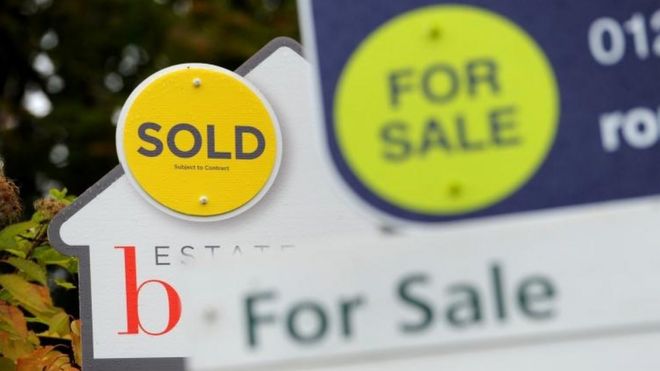
For sale and sold signsImage copyrightPA
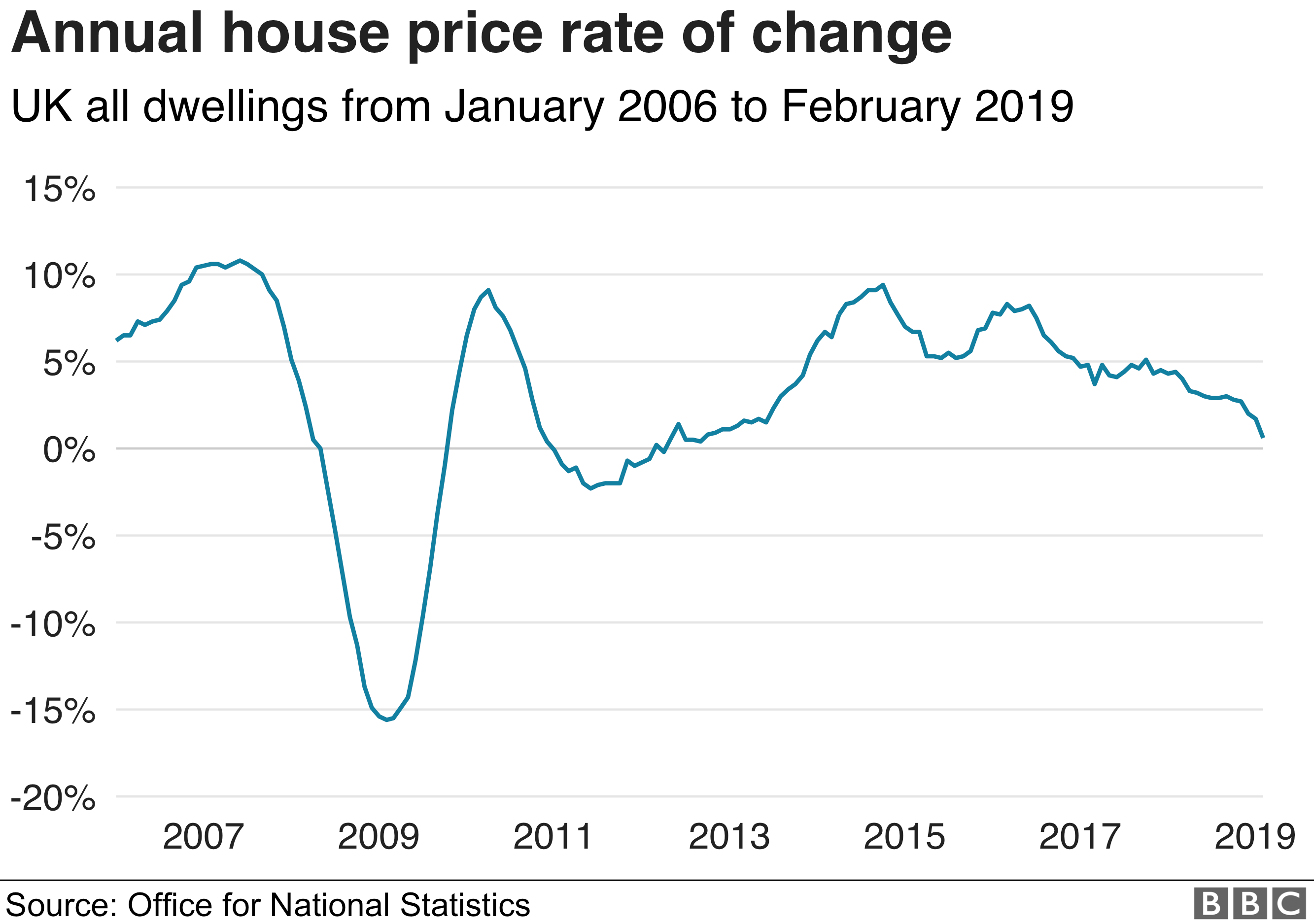
House prices rose in February at the slowest rate since September 2012 while in London house prices fell, the Office for National Statistics said.
Average house prices increased by 0.6% in the year to February 2019 but fell by 3.8% in London.
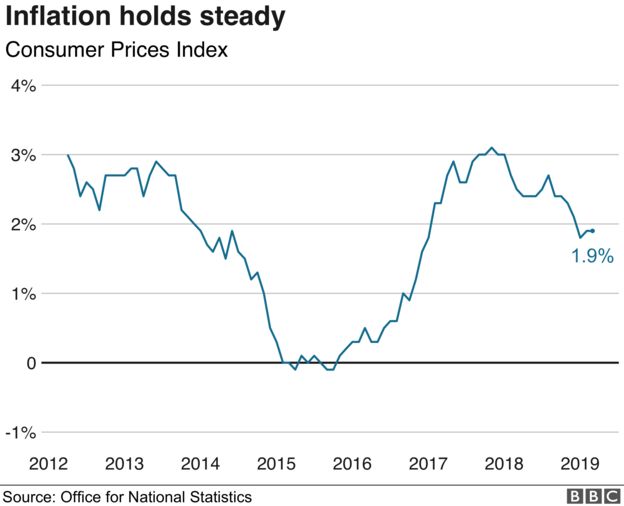
The ONS said inflation was stable at 1.9% in March as a rise in fuel prices from February was offset by falls in food prices.
The figures ease pressure on the Bank of England to raise interest rates.
The Bank of England targets inflation - the rate of price increases - at 2% and last month kept rates unchanged at 0.75%, where they have been since August last year.

What is happening to house prices?

The ONS said there had been a slowdown in house price growth over the past two years.
The average UK house price was £226,000 in February, £1,000 higher than a year ago.
chart
The fall in London house prices was the largest fall since mid-2009, but the city remains the most expensive place to buy property with an average price of £460,000.
Ben Brettell, senior economist at Hargreaves Lansdown, said the fall in London house prices was the largest since the immediate aftermath of the financial crisis.
"This follows efforts by policymakers to cut down on riskier mortgage lending, though clearly uncertainty over Brexit will have played a large part in the capital's faltering housing market," he said.
Other indicators have pointed to a subdued housing market. Halifax, the UK's biggest lender, said earlier this month that property prices had fallen by 1.6% in March compared with February.

What is driving inflation?

At 1.9%, the latest inflation rate, measured by the Consumer Price Index, was a little lower than the 2% that had been forecast by economists.
Mike Hardie, head of inflation at the ONS, said: "Inflation is stable, with motor fuel prices rising between February and March this year, offset by falls in food prices as well as the cost of computer games growing more slowly than it did at this time last year."
chartImage copyrightAFP
Inflation in the games, toys and hobby sector fell to 1.1% in March from 3.1% in February helping to keep a lid on the overall basket of prices.
Average petrol prices were 1.2p per litre higher at 120.3p.

What does it mean for interest rates?

Mr Brettell said the inflation number made the Bank of England's job easier "as there's no pressure to raise rates as it grapples with continued uncertainty over Brexit".
Howard Archer, economic adviser to the EY Item Club of forecasts said it was "decent news for both consumers and the Bank of England".
It comes after data on Tuesday had shown that average weekly earnings, excluding bonuses, rose 3.4% in the three months to February and the unemployment rate lower than at any time since the end of 1975.
The Bank of England's Monetary Policy Committee will meet next month to discuss rates.
Mr Archer said: "Despite a tight labour market, it is difficult to see the Bank of England raising interest rates at their May meeting or any time soon, amid likely MPC concern that prolonged Brexit uncertainties will likely to weigh down on the economy".
However, Samuel Tombs, chief UK economist at Pantheon Macroeconomics, said that the inflation data would not give the MPC "breathing space" to keep rates on hold because "the labour market is still tightening and the economy is coping with Brexit uncertainty".

What is the economic outlook?

The Bank of England has said that economic outlook would continue to depend "significantly on the nature and timing of EU withdrawal".
In the short-term economists say pressure on inflation could come from household energy prices in April when energy regulator Ofgem increases its price cap by 10%.
Mr Archer said it was "questionable" whether earnings growth can continue as the growth in wages dipped to a five-month low of 3.2% in the month of February.

Tuesday, April 16, 2019

Reuters News - Notre-Dame blaze probably accidental, French prosecutors say

PARIS (Reuters) - The fire that tore through Notre-Dame cathedral was probably caused by accident, French prosecutors said on Tuesday after firefighters doused the last flames in the ruins overnight.

More than 400 firemen were needed to tame the inferno that consumed the roof and collapsed the spire of the eight-centuries-old cathedral. They worked through the night to bring the fire under control some 14 hours after it began.
“We are favoring the theory of an accident,” Paris public prosecutor Remy Heitz said, adding that 50 people were working on what was expected to be a long and complex investigation.

Monday, April 15, 2019

BBC News - EU approves new trade talks with US

By Andrew Walker
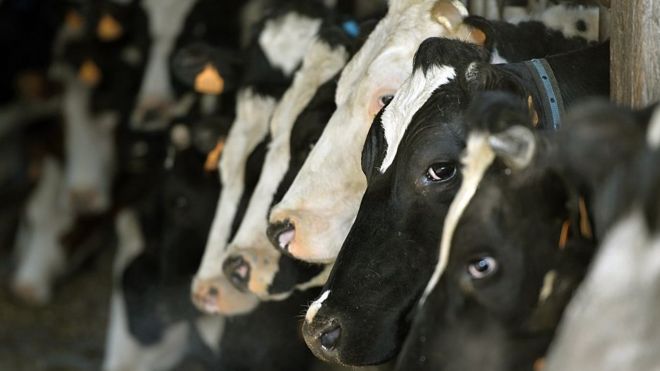
Cows wait before leaving for pasture grazing in Florian Couillaud's organic dairy farm near Nantes, in BrittanyImage copyrightGETTY IMAGES
Image captionFrance does not want farm tariffs to be included in trade talks
European Union countries have approved plans for trade talks with the United States.
President Donald Trump and the head of the European Commission, Jean-Claude Juncker, agreed last year that they wanted to reduce trade barriers.
The decision by EU ministers gives the Commission authorisation to conduct formal talks.
But there is already a disagreement over whether farm goods should be covered by the talks.
If the talks do get going, it would not be the first attempt by the two sides to make a bilateral trade agreement.
Under President Barack Obama, the US and the EU had a programme of negotiations known as the Transatlantic Trade and Investment Partnership, or TTIP.
It was very controversial, especially in Europe. Among the many criticisms from campaigners was the view that it would have given too much scope for international businesses to challenge the decisions of elected governments.
In any event, TTIP was abandoned.
The proposals now coming out of Brussels are much less wide-ranging than TTIP was.

Breaking barriers

EU ministers have given the Commission - which conducts trade talks on the group's behalf - a mandate to negotiate on two tracks.
One is to seek the elimination of tariffs (taxes on imports) on industrial goods on a "reciprocal basis".
The second is intended to reduce regulatory barriers to trade, specifically in an area known as conformity assessment. That is the procedure by which regulators ensure that goods comply with, for example, safety rules before they are made available for sale.
The idea is to develop arrangements that would enable an agency in the EU (or the US) to certify that a product complies with all the relevant rules in the US (or the EU).
Getting goods assessed by an agency in a firm's home country can be cheaper and less difficult. The Commission says this is especially an issue for smaller businesses.
Analysis by the Commission said that eliminating tariffs could boost EU exports to the US by 7% and slightly more for goods shipped in the opposite direction.

French opposition

The EU's decision was not unanimous. France voted against and Belgium abstained.
French officials in particular are reported to be opposed to trade negotiations with the US because of the Trump administration's decision to withdraw from the Paris Agreement on tackling climate change.
France has, however, been outvoted. But the negotiating guidelines given to the Commission do respect French concerns in that they do not allow for talks on cutting tariffs on agricultural goods.
This could be a major obstacle to negotiations , because the US does want farm goods included.
Germany was particularly keen to make progress with the talks.
President Trump is considering new tariffs on car imports. The US is an important market for German carmakers and getting the talks going could reduce the risk that the US might act.
The bilateral tension was increased further last week, when the US announced a list of European goods for extra tariffs in retaliation for subsidies to the aircraft maker Airbus. The US has won a World Trade Organization dispute in which it claimed the subsidies were prohibited under WTO rules.
The US is waiting for a WTO arbitrator to rule on how much retaliation it can apply. The EU has also won a case against the US over aviation subsidies to Boeing.

Wednesday, April 10, 2019

BBC News - World economy facing delicate moment, IMF says

By Andrew Walker
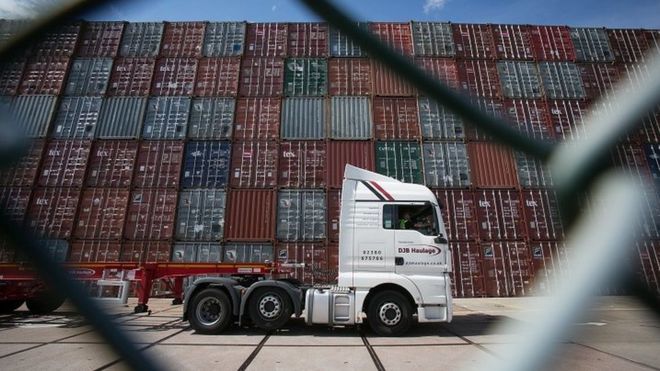
Truck in front of containersImage copyrightGETTY IMAGES
The global economy is at what the International Monetary Fund's chief economist calls a "delicate moment".
Gita Gopinath says that while she does not predict a global recession, "there are are many downside risks".
The IMF has released its regular assessment of the World Economic Outlook, which forecasts global growth of 3.3% this year and 3.6% in 2020.
That would be slower growth than last year - and for 2019, a downgrade compared with the previous forecast.
The downward revision of 0.2 percentage points for global growth is spread widely.
Developed economies affected include the US, the UK and the eurozone.
The UK economy is predicted to grow by 1.2% in 2019, down 0.3% from the IMF forecast in January. Growth in 2020 has also been revised down.
The revisions are especially marked for Germany and Italy, which is already in recession.
The IMF expects weaker performance in Latin America, as well as in the Middle East and North Africa.
For China, there are small revisions, upward for this year and downward for next. The slowdown there, which began at the start of the decade, is expected to continue.

'Precarious' recovery

The weakness in the forecast reflects a slowdown in the latter part of 2018, which the IMF expects to continue in the first half of this year.
After that, growth should pick up more pace, with the additional momentum continuing into next year.
But Ms Gopinath describes that recovery as "precarious".
She says it depends on a recovery in a number of developing economies that are stressed, notably Turkey and Argentina.
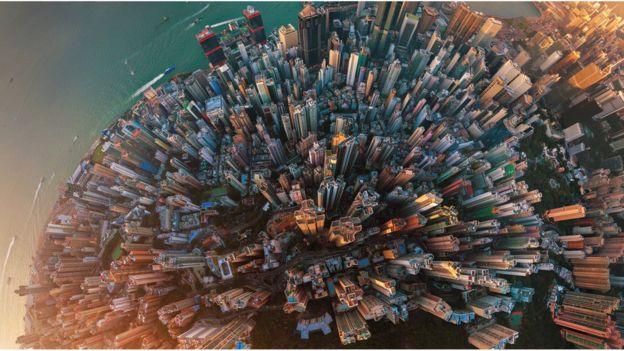
Hong Kong island aerial viewImage copyrightGETTY IMAGES
Ms Gopinath also expects a partial recovery in the eurozone.
The US, however, is likely to slow further, growing by slightly less than 2% next year as the impact of President Donald Trump's tax cuts fades.
There is no sign in her blog, or in the IMF's report, of any sympathy for President Trump's view that the main thing holding back the US economy is the Federal Reserve's increases in interest rates over the last two years.

Flare of disruption?

The risks that Ms Gopinath warns about include some familiar ones.
The first she mentions is the possibility that global trade tensions could flare up again and spread into new areas.
She refers to cars in particular, an area where President Trump is considering new tariffs on imported goods.
That, she suggests, could lead to "large disruptions to global supply chains". She says the escalation of US-China trade tensions contributed to last year's slowdown.
She also mentions risks associated with Brexit. The forecasts for the UK are based on the expectation of an orderly departure - with a deal - from the EU later this year. A no-deal Brexit would be more costly.
Other risks include the possibility of a deterioration in financial markets, leading to higher borrowing costs, including for governments. That raises the possibility of what she calls sovereign/bank doom loops.
That was a particular problem in the euro-area financial crisis, when financial problems for governments and banks reinforced one another.

Monday, April 8, 2019

Reuters News - SoftBank-backed Grab seeks another $2 billion funding in expansion drive

SINGAPORE (Reuters) - Grab is looking to raise another $2 billion this year to ramp up expansion, its CEO Anthony Tan told Reuters, just weeks after announcing over $4.5 billion of funding in what has become Southeast Asia’s largest round of private financing.

The mega funding comes as Grab rolls out an aggressive strategy to expand its bouquet of services, from transport to food delivery and payments, as it races Indonesia’s Go-Jek to become an app-for-everything in Southeast Asia, home to about 650 million people.
Grab, which is backed by Japan’s SoftBank, expects to invest a significant portion of the funds in Indonesia, it said in a statement later. Reuters reported the funding target earlier on Monday.
“We basically received a very strong vote of confidence. And Masa shared that SoftBank is very happy with Grab and that SoftBank will provide unlimited support to power our growth,” Tan said, referring to SoftBank founder and CEO Masayoshi Son.
SoftBank did not respond to a request for comment.
Funding, to be raised from strategic investors, including SoftBank, will be a mix of debt and equity, Tan said.
Grab’s ongoing massive financing round started soon after it bought the Southeast Asian operations of U.S. peer Uber in March last year.

The Singapore-headquartered firm, like its regional rival Go-Jek, has been raising billions of dollars to bring ride-hailing, food delivery, e-commerce and banking to a populous region with a growing number of consumers that use smartphones to commute, shop and make payments.
Both firms started out in ride-hailing and have since amassed millions of users with cut-rate prices.
Backers for Go-Jek include Temasek Holdings, Tencent and Alphabet Inc’s Google.
Grab counts Toyota, Microsoft, China’s Didi Chuxing and Hyundai among its backers.
People with direct knowledge of the matter said Grab has raised about $8 billion since its launch almost 7 years ago.
Last month, Grab’s president Ming Maa, a former SoftBank executive, said the ride-hailing firm was considering raising more funds in its ongoing financing round, in which the SoftBank Vision Fund has invested $1.5 billion.
Tan said: “With the amount of funding we have raised, and the support from strategic investors like SoftBank, we are so well-funded to execute on our expansion and investment plans, so there is really no need to IPO.”
Grab wants to make at least six investments or acquisitions this year, and plans to add 1,000 tech staff globally, Tan said.
In Singapore, it will double staff to 3,000 when its $134-million headquarters is complete by end-2020.
SoftBank’s support will help Grab “grow very aggressively this year across our verticals - transport, mobility, food and payments”, Tan told Reuters in an interview.
Reporting by Aradhana Aravindan and Anshuman Daga; Additional reporting by Sam Nussey in TOKYO; Editing by Christopher Cushing and Himani Sarkar

Friday, April 5, 2019

BBC News - House prices 'subdued' amid Brexit impasse

By Kevin Peachey
For sale and sold signsImage copyrightPA
UK house price growth will continue to be "subdued" during Brexit uncertainty - particularly in London, according to the Halifax.
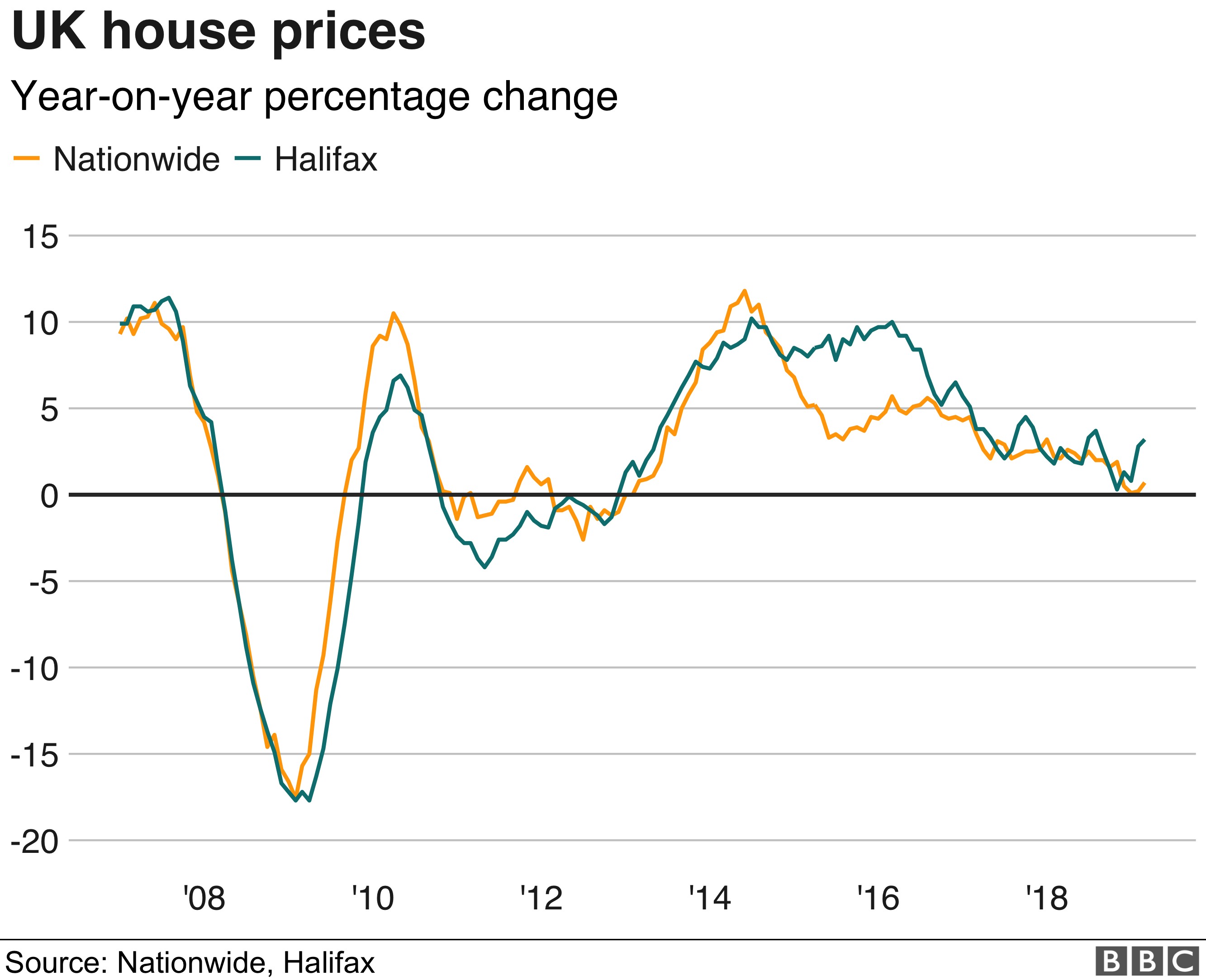
The UK's biggest mortgage lender said that property prices had fallen by 1.6% in March compared with the previous month.
However, prices were 3.2% higher in the first three months of the year compared with the same period in 2018.
It said the price of the average home was £233,181.
A lack of activity from both buyers and sellers meant that prices were unlikely to fall sharply, the Halifax said. However, this meant it was still difficult for many potential first-time buyers to raise a deposit.
"These conflicting challenges, when combined with the ongoing uncertainty around Brexit, have had an impact across the country but most notably in London, meaning that we continue to expect subdued price growth for the time being," said Russell Galley, managing director of the Halifax.
UK house prices
Tomer Aboody, director of property lender MT Finance, said: "For the past couple of years March was flagged up as the date when we would get Brexit [but] people have been too busy watching the political shenanigans on television to go out and view houses.
"The Brexit saga is such a debacle and until it gets sorted, one way or another, few people are going to do anything."
A week ago, rival lender the Nationwide said that UK house price in March were up 0.7% compared with the same month a year earlier, although property values in England had fallen over the same period.

Thursday, April 4, 2019

Reuters News - Water is now Gold for desperate Venezuelans

Living with a scarcity of water is becoming the norm for many Venezuelans.
Families interviewed by Reuters say they have spent months without receiving any water from the tap after power blackouts cut off supply and pipes failed due to a lack of maintenance. Faced with uncertainty of when it might return, and whether it would be enough, they are conserving as much as water as they can take from rivers or buy at shops. They are bathing, washing clothes and dishes, and cooking with just a few liters a day.
From the poorest slums, to the wealthiest neighborhoods, the shortage of water cuts across Venezuelan society as families endure the country's deepest ever economic crisis
A 5 liter (1.32 gallons) bottle costs about $2 at a Caracas supermarket, out of reach for many low-income people in Venezuela, where the monthly minimum wage is only around $6 each month.
"We try to save water scrubbing ourselves standing in bowls," said Yudith Contreras, a 49-year-old lawyer, in her apartment where little water has arrived over the past two years. She has taken to getting water from streams that run down the Avila mountain above Caracas.
Contreras, who is from one of the families interviewed by Reuters in a ten-story housing complex in downtown Caracas, said her family recycles the water by using it to flush the toilet. In her kitchen and bathroom, she keeps containers of water, which she carries up the nine floors to her apartment as the elevator does not work.
"You have to save water because we don't know how long this situation will go on for," she said.
Some residents of the building, a few blocks from the presidential Miraflores Palace, have already exhausted their water supplies. "Today I finished all that I had stored," said David Riveros, a retired bus driver living on the first floor.
President Nicolas Maduro's government blames the scarcity of water on a long drought and also accuses opponents of sabotaging its supply. The country's opposition, led by Juan Guaido, who in January invoked the constitution to assume the interim presidency after declaring Maduro's re-election a fraud, says the problem is due to little maintenance done over many years on Venezuela's power and water networks.
Earlier this month, Venezuela was plunged deeper into chaos after a near week-long power blackout cut off the already scant water supply to most residents. Since then, Maduro has promised to place enormous water tanks on the roofs of houses and apartment blocks to alleviate the problem.
Since the nationwide blackout, the worst in decades, lines of people queuing to fill up water flowing from the Avila have multiplied, despite warnings that the water was not fit for consumption and could contain bacteria and parasites.
Yuneisy Flores, a 31-year-old homemaker whose family live on the fourth floor, washes her dishes in cartons and strains the water to remove the leftovers of food. She then uses the liquid to flush the toilet. She bathes her 3-year-old daughter in a sink to recycle the water.
In her home, three tanks and several other containers collect water when it comes intermittently. Flores, her husband, and their two little children bathe in one of the tanks, which holds some 18 liters.
"It's hard, too hard, you can die without water," she said. "We weren't aware of this before. Water now is gold."