Monday, May 27, 2019

BBC News - How will Modi handle India's economy?

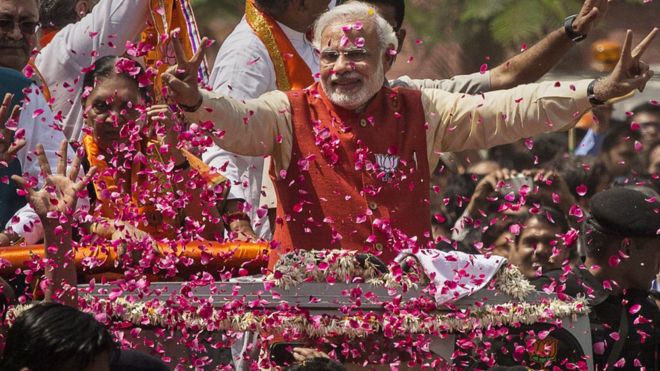
Narendra ModiImage copyrightGETTY IMAGES
Narendra Modi has secured a historic second election victory.
Indian stocks and the rupee rose to welcome the news: another parliamentary majority for the BJP party could grant Mr Modi the opportunity to make promised reforms a reality.
But once the euphoria around his emphatic win at the polls has faded, there will remain some tough economic challenges in his in-tray.

What did he do in his first term?

The economic record for Mr Modi's first term in office is mixed.
He initiated some bold reforms, such as a new bankruptcy law, to help tackle a rise bad debts that was putting pressure on the banking sector.
His government reduced red tape, helping move India to 77th in the World Bank's 2019 Doing Business ranking, an improvement from 134th place when he first took office in 2014.
India also became the world's fastest growing economy during that first term.
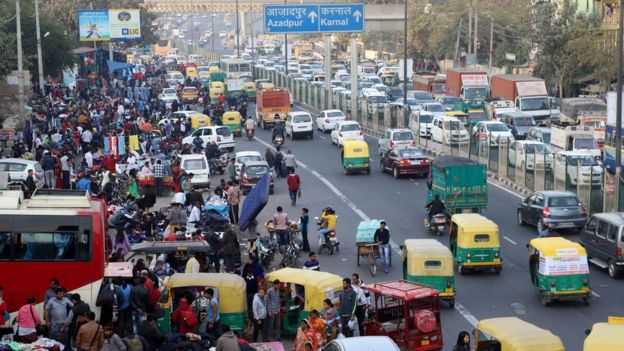
Delhi street sceneImage copyrightGETTY IMAGES
But his biggest gamble, banning more than three quarters of the rupee notes in circulation in order to battle corruption, misfired and delivered a significant blow to economic growth. Without replacement notes ready in time, India's gigantic informal economy was temporarily crippled - leading to job losses.
The rollout of a new national sales tax didn't go smoothly either. In the long run the new tax is expected to boost economic growth by streamlining a multitude of complicated taxes into a single tax. But in the short term glitches around its introduction had a severe impact on millions of small and medium-sized businesses.

What should we expect in his second term?

As Mr Modi gets his feet back under the desk for his second term, economists like Surjit Bhalla believe that his increased majority will give Mr Modi more freedom to take tough decisions.
"Given the size of the mandate, we can expect bolder reforms during the next five years," says Mr Bhalla, who served on the prime minister's economic advisory council during Mr Modi's first term.
But the scale of India's problems matches that mandate.
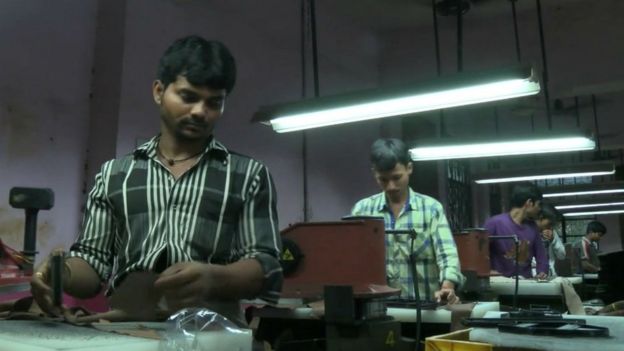
Workers in a shoe factory
Economic growth slowed to 6.6% in the three months to December 2018, the slowest rate for six quarters.
According to a leaked government report, unemployment touched a 45-year high between 2016 and 2017.

What will he do about jobs?

Experts say that Mr Modi needs to spur flagging private sector investment in order to boost job creation. His flagship Make in India programme, aimed at giving manufacturing a big boost, has yielded mixed results so far.
Ajit Ranade, chief economist of Mumbai-based, Aditya Birla Group, believes that focusing on overseas markets is the key to creating more employment opportunities.
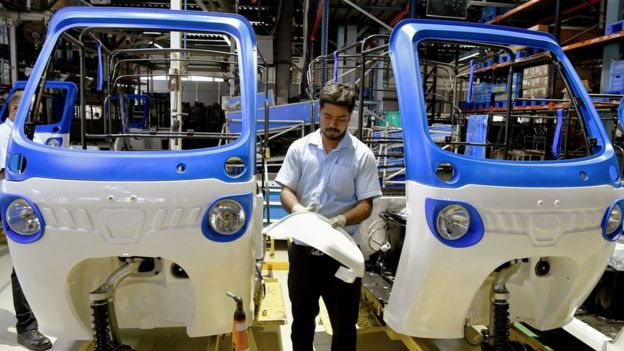
Rickshaw making plant in BangaloreImage copyrightGETTY IMAGES
Image captionMr Modi has promoted a "Make in India" campaign to bolster manufacturing
"Exports and manufacturing are intertwined. Unless exports grow the manufacturing sector won't expand," he says.
The new government should focus on labour-intensive sectors like construction, tourism, textiles and agricultural products, he adds.

Can Modi boost growth?

Unlike China, India's economic growth has been driven by domestic consumption over the last fifteen years. But data released over the last few months suggests that consumer spending is slowing.
Sales of cars and SUVs have slumped to a seven-year low. Tractor, motorbike and scooter sales are down. Demand for bank credit has sputtered. Hindustan Unilever has reported slower revenue growth in the most recent quarter. All of these are important benchmarks for measuring consumer appetite.
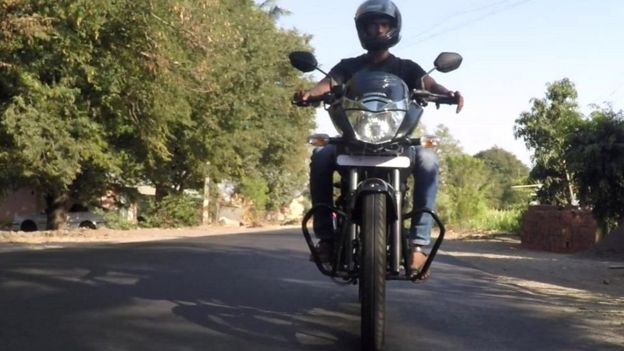
Bike
Image captionSales of motorbikes have been falling
Mr Modi's party promised in its manifesto that it would cut income tax to ensure more cash and greater purchasing power stayed in the hands of middle-income families.
However, given the current state of government finances, that may not be possible immediately. India's 3.4% budget deficit - the gap between government expenditure and revenue - may restrict Mr Modi's options.
"The widening fiscal deficit is a slow-acting poison," says Mr Ranade. He believes this will hold back medium and long-term growth.

Will he help farmers?

The agrarian crisis was a constant challenge for Mr Modi during his first term. Farmers across the country protested on the streets, demanding higher prices for their crops.
Small-scale farmers have been promised more support, but structural changes to the way the market works might be preferable to measures that will put additional pressure on the government's already stretched budget, argues Ila Patnaik, a former economic advisor to the government of India.
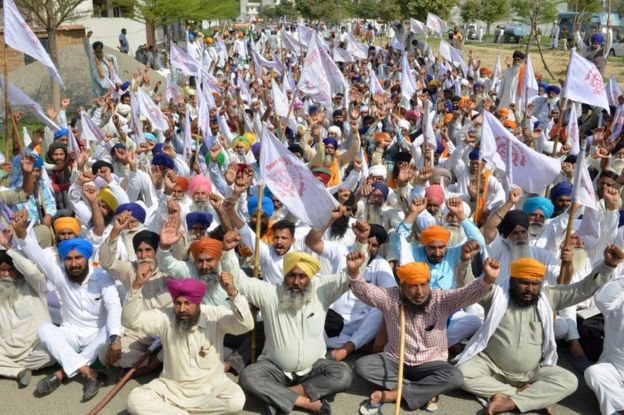
Indian farmers shout slogans during a protest against the alleged anti-farmer policies imposed by the central and state government, in Amritsar on March 30, 2019Image copyrightGETTY IMAGES
Image captionIndia has seen huge protests by farmers in recent years
She would like to see the end of the system whereby farmers are required to sell their products to state-owned agencies at a fixed price.
"We need to free up the farmers so that they can sell products to whoever they want. This will also encourage them to move to high value products," she says.

Will Modi push privatisation?

One of his headline election pledges was a promise to spend $1.44 trillion to build roads, railways and other infrastructure. But such an eye-watering sum will have to come from somewhere. Many observers expect privatisation to play a key role.
Mr Modi made slow progress on his pledges to sell off government enterprises in his first term. The government did initiate the process of selling a majority stake in national carrier Air India, but with a tepid response from investors, the plan failed to take off.
Mr Bhalla expects Mr Modi to pursue privatisation more aggressively in his second term.
"The next two years is a good time for the government to [speed up] the process of privatisation," he argues.
And he believes a willingness to embrace bolder policies could entice more foreign investors to put their money in India.
"During his first term, Mr Modi has shown the appetite to take up tough reforms and he will definitely try to take even bigger risks during his second term," he says

Friday, May 24, 2019

Reuters News - In upset, Dutch Labour party trumps populists in European vote: exit poll

By Toby Sterling and Anthony Deutsch
AMSTERDAM (Reuters) - The Labour party of European Commissioner Frans Timmermans on Thursday won a surprise victory in a Dutch election for European Parliament, an exit poll showed, easily beating a Eurosceptic challenger who had been topping the polls.
The leading social democrat candidate to head the EU Commission, Timmermans propelled his pro-European party to an upset win, taking more than 18% of the vote.
The upstart far right Forum for Democracy of nationalist Thierry Baudet, which had been neck and neck in polls alongside Dutch Prime Minister Mark Rutte’s conservatives, finished third at 11%, the exit poll showed.
Labour doubled its 2014 showing and beat opinion polls, most of which showed it finishing third at best.
The Dutch vote was a first test of the appeal of populist and Eurosceptic parties contesting elections across the bloc through Sunday, and the outcome may offer some relief to established pro-EU parties.
“I hope that this gives a tailwind for a lot of other social democrats in Europe”, Timmermans said in a reaction to the poll result.
The Dutch result could prove to be an outlier. Far-right parties are expected to increase their standing in the European Parliament, but are not expected to take more than a fifth of seats in the May 23-26 election.
The Netherlands and Britain were the first countries to vote. British polling stations close at 2100 GMT.
A YouGov poll on Wednesday put support for Nigel Farage’s Eurosceptic Brexit party, which is campaigning for Britain to leave the European Union, at 37% with the Conservatives of embattled Prime Minister Theresa May on just 7%.
In France, Marine Le Pen’s National Rally leads opinion polls, slightly ahead of President Emmanuel Macron’s Republic On the Move party, according to a survey published by Les Echos newspaper on Thursday.
In Germany, Angela Merkel’s Christian Democrat party is expected to remain the largest, with the anti-immigrant Alternative for Germany seen at 12%, in fourth place.
Italy’s far right ruling League party, led by Deputy Prime Minister and Interior Minister Matteo Salvini, is seen remaining the country’s largest.
In the Netherlands, where turnout rose 4 percentage points from five years ago to 37%, Rutte’s People’s Party for Freedom and Democracy (VVD), came in second at 14%, according to the Ipsos exit poll, which has a margin of error of 2%.
The Freedom Party of Geert Wilders, another Eurosceptic best known for his campaign against Islam, won 4%, a decade low.
Additional reporting by Thomas Escritt in Berlin; editing by Darren Schuettler, Toby Chopra and G Crosse

Thursday, May 23, 2019

Reuters News - Deutsche Bank investors meet amid questions on strategy, leadership

FRANKFURT (Reuters) - Investors in Deutsche Bank are gathering on Thursday for an annual meeting that is expected to be dominated by questions over the bank’s strategy and leadership just days after shares hit a record low.
Major investors over the past week have called for Deutsche to scale back its sprawling global investment banking unit.
Top shareholders have also said that the bank’s chairman, Paul Achleitner, should step down before his term ends in 2022.
Deutsche Bank shares hit record lows on Monday and Tuesday. They are down 36% since last year’s shareholder meeting.
In recent years, Deutsche Bank has been plagued by failed regulatory tests, ratings downgrades, big fines and management reshuffles. It posted its first profit in four years in 2018.
The bank was already facing a potential rocky ride at this year’s gathering after two advisory groups to shareholders - Institutional Shareholder Services (ISS) and Glass Lewis - urged them to issue a vote of no confidence in management.
One small but vocal investor last month added to the meeting’s agenda a vote to oust Achleitner because the bank “remains trapped in an unbroken downward spiral”. The supervisory board issued a statement backing its chairman.
In an interview published in a German newspaper ahead of Thursday’s meeting, the bank sought to fend off some of the expected criticism.
The bank will remain present in the U.S., which is primarily part of the investment bank division, finance chief James von Moltke said in an interview with Boersen-Zeitung published Thursday. But Deutsche was regularly looking for alternatives to lift growth and cut costs at the investment division, he said.
Reporting by Tom Sims; editing by Gopakumar Warrier

Wednesday, May 22, 2019

BBC News - Energy bills push inflation to 2019 high

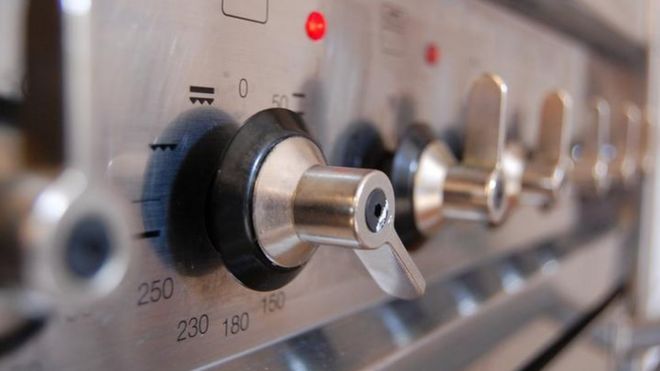
Gas oven
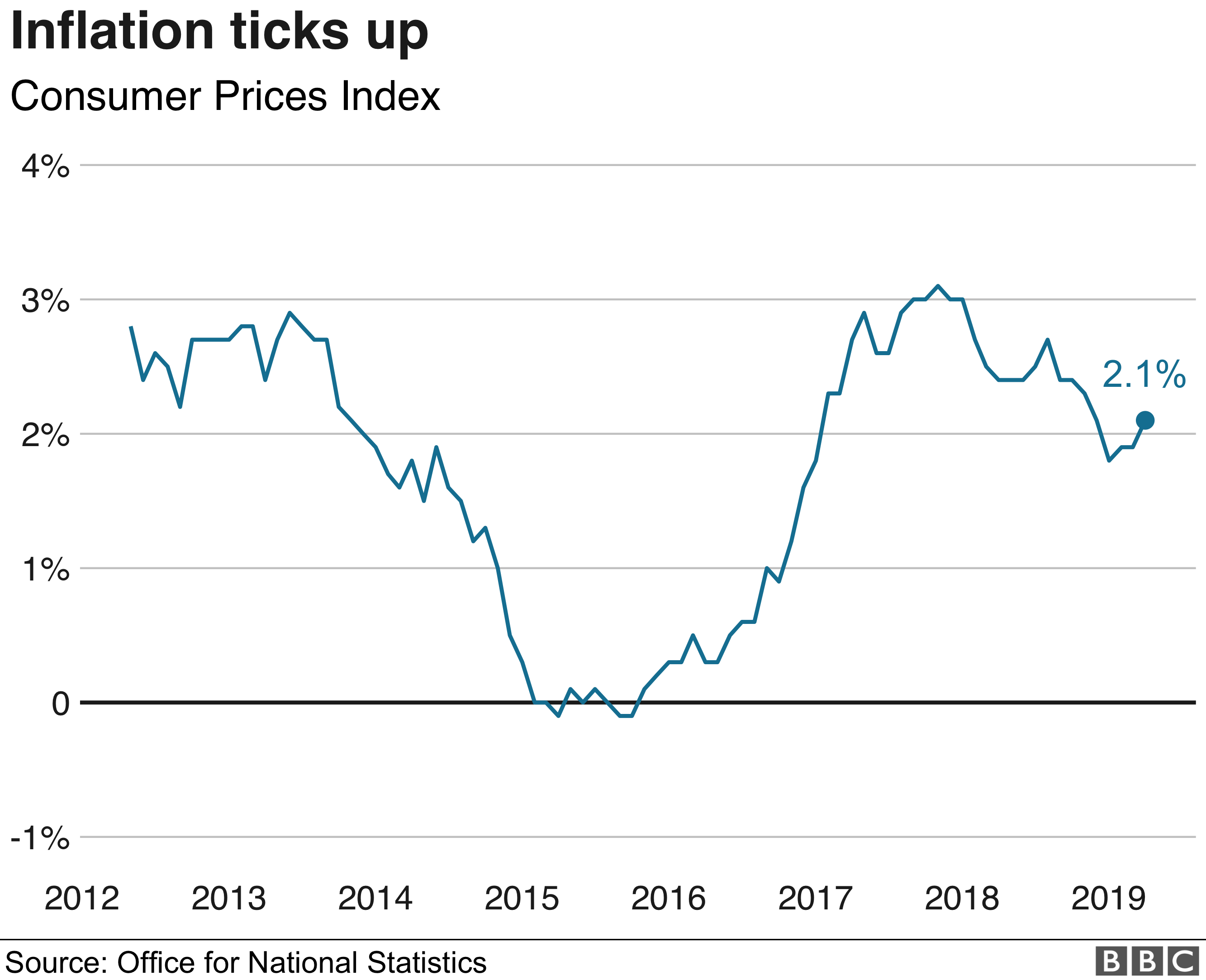
Inflation reached its highest level so far this year in April, when higher energy bills pushed up prices.
The Office for National Statistics said the Consumer Price Index was 2.1% in April, up from 1.9% in March.
That is above the 2% target set by the Bank of England but less than expected.
Computer games and package holiday prices helped to offset the impact of the higher energy bills, sparked by the rise in Ofgem's price cap on gas and electricity.
The ONS said electricity and gas prices rose between March and April 2019 by 10.9% and 9.3%, respectively.
chart
"The upward movement partially reflected the response from energy providers to Ofgem's six-month energy price cap, which came into effect from 1 April 2019," the ONS said.
Last month, Ofgem raised the maximum prices that can be charged for gas and electricity to those who have not switched suppliers and are on default tariffs.
Air fares also pushed up the index, the ONS, said pointing to the late timing of Easter, with prices rising 26.4% on the month.
Prices fell in "recreation and culture" by 0.8% between March and April 2019, compared with a rise of 0.4% between the same two months of 2018. Prices of games, toys and hobbies fell, particularly computer games, the ONS said.
The 2.1% rise - to a high for the year - was less than the 2.2% increase that had been forecast by economists.
The measure of price rises had stood at 1.9% in both March and February, up from a two-year low of 1.8% in January.
The Bank of England said earlier this month that it was expecting growth and inflation to pick up over the next two years and that interest rate increases could be "more frequent" than expected.
chart
Interest rates have been at 0.75% since last August.
Suren Thiru, head of economics at the British Chambers of Commerce, said there was little reason for the Bank of England's Monetary Policy Committee (MPC) to move rates soon.
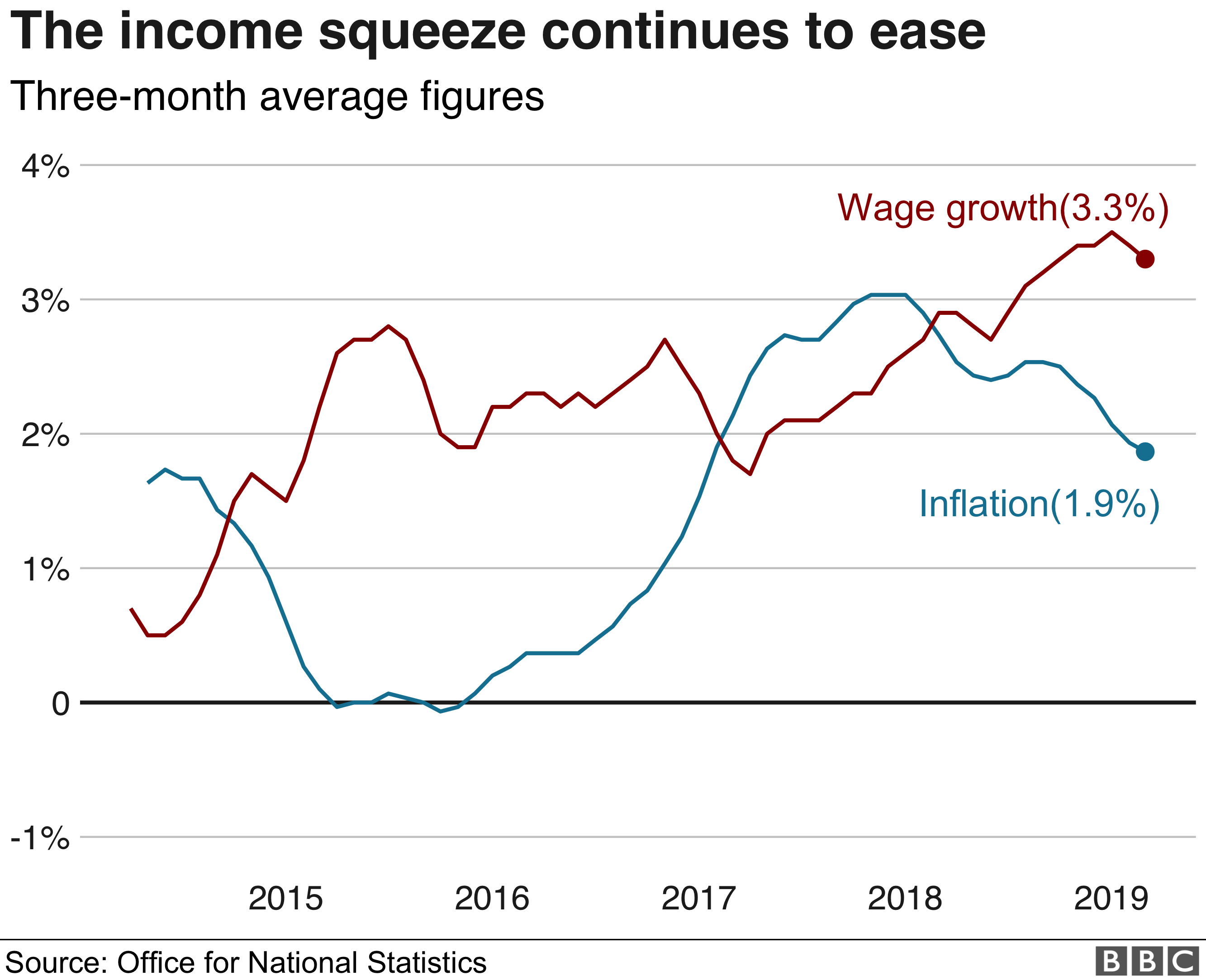
"Rising inflation alongside slowing wage growth is a concern, as it squeezes real household incomes. If this trend continues, it could well choke off the recent improvement in consumer spending, a key driver of UK growth," he said.
"While consumer prices are likely to drift slightly higher in the near term, the outlook for inflation remains relatively subdued, with the current pressure on prices largely due to a number of temporary factors, such as rising energy costs."
Excluding bonuses, average weekly earnings for employees rose by 3.3% in the first three months of the year, when the comparable rate of inflation was 1.9%.
But Samuel Tombs, chief UK economist at Pantheon Macroeconomics, said the MPC could not be complacent about price rises and that he expects a rate rise in November.

Tuesday, May 21, 2019

Reuters News - Britain's May offers "new deal" to try to break Brexit deadlock

LONDON (Reuters) - Prime Minister Theresa May will set out on Tuesday a “new deal” for Britain’s departure from the European Union, her fourth attempt to break an impasse in parliament over Brexit that has plunged her government into crisis.


Three years since Britain voted to leave the EU and almost two months after the planned departure date, May is mounting a last bid to try to get a deeply divided parliament’s backing for a divorce deal, to leave office with some kind of legacy.
The odds do not look good. Despite her spokesman saying the deal will include “certain significant new aspects”, many lawmakers, hardened in their positions, have decided not to vote for the Withdrawal Agreement Bill, legislation which implements the terms of Britain’s departure.
At a meeting of her top team of ministers, May outlined her plan to try to get the bill through parliament to secure Britain’s exit from the EU with a deal.
“The prime minister said that the Withdrawal Agreement Bill is the vehicle which gets the United Kingdom out of the European Union and it is vital to find a way to get it over the line,” her spokesman told reporters.
“The prime minister will be setting out further details on the way forward in a speech this afternoon.” The speech will take place at 1500 GMT.
Her ministers, like parliament and the rest of the country, are split over Brexit, but the spokesman characterized the hours-long meeting as one of “shared determination” to find a way to break the deadlock.
But with dozens of her own Conservative Party lawmakers determined to vote against the bill, May must try to win over opposition Labour lawmakers, including by offering to entrench workers’ rights and environmental protections into the legislation.

CONCESSIONS

It was not clear whether she would move significantly closer to Labour’s position on a post-Brexit customs union and the EU’s single market, but could offer some kind of temporary arrangement - something the opposition party has rejected but which will further enrage Brexit-supporting lawmakers.
May wants to get her withdrawal deal, agreed with the EU in November, through parliament, so, as promised, she can leave office having at least finalised the first part of Britain’s departure and prevented a “no deal” Brexit, an abrupt departure that many businesses fear will create an economic shock.
May’s finance minister, Philip Hammond, rammed the point home in parliament on Tuesday when he said a no deal Brexit would leave Britain poorer. He is expected to send the same message to business leaders in a speech later in the day.
“The 2016 Leave campaign was clear that we would leave with a deal,” he will say, according to advance extracts.
“So to advocate for ‘no deal’ is to hijack the result of the referendum, and in doing so, knowingly to inflict damage on our economy and our living standards. Because all the preparation in the world will not avoid the consequences of no deal.”
Additional reporting by Kylie Maclellan and William James; Editing by Janet Lawrence

Monday, May 20, 2019

BBC News - Japan economy beats expectations of slowdown

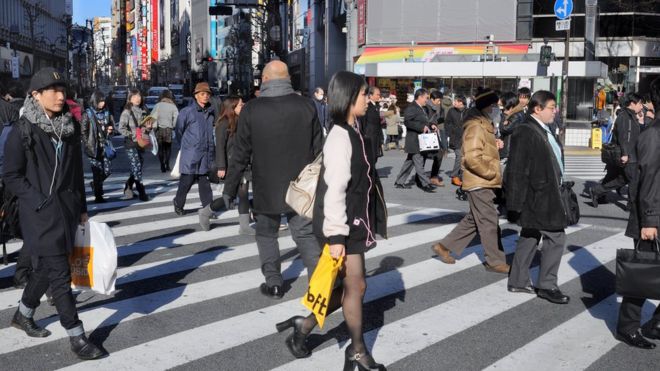
Japanese people cross a street in ShibuyaImage copyrightGETTY IMAGES
Japan's economy unexpectedly grew in the three months to March, shrugging off forecasts for a contraction in the world's third largest economy.
The economy grew at an annualised 2.1% in the period, preliminary gross domestic product (GDP) data showed.
That beat analyst expectations for a 0.2% contraction, as imports fell faster than exports.
The data were closely watched for any signals a planned sales tax rise could be delayed.
The surprise expansion in the official GDP figure was fuelled mostly by imports falling faster than exports.
Imports slid 4.6% - the biggest fall in a decade, according to Reuters - while exports dropped more than a 2.4%.
"The surprising resilience of the economy at the start of the year means that GDP growth will be stronger this year than we had anticipated," senior Japan economist at Capital Economics Marcel Thieliant said.
Mr Thieliant also said that following the better-than-expected growth figures Japan "will press ahead with the sales tax hike scheduled for 1 October".
Some policymakers have called for a delay to the sales tax increase from 8% to 10% given a backdrop of uncertain domestic and global economic conditions.
Prime Minister Shinzo Abe has already delayed the planned increase and uncertainties in the world economy - including slowing growth in China and its trade war with the US - have prompted some concern that it may be delayed again.
But the country's Economy Minister Toshimitsu Motegi appeared to indicate that the plans for higher sales tax remained on track.
"There's no change to our view that the fundamentals supporting domestic demand remain solid," Mr Motegi told reporters, according to Reuters.

Thursday, May 16, 2019

BBC News - Markets calm amid hopes for US-China talks

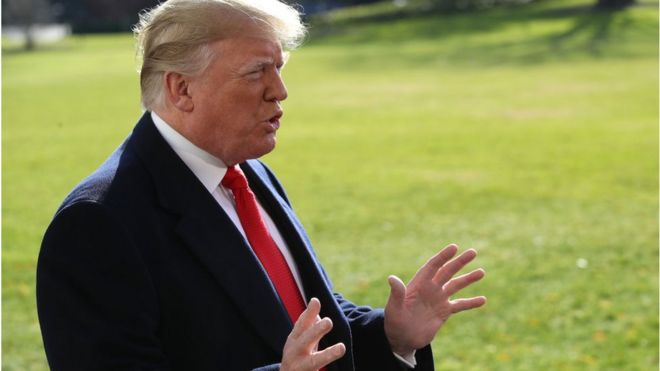
Donald TrumpImage copyrightGETTY IMAGES
Global stock markets have steadied amid hopes that the US and China will resume talks next month, following an escalation in their trade war.
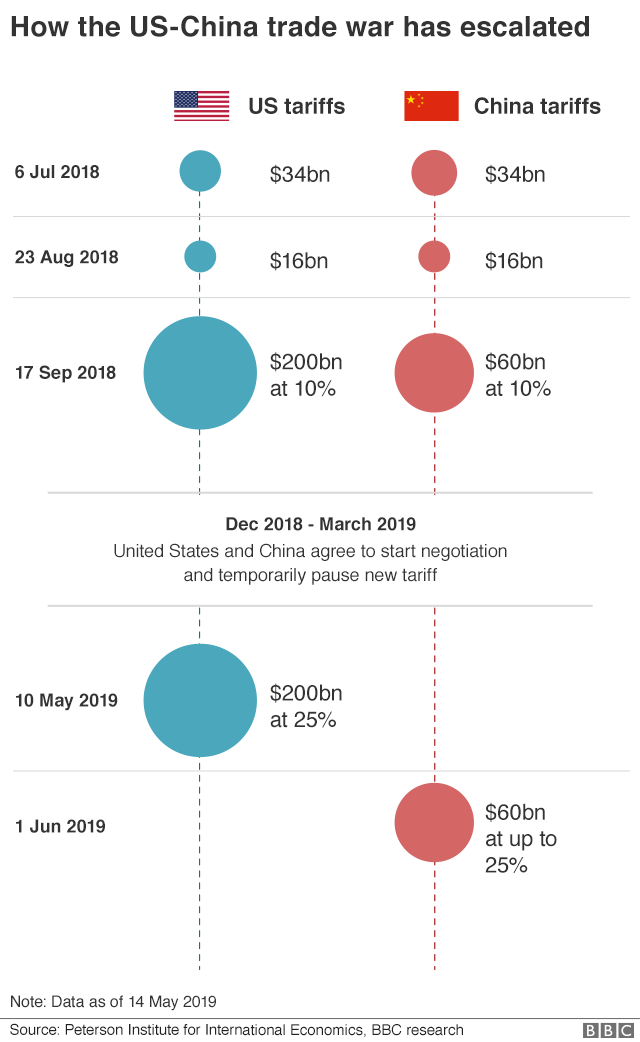
On Monday, China said it would hike tariffs on $60bn (£46bn) of US exports, causing stock markets to tumble.
But later US President Donald Trump said he expected to meet China's president at the G20 summit in Japan.
He also said he had not decided whether to go ahead with threatened tariffs on another $325bn of Chinese imports.
At a briefing on Tuesday, China's foreign ministry spokesman Geng Shuang said: "The two heads of state maintain contact through various means."
But when asked whether China was making preparations for a possible Xi-Trump meeting, Mr Geng said: "I have no information at present about the specific question raised."
Asia markets rose in early trading on Wednesday, with the Shanghai Composite adding 0.9%.
The gains in Asia followed a modest rise on Wall Street. The Dow Jones Industrial average closed 0.8% higher after falling more than 2% the previous day when China announced its retaliatory measures.
The S&P 500 climbed 0.8% and the Nasdaq ended 1.1% ahead.
European indexes also recovered with London's FTSE 100 up 0.8%, Germany's Dax 0.4% higher, and the French Cac 40 up 0.9%.
On Friday, Washington doubled duties on $200bn of Chinese goods, having accused Beijing of trying to renegotiate a trade deal.
US China trade war timeline
Presentational white space
The war of words between the countries had intensified after the latest round of US-Chinese trade negotiations ended in Washington last week without a deal,
Mr Trump warned China not to raise levies and urged US firms to buy goods from other countries such as Vietnam.
But Mr Geng told a news briefing in Beijing that China would "never surrender to external pressure".
From 1 June, China will impose duties on US goods including beef, lamb and pork products, as well as various varieties of vegetables, fruit juice, cooking oil, tea and coffee.

'Good relationship'

As well as ordering a tariff increase on $200bn worth of Chinese imports, Mr Trump had directed the US trade department "to begin the process of raising tariffs on essentially all remaining imports from China".
But after China's response, he said he had "not made a decision" on whether to go ahead with those additional levies.
He also said the US had "a very good relationship" with China, and the two sides would talk at G20 summit on 28-29 June.
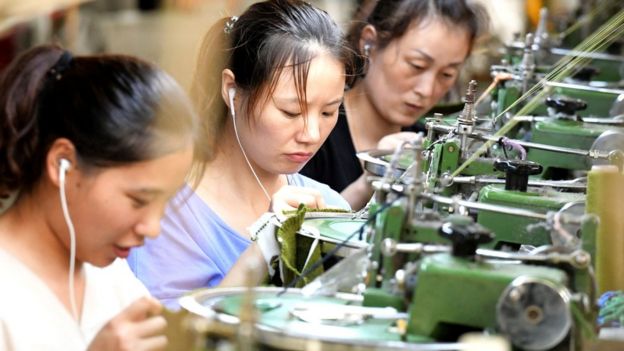
This photo taken on August 13, 2018 shows employees working on a production line of clothes for export at a factory in Xiayi county, in Shangqiu in China's central Henan province. -Image copyrightGETTY IMAGES
"Maybe something will happen," he said. "We're going to be meeting, as you know, at the G20 in Japan and that'll be, I think, probably a very fruitful meeting."
The US argues that China's trade surplus with the US is the result of unfair practices, including state support for domestic companies.
It also accuses China of stealing intellectual property from US firms.
But Mr Trump's approach in the dispute has put him at odds with his own top economic adviser, Larry Kudlow, who has said "both sides will suffer".
On Tuesday, the president remained defiant, tweeting: "In one year Tariffs have rebuilt our Steel Industry - it is booming! We placed a 25% Tariff on 'dumped' steel from China & other countries, and we now have a big and growing industry."