India has lost its spot as the world's fastest-growing major economy after it grew more slowly than expected in the first three months of 2019.
Official data showed the economy grew 5.8%, which is slower than the 6.4% growth registered by China, and down from 6.6% in the previous quarter.
It was the first set of figures since Narendra Modi secured a second election victory this month.
During his first term, India became the world's fastest-growing economy.
But the latest figures, which show the slowest growth rate in 17 quarters, mean India's growth rate has fallen behind China for the first time in nearly two years.
Economists had been expecting the economy to grow 6.3% in the first quarter.
The figures will put pressure on Prime Minister Modi's government and the central bank to provide stimulus to the economy through fiscal measures.
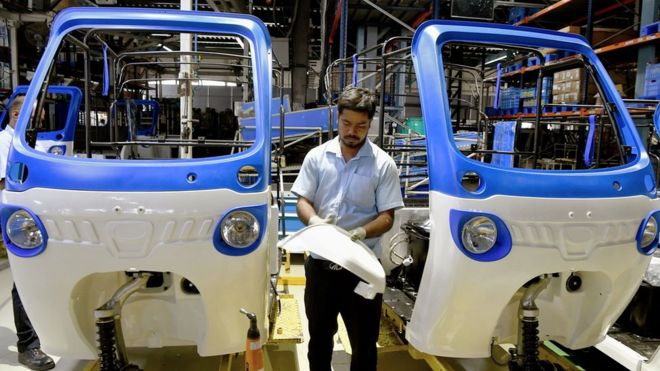
Unlike China, India's economic growth has been driven by domestic consumption over the last 15 years and the latest data showed weaker consumer demand.
There was also a slower growth in investment, which fell to 3.6% from 10.6% in the previous quarter.
Finance secretary Subhash Chandra Garg said that the next quarter - the three months of April to June - could also be "relatively slower".
But, it should start to turnaround in the third quarter, he said.
'Jobs crisis'
The Reserve Bank of India is now expected to cut interest rates next month.
Unemployment data, that has been repeatedly delayed, was also issued on Friday and showed a rate of 6.1% in the 2017/18 fiscal year.
"It shows the jobs crisis is still there: there are not many new ones being created," said NR Bhanumurthy, a professor at the National Institute of Public Finance and Policy in New Delhi.
There has not been detailed official data on unemployment for several year and chief statistician Pravin Srivastava told reporters "it would be unfair to compare it with the past."
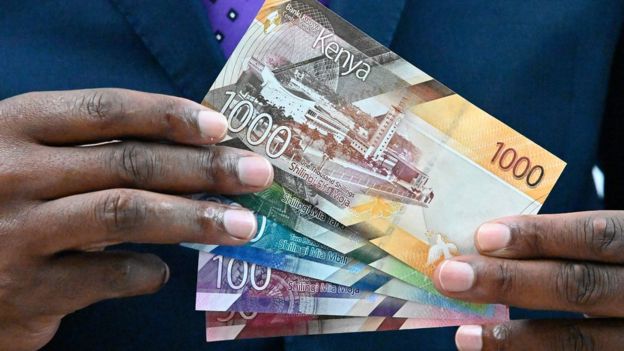
Image copyrightGETTY IMAGESImage captionKenyans will exchange the old 1,000 shilling notes for the new tender
Kenya's President Uhuru Kenyatta has announced that the country's currency is to be replaced with a new generation of banknotes.
Kenyans must return their 1,000 shilling ($10; £8) notes to banks by 1 October, in a bid to fight money laundering, counterfeits and corruption.
New banknotes are to be brought in over the coming months with other denominations being phased out gradually.
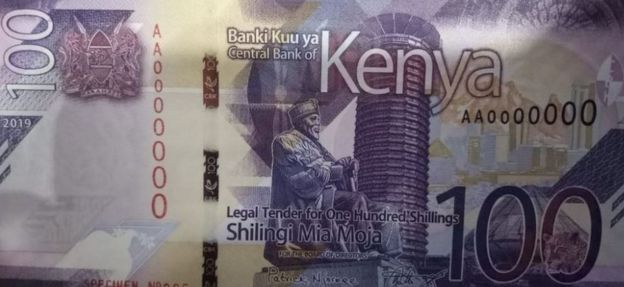
Some Kenyans have expressed anger over the new banknote design, which features an image of a statue of Kenya's first President, Jomo Kenyatta - the current president's father.
The decision on the design, as well as the clampdown on the 1,000 shilling notes, has been challenged in court.
Why is Kenya replacing its banknotes?
Kenya is withdrawing the note to crack down on embezzlement and tackle a wave of counterfeit 1,000 shilling notes.
The governor of Kenya's central bank, Patrick Njoroge, also expressed "grave concern" over larger banknotes being used for "illicit financial flows in Kenya and also other countries in the region".
The 1,000 shilling note is the highest value note in Kenya and according to Mr Njoroge, the Kenyan shilling is the equivalent to the US dollar in east Africa, in terms of its recognition.
Image copyrightGETTY IMAGESImage captionPatrick Njoroge displays some of the new designs for the Kenyan currency notes
President Kenyatta promised to stamp out corruption when he was elected in 2013.
But his critics say there have been few convictions since then, especially of high-profile people.
BBC Africa business reporter Georgie Ndirangu says the demonetisation - the withdrawal of a coin, note, or precious metal from use as legal tender - is seen as a direct response to this criticism.
Officials and well connected businessmen in corrupt cartels are believed to hold hundreds of millions of illegally obtained shillings in cash, and withdrawing the 1,000 shilling note is expected to close many money-laundering avenues, as they have to be exchanged for the new currency, he said.
How will the changeover happen?
Mr Njoroge said the four-month transition period should allow enough time for Kenyans to exchange their old 1,000 shilling notes.
Those exchanging less than 5m shillings would be able to do so at their local bank but any higher amounts will need approval from Kenya's central bank.
Mr Njoroge said he would be holding talks with managers of foreign-exchange bureaux and money-remittance providers to put in place controls to prevent illicit financial flows.
He said he would communicate with banks across the region so that illegal money did not get exchanged in their countries.
Why are Kenyans angry about the new currency?
As well as showcasing Kenya's wildlife, the new banknote design features the Kenyatta International Convention Centre (KICC) with a statue of Jomo Kenyatta in the middle.
Image captionThe new 100 shilling note showing the statue of President KenyattaImage captionThe new bank note also displays Kenya's Big Five - its most famous wildlife
He played a major role in leading Kenya to independence and went on to become the country's first president.
The Constitution of Kenya 2010 says that money - both coins and banknotes - should not feature a portrait of an individual.
Human Rights Activist Okiya Omtatah is challenging the decision in court, arguing that there has been a lack of public participation in designing the notes, as well as the demonetisation of the current 1,000 shilling note.
But some Kenyans back the decision to put Kenyatta on the note. One man said it was a "sign of respect" for the "founding father" of Kenya.
LONDON (Reuters) - Britain rolled out the royal red carpet for Donald Trump on Monday but the pomp, pageantry and banquet with Queen Elizabeth looked set to be overshadowed by the U.S. President’s views on Brexit, the UK’s next leader and a row over China’s Huawei.
Trump and his wife, Melania, were greeted by the 93-year-old monarch at Buckingham Palace at the start of a three-day state visit which sees him feted with the full force of royal ceremony: a formal dinner with the queen, tea with heir Prince Charles, and a tour of Westminster Abbey, coronation church of English monarchs for 1,000 years.
“I look forward to being a great friend to the United Kingdom, and am looking very much forward to my visit,” Trump wrote on Twitter as he landed at London’s Stansted Airport.
But beyond the theater, the proudly unpredictable 45th U.S. president is rocking the boat with the United States’ closest ally, whose political establishment has been in chaos for months over Britain’s departure from the European Union.
As he was flying into the British capital, he reignited a feud with London Mayor Sadiq Khan - who had written on Sunday that Britain should not be rolling out the red carpet for the U.S. president - describing him as a “stone cold loser.
The state visit, promised by Prime Minister Theresa May back in January 2017 when she became the first foreign leader to meet him after he took office, is cast as a chance to celebrate Britain’s “special relationship” with the United States, boost trade links and reaffirm security cooperation.
At Buckingham Palace, Melania, stood beside Elizabeth and Charles’s wife Camilla, while Charles and Trump inspected the guard.
Trump will have lunch with the queen before the monarch’s second son Prince Andrew accompanies him to Westminster Abbey where the president will lay a wreath at the Grave of the Unknown Warrior.
The day culminates with a lavish state banquet at Buckingham Palace - where men wear white tie coats with tails and women evening gowns.
UNCONVENTIONAL
But away from the pageantry, Trump is set to make his trip the most unconventional state visit in recent British history.
He has already waded far into Britain’s turbulent domestic politics, where more than a dozen candidates are vying to replace May, who announced last month she was quitting after failing to get her EU divorce deal through parliament.
The president, who has regularly criticized May’s Brexit tactics, said Britain must leave the bloc on the due date of Oct. 31 with or without a deal and praised a more radical Brexit-supporting potential successor as British leader.
He also called for arch-Brexiteer Nigel Farage, a scourge of May’s ruling Conservative Party, to conduct talks with the EU.
Brexit is the most significant geopolitical move for the United Kingdom since World War Two and if it ever happens then London will be more reliant on the United States as ties loosen with the other 27 members of the EU.
HUAWEI TENSIONS
At a meeting with May, Trump will also warn Britain that security cooperation, a cornerstone of the western intelligence network, could be hurt if London allows China’s Huawei a role in building parts of the 5G network, the next generation of cellular technology.
The Trump administration has told allies not to use its 5G technology and equipment because of fears it would allow China to spy on sensitive communications and data. Huawei denies it is, or could be, a vehicle for Chinese intelligence.
U.S. Secretary of State Mike Pompeo told Britain last month it needed to change its attitude toward China and Huawei, casting the world’s second largest economy as a threat to the West similar to that once posed by the Soviet Union.
Britain’s relationship with the United States is an enduring alliance, but some British voters see Trump as crude, volatile and opposed to their values on issues ranging from global warming to his treatment of women.
Hundreds of thousands protested against him during a trip last year and a blimp depicting Trump as a snarling, nappy-clad baby will fly outside Britain’s parliament during the visit. Other protesters plan a “carnival of resistance” in central London.
Jeremy Corbyn, the socialist leader of Britain’s opposition Labour Party, who has declined an invitation to attend the state banquet, scolded Trump for getting involved in British politics.
Another senior Labour lawmaker, Yvette Cooper, said it was wrong to gift Trump the opportunity of photographs with the royal to boost his re-election campaign next year.
“So appalled Theresa May has given this man a red carpeted platform to do this,” she wrote on Twitter. “Doesn’t help Britain to be lavishing pomp on a president so determined to be divisive, childish & destructive.”
While Monday is dominated by pageantry, the second day of Trump’s trip will focus on politics, including a breakfast with business leaders, talks with May in 10 Downing Street, a news conference and a dinner at the U.S. ambassador’s residence.
Additional reporting by Kate Holton, Andrew MacAskill, Alistair Smout and William Schomberg; Writing by Guy Faulconbridge and Michael Holden; Editing by Jon Boyle
US President Donald Trump has announced tariffs on all goods coming from Mexico, demanding the country curb illegal immigration into the US.
In a tweet, Mr Trump said that from 10 June a 5% tariff would be imposed and would slowly rise "until the illegal immigration problem is remedied".
Jesús Seade, Mexico's top diplomat for North America, said the proposed tariffs would be "disastrous".
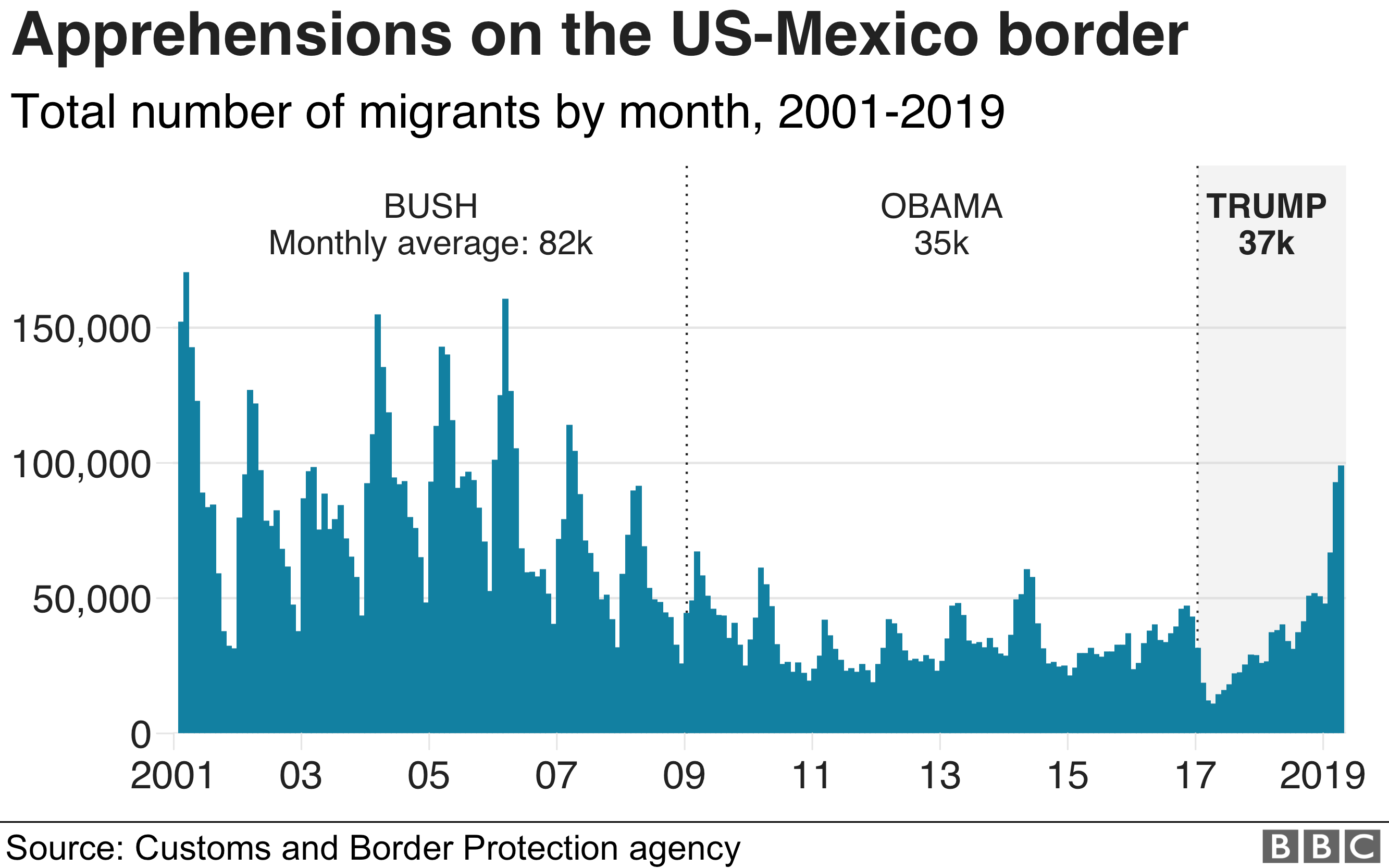
Mr Trump declared a national emergency at the US-Mexico border in February.
He said it was necessary in order to tackle what he claimed was a crisis at the US southern border.
Border agents say they are overwhelmed, but critics say they are mishandling and mistreating migrants.
The US president has long accused Mexico of not doing enough to stem the flow of people, and this is his latest attempt to put pressure on the neighbouring state.
Mr Seade said Mexico "must respond vigorously" if the tariffs - a tax on products made abroad - were brought in.
However, Mexican President Andrés Manuel López Obrador responded by saying he did not want "confrontation".
"I propose deepening our dialogue, to look for other alternatives to the migration problem," he wrote in a letter on Thursday.
During his election campaign and throughout his time in office, President Trump has sought funds to build a wall on the US-Mexico border.
He declared the national emergency at the border in an attempt to divert federal funds for a barrier wall, but a judge blocked his efforts in May.
The White House said on Thursday that the president would use the International Emergency Economic Powers Act to implement the new tariffs on Mexico.
The announcement came the same day that the White House told Congress it planned to pursue a new trade deal with Mexico and Canada.
The tariffs would stay at that level "unless and until Mexico substantially stops the illegal inflow of aliens coming through its territory", he said.
"For years, Mexico has not treated us fairly - but we are now asserting our rights as a sovereign nation," the statement said.
The president also took aim at his Democratic opponents, accusing them of a "total dereliction of duty" over border security.
The Democratic-controlled House of Representatives is taking legal action to halt the Trump administration's efforts to build a border wall, saying it would be a waste of funds and would not stop illegal immigration.
President Trump's latest tariff proposal is driven by a political issue - which is not to say that previous tariff moves did not have any politics behind them. But it is sure to have financial and economic consequences.
Stock markets in many countries have already registered significant falls. Japanese car makers were among those hit - they have operations in Mexico which will be affected if President Trump does go ahead.
Perhaps he hoped that a welcome side effect would be improved competitiveness for American industry.
Well, half the potential impact for the first stage in the proposed tariffs hikes was wiped immediately by a decline in the value of the Mexican peso, which has the effect of making Mexico a little more competitive, at least until the tariffs come into effect.
There could also be ramifications for the new trade deal between the US, Mexico and Canada. It will probably make the Mexican Congress a lot more wary about approving the accord.
What has Mexico done to tackle migration?
Migrants, most of whom say they are fleeing violence in Central American countries, travel through Mexico on their way to the US, where they hope to claim asylum.
Mr Trump believes they should be stopped long before they reach the border, however.
President López Obrador used the arrests to emphasise the country was not giving migrants "free passage".
However, he added that it was out of concern for the migrants' safety over anything else.
What will the tariffs affect?
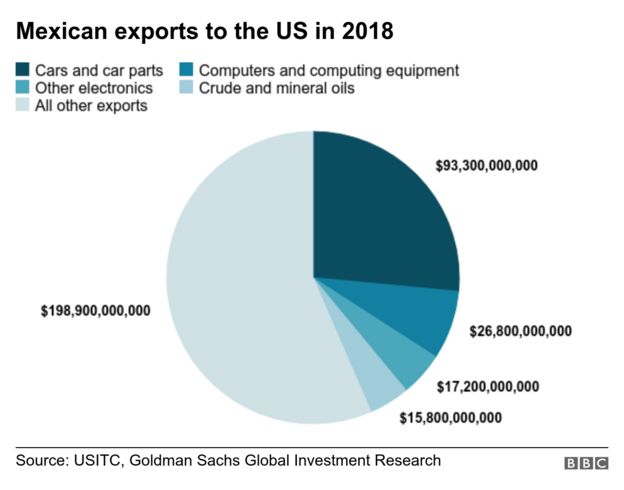
Mexico was the second largest supplier of goods to the US last year, with imports totalling $352bn (£275bn), according to Goldman Sachs.
It is known for agricultural products like avocados and tequila, but the country is also a major manufacturing hub and home to many US companies.
The country produces hundreds of thousands of cars every month, and is also home to technology and aerospace companies. It is one of the G20 economies.
US firms Ford, General Motors, John Deere, IBM and Coca-Cola all operate in Mexico, as well as thousands of other multinationals.
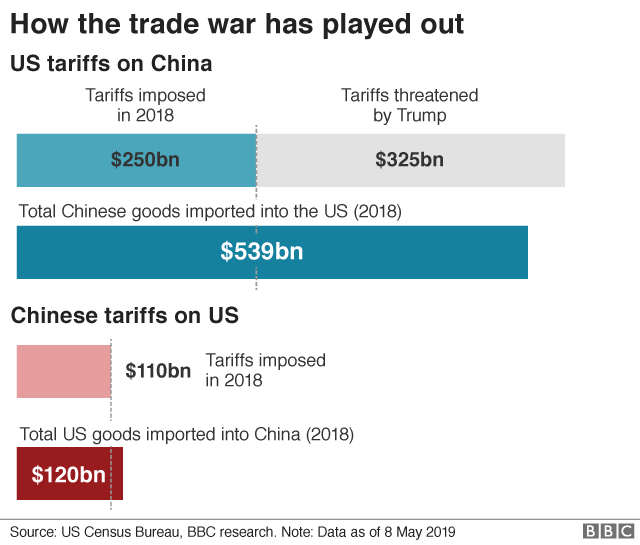
The president's statement comes amid a trade war with China.
After complaining for years about the US trade deficit with China, Mr Trump imposed tariffs on hundreds of billions of dollars worth of goods coming from the country.
Image copyrightGETTY IMAGESImage captionChina carries out most of the mining and production of rare earth minerals
China has been signalling that it may restrict the export of rare earth minerals to the United States as the trade conflict between the two countries escalates.
It is by far the largest producer of these raw materials, vital for many American industries including high-growth sectors such as electric car and wind turbine production.
Last year, the US Geological Survey designated these minerals critical to the economy and national defence.
"China is seriously considering restricting rare earth exports to the US," tweeted the editor of Chinese state-run Global Times this week.
Image copyrightGETTY IMAGES
What are rare earths?
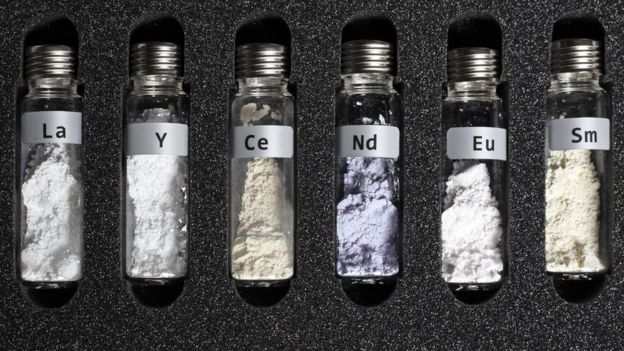
Rare earths are a group of 17 elements used in production in a huge number of sectors, including renewable energy technology, oil refinery, electronics, and the glass industry.
Although called "rare", they are actually found relatively abundantly in the Earth's crust, according to the US Geological Survey.
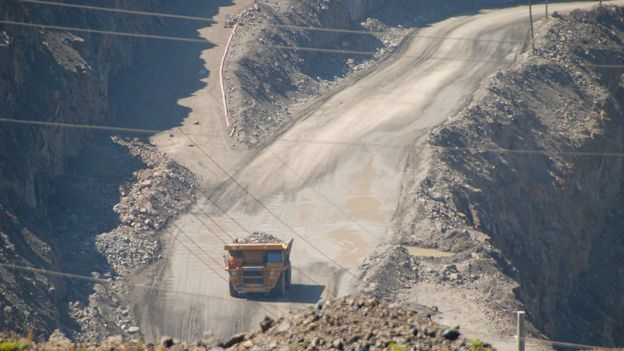
However, there are relatively few places in the world that mine or produce them.
Extraction is both difficult and potentially damaging to the environment.
Chinese mines account for around 70% of global output.
Myanmar, Australia, and the United States plus a few other countries which mine only small amounts, account for the rest.
China's dominance of rare earth mining
Yearly mine production (tonnes)
Source: US Geological Survey
In the refining of rare earth ores, China is even more dominant.
Last year, almost 90% of all the processing into usable oxides was done in China.
An Australian company operating in Malaysia produces almost all the rest.
Over the past five years, China's exports of rare earth oxides have almost doubled, according to official Chinese statistics.
How reliant on China is the US?
Around 80% of the rare earths imported by the United States comes from China, according to US government data.
Estonia, France and Japan also supply processed rare earths to the US, but the original ore comes from China.
The one rare earth mine operating in the United States sends its ore to China for processing - and already faces a 25% import tariff imposed by China.
There is an option for the US to import from Malaysia, but not in the quantities required.
Also, the Malaysian government has threatened to discontinue production because of environmental concerns.
Image copyrightGETTY IMAGESImage captionRare earths mine in China
Could the US start its own refining industry for rare earths?
It's certainly possible, but this would take time and the sources of ore could be limited if China were ruled out.
Until the 1980s, the US was in fact the largest producer of rare earths.
China has restricted exports of rare earths before.
In 2010, they did it against Japan, over a territorial dispute.
The restriction of exports to the United States, if enforced, could have a major impact on major US industries worth trillions of dollars that rely on rare earth minerals.
 GETTY IMAGES