Friday, September 20, 2019

BBC News - Why is the Fed pumping money into the banking system?

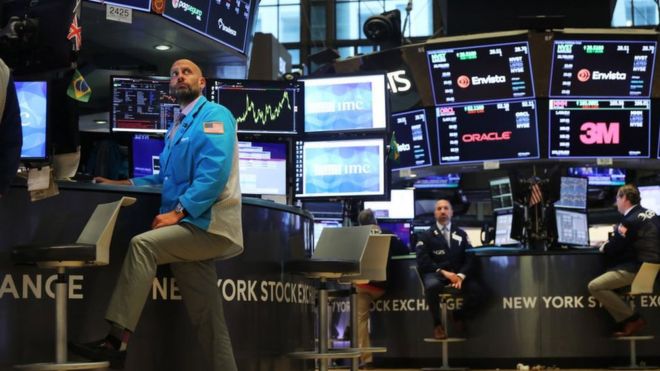
New York stock exchangeImage copyrightGETTY IMAGES
Image captionAll eyes are on the repo market
The US central bank has pumped more than $200bn (£160bn) into the financial system this week - the first time there's been such an intervention since 2008.
The Federal Reserve's aim was to stabilise what is usually a calm part of the market.
Interest rates in the so-called "repo market" had shot up to 10% in some cases - although the cost of borrowing in that market more typically hovers around the benchmark rate set by the Fed - around 2%.
So what happened and should we worry?

First things first: what's the repo market?

Banks, hedge funds and other players borrow money regularly on a short-term basis to ensure their books are in order, no matter what their daily activities.
The borrowers typically offer government bonds or other high quality assets as collateral, which they repurchase, plus interest, when they repay the loan - often the next day.
Those repurchase agreements give the repo market its name.

What happened this week?

This is a huge market, with some $3tn changing hands each day, according to the US Office of Financial Research.
Under normal conditions, interest rates in the repo market are low, since the loans are considered safe and there's plenty of cash on hand.
But this week the cost of borrowing shot up - toward 10% in some cases. And the rate at which banks lend to each other - the Fed's benchmark - exceeded 2.25%, the top of its desired range.
The rise prompted the Fed to take action. Four times this week, it injected money into the market, offering to buy up to $75bn in treasuries or other assets from banks in a bid to boost bank reserves and keep them lending.

Why did the rates suddenly spike?

Strains in the repo market were among the first signals of trouble ahead of the 2008 financial crisis. Back then banks had suddenly become wary of lending, worried there were unforeseen risks associated with assets that had previously been considered safe.
This time, analysts think what's happening is caused by an issue with money supply.
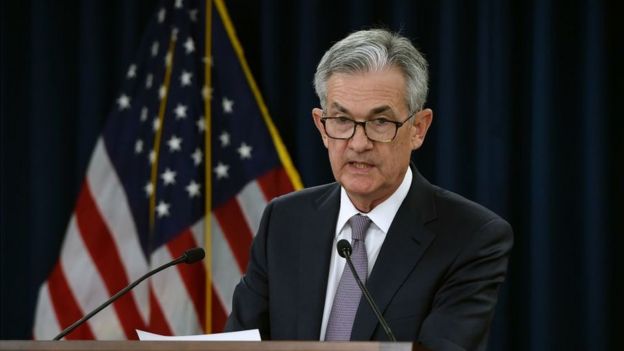
US Fed chairman Jerome PowellImage copyrightEPA
Image captionThe Federal Reserve has intervened to ensure enough cash is available
Money has been sucked out of the market by two events that happen to have coincided. The first is a tax deadline which means firms need cash to pay what they owe the taxman. The second is the due date for payments on a recent offering of government bonds.
On top of that the Fed has also been steadily reducing the overall supply of money in the market, aiming to get conditions closer to how they were before the financial crisis.

Is that the mystery solved then?

A lot of people still don't think those explanations are enough to explain the scale of the interest rate rise.
"The thing that's really confounding is just how much rates moved in a short time," says Zachary Griffiths, rate strategist at Wells Fargo.
"Everyone's kind of trying to get a firmer grasp... on all the different nuances that could have led to such a big move."
There could be other one-off factors triggering this spike, such as an oil bet that went bad after the attack on Saudi Arabia, says Priya Misra, head of global rates strategy at TD Securities.
But she notes that the repo market also showed signs of stress in April and December, suggesting an underling structural issue - namely that the Fed has gone too far in reducing reserves.
"We are in uncharted waters," she says. "The Fed is trying to figure out the appropriate level of excess reserves."

Should we be worried?

On Wednesday, Federal Reserve Chair Jerome Powell conceded that the Fed had not anticipated such a large spike in interest rates, despite warnings of a possible crunch.
Mr Powell was also quick to talk down concerns that the issue signals a bigger problem or that the bank had lost its grip on its policy.
"We don't see this as having any implications for the broader economy, or for the economic outlook, nor for our ability to control rates," he said.
And the Fed used to conduct these kinds of market operations prior to the financial crisis, without prompting undue concern.

Did the Fed's intervention work?

Rates dropped back following the Fed's action, and so far stock markets and other parts of the system don't appear to have been affected.
But analysts warn that the turmoil is likely continue, saying the end-of-quarter rush to square up company balance sheets could cause more stress.
"Our big takeaway there is, we're going to have to keep an eye on this," says Mr Griffiths.

Thursday, September 19, 2019

Reuters News - U.S., Chinese trade deputies face off in Washington amid deep differences

WASHINGTON (Reuters) - U.S. and Chinese deputy trade negotiators were set to resume face-to-face talks on Thursday for the first time in nearly two months as the world’s two largest economies try to bridge deep policy differences and find a way out of a bitter and protracted trade war.
The negotiations on Thursday and Friday are aimed at laying the groundwork for high-level talks in early October that will determine whether the two countries are working towards a solution or are headed for new and higher tariffs on each other’s goods.
A delegation of about 30 Chinese officials, led by Vice Finance Minister Liao Min, were set to launch talks on Thursday morning at the U.S. Trade Representative’s (USTR) office near the White House. The U.S. side is expected to be led by Deputy USTR Jeffrey Gerrish.
The discussions are likely to focus heavily on agriculture, including U.S. demands that China substantially increase purchases of American soybeans and other farm commodities, a person with knowledge of the planned discussions told Reuters.
Two negotiating sessions over the two days will cover agricultural issues, while just one will be devoted to texts covering core changes to strengthen China’s intellectual property protections and end the forced transfer of U.S. technology to Chinese firms.
“Sessions on agriculture will get a disproportionate amount of air time,” the source said, adding that one of these sessions also will include a focus on U.S. President Donald Trump’s demand that China cut off shipments of the synthetic opioid fentanyl to the United States
Trump is eager to provide export opportunities for U.S. farmers, one of his key political constituencies who have been battered by China’s retaliatory tariffs on U.S. soybeans and other agricultural commodities.

CURRENCY ON TABLE

U.S. Treasury Secretary Steven Mnuchin, who will participate in the October talks along with USTR Robert Lighthizer and Chinese Vice Premier Liu He, has said that currency issues will be a focus of the new rounds of talks.
Mnuchin formally declared China a currency manipulator last month after the yuan slipped below 7 to the dollar, accusing Beijing of pushing its currency lower to gain a trade advantage.
Trump has said that China failed to follow through on agricultural purchase commitments made by its president, Xi Jinping, at a G20 leaders summit in Osaka, Japan as a goodwill gesture to get stalled talks back on track. China has denied that such commitments were made.
When such purchases failed to materialize during U.S.-China trade talks in late July, Trump quickly moved to impose 10% tariffs on virtually all remaining Chinese imports untouched by previous rounds of tariffs.
But in an easing of tensions last week, Trump delayed a scheduled Oct. 1 tariff increase on $250 billion worth of Chinese imports until mid-month, as China postponed tariffs on some U.S. cancer drugs, animal feed ingredients and lubricants.
Beijing also is seeking an easing of U.S. national security sanctions against telecom equipment maker Huawei Technologies [HWT.UL], which has been largely cut off from buying sensitive U.S. technology products.
The trade war, which has dragged on for 14 months, has rattled financial markets as policymakers and investors worry about the broadening global economic fallout of the dispute.
The spectre of a global recession has prompted central banks around the world to loosen policy in recent months. The Federal Reserve on Wednesday cut rates for the second time this year, saying the reduction provided “insurance against ongoing risks” including weak world growth and resurgent trade tensions.

IDEOLOGICAL DIVIDE

Trade experts, executives and government officials in both countries say that even if the September and October talks produce an interim deal that includes purchases and a reprieve for Huawei, the U.S.-China trade war has hardened into a political and ideological battle that runs far deeper than tariffs and could take years to resolve.
Jon Lieber, a principal in PwC’s national tax services practice, said a possible “very narrow agreement” in October would do little to solve fundamental differences between the two countries.
To keep markets steady, the two sides could well “string along the talks for a longer period of time,” he added.
Representative Kevin Brady, the top Republican on the House Ways and Means Committee, told reporters on Wednesday that he was cautiously optimistic about the talks.
While he is no fan of tariffs, Brady said Trump was right to challenge China’s trade actions.
“Zero is always best, but there is a necessity to change the whole trading relationship with China.”
Reporting by David Lawder and Andrea Shalal; Editing by Shri Navaratnam

Wednesday, September 18, 2019

BBC News - Why the Fed's interest rate move matters

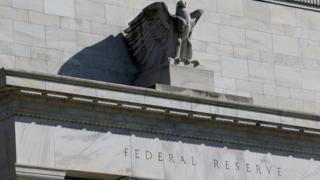
Federal Reserve buildingImage copyrightREUTERS
The Federal Reserve, the US central bank, is expected to cut its main interest rates at a meeting in Washington on Wednesday.
If it does, the aim will be to stimulate the US economy and get inflation closer to the Fed's target of 2%. But it will have ramifications far beyond US shores.

Why does Fed policy matter for the rest of the world?

There are two general answers.
One is that the US economy's performance is important for the rest of us. If the Fed gets it wrong the US could end up underperforming, which would be bad news for many other countries.
The second point is that Fed policy can have an impact through financial markets by affecting exchange rates, interest rates and international flows of investment money.

So what is the impact of the US economy on the rest of us?

For most countries on the planet, the US is an important export market - for many, the largest of all.
If the US has a recession it will buy less stuff from abroad than it would have if growth had been maintained. Its immediate neighbours, Canada and Mexico, are particularly exposed. For both, more than three-quarters of their exports go to the US.
The UK is also at some risk from economic storms in the US, although not to the extent of those two. The US is the largest single country export destination for the UK - though it is much smaller than the EU taken as a whole. The US accounts for about 13% of UK exports.

And what is the Fed's role in this?

The Federal Reserve has a mandate from the US Congress to promote maximum employment and stable prices.
It raises interest rates if inflation is too high, or it thinks it is heading that way. It cuts rates if it thinks there is a danger of economic growth slowing too much or inflation being too low.
Rate cuts make it more attractive for business to borrow to invest and households to borrow to spend. The Fed is perhaps the key player in trying to prevent a recession and promoting a recovery if there is a downturn.
The Fed has started reducing interest rates in an attempt to maintain solid economic growth in the US.
Growth has slowed, though there does not appear to be an imminent danger of the economy actually contracting. That said, there have been some warning signs in the financial markets that often do signal a recession is not that far away.
If it can succeed in achieving that, it will reduce the risks of the rest of the world having a period of weak economic performance.

What is the impact on currency markets?

Cuts in interest rates in any country tend to make its currency lose value against others.
That is because lower interest rates mean there is less money to be made by investing in assets that yield interest, such as government bonds or debt.
If investors are less keen to buy, for example US government bonds, they have less demand for the currency needed to buy them. So the currency concerned, the dollar in this case, tends to lose value.
That in turn will make other countries less competitive against goods that are priced in US dollars. But it also helps slow inflation by making dollar-priced goods cheaper in other countries' currencies.

What about international investment?

When an economy as large as the US changes its interest rates, it is possible for the movement of investment funds to be disruptive.
There was an episode in 2013 when the Fed started to consider reducing its quantitative easing programme, which involved creating new money to buy financial assets such as government bonds. It was a move which was in some ways akin to raising interest rates.
The plan was to "taper" its quantitative easing, and the result for emerging economies such as India and Indonesia came to be known as the "taper tantrum".
That led to large amounts of money leaving emerging markets, and there were concerns at the time that it might even lead to a new financial crisis in those countries. In the event, that did not happen.
This time, because interest rates are likely to be cut, it is more likely that money will go into emerging economies. That can sometimes lead to financial instability (or unsustainable bubbles). That is not an immediate concern now, but it is a reason why countries need to keep a careful eye on what happens in the US.

Tuesday, September 17, 2019

Reuters News - Trade talks seen as unlikely to mend U.S.-China divide

BEIJING/WASHINGTON (Reuters) - U.S. and Chinese officials will restart trade talks at the end of this week, but any agreement the world’s largest economies carve out is expected to be a superficial fix.
The trade war has hardened into a political and ideological battle that runs far deeper than tariffs, trade experts, executives, and officials in both countries say.
China’s Communist Party is unlikely to budge on U.S. demands to fundamentally change the way it runs the economy, while the U.S. won’t backtrack on labeling Chinese companies national security threats.
The conflict between the two countries could take a decade to resolve, White House economic advisor Larry Kudlow warned on Sept. 6. Yu Yongding, an influential former policy adviser to China’s central bank, told Reuters that China was in no rush to make a deal.
Presidents Donald Trump and Xi Jinping may hammer out an interim agreement in October to soothe stock markets and claim political victory after this week’s lower-level talks.
But any final agreement is “extremely unlikely to meaningfully address the Chinese structural reforms” sought by the U.S. and other countries, said Kellie Meiman Hock, a former U.S. Trade Representative official and managing partner with McLarty Associates, a policy and government consultancy.
Negotiators have made little discernable progress on the many points of disagreement since negotiations broke down in May, sources briefed on the talks say.

ISSUES DIVIDE

Beijing is unwilling to address the way it supports state-owned companies and subsidizes their products in coming talks, sources in China and the U.S. say. The U.S. continues to label Chinese tech company Huawei a national security threat, and dangle the threat of new tariffs against China.
“The ultimate result of talks must be the dropping of all tariffs,” said He Weiwen, senior fellow, Chongyang Institute for Financial Studies at Renmin University. “This is the baseline for China.” He is not optimistic about the talks’ prospects.
Since trade negotiations between the world’s largest economies collapsed in May, both countries have also broken promises and traded public insults. The mood is upbeat, but a single Trump tweet could turn that around, analysts say.
“They’re locked in this uncomfortable embrace,” said William Reinsch, a former senior Commerce Department official and Center for Strategic and International Studies fellow.
“Both presidents have undercut their negotiators and neither side can rely on what the other has said,” he said.

‘TECTONIC SHIFT’

Trump’s “tough on China” stance has swept in a new way of thinking about Beijing in Washington, despite the unpopularity of many of his other policies. The U.S. Congress, bitterly divided along partisan lines on most issues, is united about the need for systemic reform in China.
Democrats running against Trump aren’t likely to repair the China relationship if they take the White House in 2020. In a debate on Sept. 12, presidential candidates used terms like corruption and theft to discuss China’s trade practices.
“There’s been a tectonic shift,” said Warren Maruyama, former general counsel for the U.S. Trade Representative’s office and a partner with law firm Hogan Lovells.
“The old idea that China was in the middle of free market economic reforms that would lead them our way is effectively dead,” Maruyama said. “There’s bipartisan support for a tougher China policy.”
Lawmakers are responding, with several China-related bills making their way through Congress, from legislation to punish Beijing for human rights abuses against Muslims in Xinjiang and to support protesters in Hong Kong.
Additionally, the 2020 National Defense Authorization Act, or NDAA, could include provisions targeting China on issues ranging from technology transfers to the sale of synthetic opioids.

POLITICAL PRESSURE

Trump faces a worsening economy and recession fears at home, thanks in part to the tariffs he has enacted, but key constituencies have stood by him so far. U.S. executives in China say Beijing is miscalculating if it thinks the trade war will undermine Trump’s political support.
“If anything, the trade war has unified support in the business community,” one senior American executive in China said.
“The problems are deep, and they are structural,” said Craig Allen, a former senior U.S. Commerce Department official who now heads the US-China Business Council. The countries’ high-tech sectors may be permanently decoupled, he said, thanks to concerns about Chinese espionage, cyber hacking and intellectual property theft.
China’s Communist Party also faces a slowing economy as it prepares to celebrate on Oct. 1 70 years of ruling the country.
Many in Beijing believe that Trump’s erratic approach to the trade war this year has provided Xi with convenient short-term political cover, allowing him to blame White House tariff increases instead of domestic policies for the slowdown. 
In a throwback to the Mao Zedong era, Xi told cadres this month that there must be a “resolute struggle” against any risks and challenges to the party’s leadership, the country’s sovereignty and security and anything that threatens the country’s core interests.
Investments between China and the U.S. dropped to the lowest six-month level in five years in the first half of this year, a study by the research firm Rhodium Group shows.
Foreign direct investment and venture-capital deals between the two countries fell to $13 billion in the period, down 49% from the first half of 2018.
Reporting by Michael Martina, Andrea Shalal, Tim Aeppel, and Patricia Zengerle. Editing by Heather Timmons and Gerry Doyle

Monday, September 16, 2019

BBC News - Oil prices soar after attacks on Saudi facilities

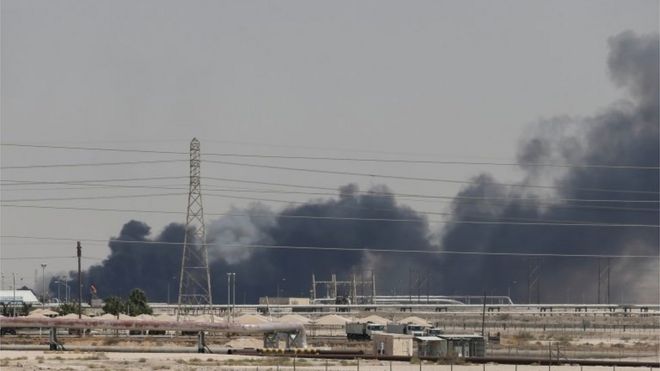
Smoke is seen following a fire at Aramco facility in the eastern city of AbqaiqImage copyrightREUTERS
Image captionSmoke is seen following a fire at Aramco facility in the eastern city of Abqaiq
Oil prices surged after two attacks on Saudi Arabian facilities on Saturday knocked out more than 5% of global supply.
Brent crude jumped 10% to $66.28 a barrel, while West Texas Intermediate rose 8.9% to $59.75 in Asian trading.
Prices pulled back slightly after US President Donald Trump authorised the release of US reserves.
The strike, which the US blames on Iran, has sparked fears of increased risk to energy supplies in the region.
The drone attacks on plants in the heartland of Saudi Arabia's oil industry included hitting the world's biggest petroleum-processing facility.
It could take weeks before the facilities are fully back on line. State oil giant Saudi Aramco said the attacks cut output by 5.7 million barrels per day.
Jeffrey Halley, senior market analyst at Oanda said the price spike across oil markets was a reaction to the "political and geopolitical implications" of the attacks.
"The bigger issue is just how secure is Saudi's infrastructure from attacks?," Mr Halley said.
US Secretary of State Mike Pompeo said Tehran was behind the attacks. Iran accused the US of "deceit."
Later Mr Trump said in a tweet the US knew who the culprit was and was "locked and loaded" but waiting to hear from the Saudis about how they wanted to proceed.

What will be the impact on oil supply?

The Saudis have not gone into any detail about the attacks, barring saying there were no casualties, but have given a few more indications about oil production.
Energy Minister Prince Abdulaziz bin Salman said some of the fall in production would be made up by tapping huge storage facilities.
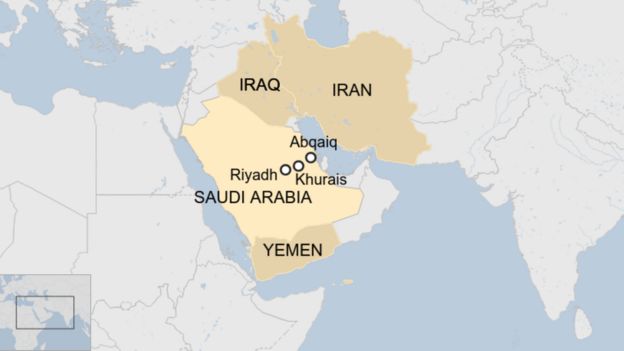
Saudi Arabia with capital Riyadh, the two oil facilities Abqaiq and Khurais, Yemen to the south and Iraq and Iran to the north
Image captionThe attacks struck Abqaiq and Khurais in central Saudi Arabia
The kingdom is the world's biggest oil exporter, shipping more than seven million barrels daily. Saudi stocks stood at 188 million barrels in June, according to official data.
"Saudi authorities have claimed to control the fires, but this falls far short of extinguishing them," said Abhishek Kumar, head of analytics at Interfax Energy in London. "The damage to facilities at Abqaiq and Khurais appears to be extensive, and it may be weeks before oil supplies are normalised."
Saudi Arabia is expected to tap into reserves so that exports can continue as normal this week.
However, Michael Tran, managing director of energy strategy at RBC Capital Markets in New York, said: "Even if the outage normalises quickly, the threat of sidelining nearly 6% of global oil production is no longer a hypothetical, a black swan or a fat tail. Welcome back, risk premium."

What are the US accusations?

Mr Pompeo said Tehran was behind the damaging attacks but gave no specific evidence to back up his accusations.
He has rejected claims by Yemen's Iran-backed Houthi rebels that they carried out the attacks.
Iran accused the US of "deceit" and its Foreign Minister Javad Zarif said that "blaming Iran won't end the disaster" in Yemen.
Yemen has been at war since 2015, when President Abdrabbuh Mansour Hadi was forced to flee the capital Sanaa by the Houthis. Saudi Arabia backs President Hadi, and has led a coalition of regional countries against the rebels.
The US meanwhile has blamed Iran for other attacks on oil supplies in the region this year, amid continuing tension following Mr Trump's decision to reinstate sanctions after abandoning the landmark international deal which limited Tehran's nuclear activities.

Friday, September 13, 2019

BBC News - Eurozone gets fresh help to bolster flagging growth

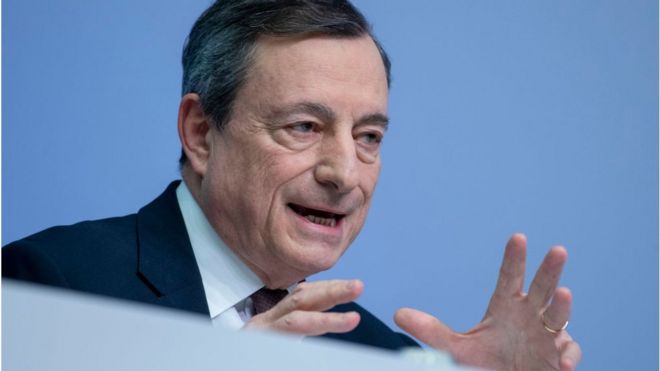
ECB chief Mario DraghiImage copyrightGETTY IMAGES
Image captionMario Draghi said the ECB had cut its forecasts for both inflation and economic growth
The European Central Bank has unveiled fresh stimulus measures to bolster the eurozone, including cutting a key interest rate.
The deposit facility rate, paid by banks on reserves parked at the ECB, was already negative, but has now been cut from minus 0.4% to minus 0.5%.
The ECB also said it was re-starting quantitative easing. It will buy €20bn of debt a month from 1 November.
The eurozone's main interest rate has remained unchanged at zero.
The moves come as the ECB combats an economic slowdown. The bank said its asset purchase programme would "run for as long as necessary", while interest rates would remain "at their present or lower levels" until eurozone inflation reached its target rate of 2%.
Quantitative easing, or QE, is a way for central banks to pump money into the financial system when interest rates are ultra-low and conventional stimulus methods no longer work.
The central bank buys assets, usually government bonds, with money it has "printed" - or, more accurately, created electronically.
Making more money available in this way is supposed to encourage financial institutions to lend more to businesses and individuals.
Under its previous QE programme, the ECB bought €2.6 trillion of bonds between 2015 and 2018.
Car manufacturing in GermanyImage copyrightGETTY IMAGES
Image captionThe eurozone's biggest economy, Germany, is thought to be on the brink of recession
ECB chief Mario Draghi told a news conference that the inflation outlook had been further downgraded.
"Headline inflation is likely to decline before rising again towards the end of the year," he said.
Mr Draghi also announced that the ECB had lowered this year's and next year's GDP growth forecasts for the eurozone. It now expects growth of 1.1% this year and 1.2% in 2020.
He said the eurozone was suffering from the "prevailing weakness of international trade in an environment of prolonged global uncertainties".
The eurozone's biggest economy, Germany, is widely thought to be on the brink of recession.
The ECB's decisions drew a swift reaction from US President Donald Trump, who tweeted that the ECB was "trying, and succeeding, in depreciating the euro against the VERY strong dollar".
Responding to Mr Trump's comments, Mr Draghi referred to him as "the First Tweeter".
"We have a mandate, we pursue price stability, and we do not target exchange rates, period," he said.

'Serious policy easing'

Mr Draghi is due to make way for incoming ECB President Christine Lagarde on 1 November.
The ECB's main refinancing rate has been at zero since March 2016.
"At first glance, the ECB has not quite thrown the kitchen sink at the eurozone economy," said Ranko Berich, head of market analysis at Monex Europe.
"The QE package is shy of market expectations, which were €30bn a month. But the Bank is clearly back in the business of serious policy easing and more aggressive action could easily be taken in response to a worsening in conditions."

Analysis

By Andrew Walker, BBC economics correspondent
So the ECB has fired off another volley of its monetary policy ammunition. But will it hit the target? Will it get inflation up towards the ECB's target and will it stimulate the eurozone's flagging economy? Many people are very sceptical.
The interest rate move takes us even further into the strange world of negative rates. There is a view that that measure is actually counterproductive, that it has an adverse impact on bank profitability. Perhaps ECB policy more widely has reached the limit of its ability to stimulate economic activity.
The other main weapon against economic weakness is in the hands of governments - fiscal policy, or public spending and taxation. For some governments in the eurozone, their scope to use that weapon is constrained by the amount of debt they already have and by eurozone rules. But the likely next head of the ECB, Christine Lagarde has called for more action in that area.
Countries such as Germany have strong government finances, but so far have been wary of departing from what they see as prudent financial management. There is, however, a growing debate about what the eurozone needs.