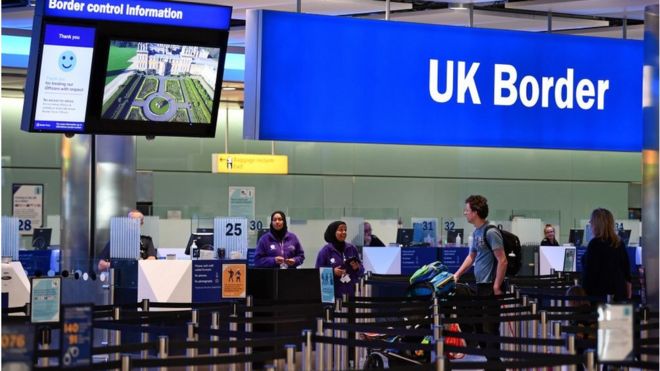
The UK's largest business, trade and education bodies have set out their priorities for a post-Brexit immigration system.
They called for flexibility for skilled workers to enter the UK through a points-based system, and a reformed sponsorship process.
The Home Office said it would introduce a points-based immigration system.
It added that it would consult businesses as the new system was rolled out.
In an open letter to Home Secretary Priti Patel, businesses said "fair and sustainable immigration" is critical for growth.
The UK's five largest business organisations and around 30 trade associations, from hoteliers to universities, employing millions of people, also welcomed signals that a £30,000 minimum salary test may change.
This would stress that the UK was open for business, they said.
The letter said: "Business understands that the immigration system must change in order to re-build public confidence.
"Insight from enterprise can help build a points-based model that provides greater control, whilst providing access to the labour and skills needed to support the economy.
"And this can go hand in hand with a continued determination to invest in training home grown talent."
Signatories included the CBI, British Chambers of Commerce, Institute of Directors, Federation of Small Businesses and MakeUK.
A Home Office spokesman said: "We will deliver on the people's priorities by introducing a points-based immigration system, attracting the brightest and best talent from around the world while cutting low-skilled immigration and bringing overall numbers down.
"This firmer and fairer system will let us decide who comes to this country based on their skills and the contribution they can make - not where they come from.
"We will continue to speak with businesses of all sizes as the system is designed and rolled out."
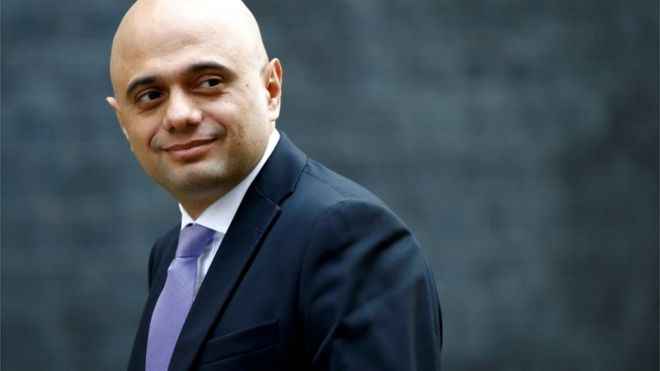
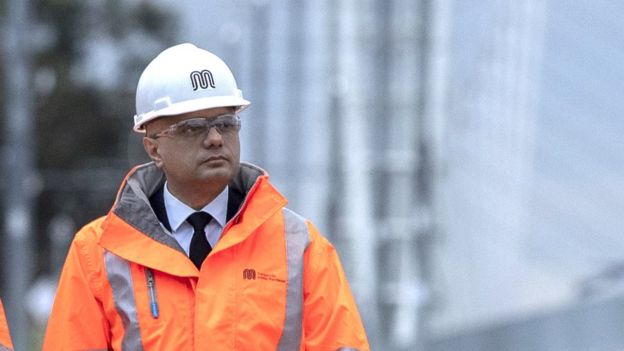
Trade tensions with the US have spiralled after the chancellor, Sajid Javid, took a defiant stance at Davos.
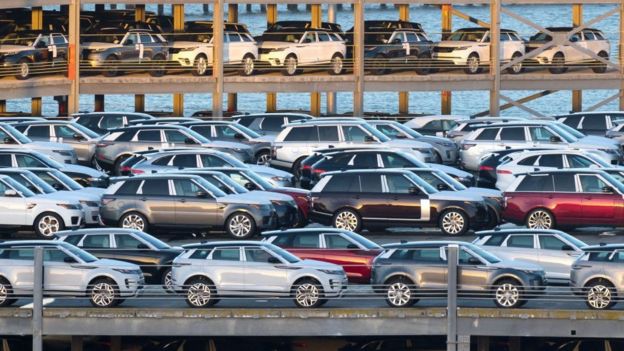
US treasury secretary Steve Mnuchin has threatened new tariffs on UK carmakers after the chancellor defied pressure to cancel a new tax on tech firms.
Mr Javid said the UK would not back down over the tax which will hit US firms like Apple, Amazon and Facebook.
A trade deal with the EU would take priority over one with the US after the UK leaves the EU this month, he added.
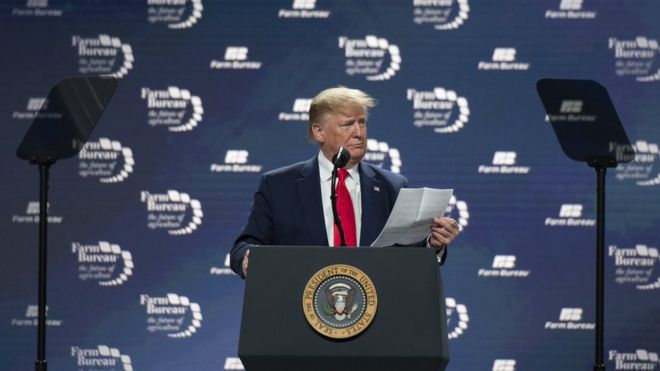
Both officials said Boris Johnson and Donald Trump would discuss the trade agreement and the tech tax this week during the World Economic Forum in Davos.
The UK government sees a new trade deal with the US as a high priority after Britain leaves the European Union at the end of this month.
But some parts of the UK economy are closely integrated with the EU, its largest trading partner.
The comments from Mr Javid and Mr Mnuchin came during a panel discussion at the annual gathering of business and government representatives in Switzerland.
The new tax is aimed at firms that do a lot of business in the UK but don't pay taxes based on the size of their sales.
Image copyrightGETTY IMAGESImage captionThe US is considering retaliatory tariffs on European car exports if a new tech tax is imposed
France this week agreed to suspend a similar measure after the US had threatened to impose new levies on French exports of wine, cheese and handbags.
France will not levy their tech tax until the end of the year to allow time for a multilateral coordinated agreement on tax reform to be agreed.
Mr Javid said that while the UK would like to see an international agreement, he planned to go ahead with the introduction of the new multibillion pound tax, which is due to take effect in April.
Mr Javid described the new tax as "proportionate".
Caution
US Treasury Secretary Steve Mnuchin said: "We think the digital tax is discriminatory in nature... if people want to arbitrarily put taxes on our digital companies we'll consider arbitrarily putting taxes on car companies."
Former UK chancellor, George Osborne, told the BBC that he thought the government would be wary of provoking the US over the new tax.
"It will be a very brave British government that walks into a trade war with the United States at the very moment when centrepiece of its economic policy is to strike a trade deal with the United States," he told the Today Programme.
What is the new tax?
The UK, along with several other European countries, wants to limit the tech giants' ability to avoid taxes.
They argue taxes should be based on where the digital activity takes place, not where firms have their headquarters. So if a UK consumer searches for a product or posts things online, and advertising is sold alongside those pages, the business should count - for tax purposes - as taking place in the UK.
But it has proven difficult to agree exactly how a new system would work.
So some countries including the UK, France, Italy, Austria and Turkey, have considering imposing unilateral levies.
But trade officials in Washington say US firms are being unfairly targeted.
'Hold fire'
The UK is under pressure to follow France's example and delay its plan to levy tax worth 2% of the revenues of search engines, social media companies and online marketplaces, a change which would bolster public finances by £500m a year.
The Organisation for Economic Cooperation and Development (OECD), which is overseeing efforts to find a joint solution, has urged national governments to wait for a multilateral agreement.
Secretary General Angel Gurria told the BBC that without that there would be a "cacophony and a mess" of 40 countries going their own way with "tensions rising all over the place".
Mr Gurria said that the UK government should "absolutely hold fire and contribute to a multilateral solution".
Industry body the Society of Motor Manufacturers and Traders (SMMT) called for the UK and US "to explore all options that avoid restrictive measures" in order to avoid a tit-for-tat trade war developing.
Mike Hawes, SMMT chief executive, said: "The US is one of UK automotive's most important global partners, second only to the EU in trade terms, so the continued threat of additional tariffs that could endanger the viability of our sector is of huge concern."
SYDNEY (Reuters) - Some residents of Australia’s capital Canberra were evacuated briefly on Wednesday after a bushfire broke out near the airport as searing hot weather ended a few days of respite and the number of out-of-control blazes surged in the southeast of the country.
Roads were closed and the authorities told people to leave or stay away from suburbs east of Canberra, as photos posted on social media showed gray smoke billowing above the city’s suburbs. There were no reports of injuries or damage, and the warning was downgraded an hour later.
“I can see the smoke from my house,” said Kane Cawse, a gym owner, by telephone as he drove toward his business in the evacuation zone about 14 km (9 miles) from the country’s parliament.
“I’m just going to see exactly what’s going on, make sure I’ve got a gym and make sure that the guys are either safe or out,” he added.
In recent weeks, Canberra and the cities of Sydney and Melbourne experienced air quality rated among the worst in the world under thick clouds of bushfire smoke.
The fire broke out as a huge dust storm crossed the country’s south, leaving skies deep orange and engulfing some outback towns, the Bureau of Meteorology said.
Since September, hundreds of wildfires in Australia have killed 29 people as well as an estimated 1 billion native animals, while incinerating 2,500 homes and a total area of bushland larger than the size of Austria.
Firefighters had taken advantage of rain and milder temperatures in the past week to contain blazes, but the respite ended on Wednesday when high temperatures and winds returned.
An economic survey on Wednesday meanwhile showed the fires were causing Australians to tighten their purse strings, a sign the natural disaster is putting pressure on the world’s 14th-biggest economy.
Economists said the cost to Australia’s A$1.95 trillion ($1.33 trillion) economy could be as high as A$5 billion ($3.4 billion), shaving 0.25 points off gross domestic product in the December and March quarters, and potentially prompting the central bank to cut rates as early as February.
Consumer sentiment in January was 6.2% lower than a year earlier, according to the Melbourne Institute and Westpac Bank survey released on Wednesday. Consumer sentiment data is considered a leading indicator, running ahead of actual spending data.
The huge bushfires have cut through the country’s east coast during the peak summer months when many businesses usually rake in earnings from both domestic and foreign tourists. Agricultural sectors, particularly the dairy industry, have also been hard hit.
Here are today’s key events in the bushfire crisis:
* Suburbs near Canberra Airport were evacuated late on Wednesday as an emergency level fire burned. There were no reports of injury or damage.
* The wildfires have killed 29 people, destroyed more than 2,500 homes and razed 11 million hectares (27 million acres) of wilderness - an area one-third the size of Germany - since September.
* Scores of fires were burning in the states of New South Wales (NSW) and Victoria on Wednesday. Temperatures in Victoria were expected to top 32 degrees Celsius (89.6 Fahrenheit) on Wednesday, leading officials to declare “extreme fire danger” in some areas. Temperatures in NSW were forecast to hit 40C (104F) on Thursday.
* A Reuters analysis shows that Australian animals living in specific habitats, such as mountain lizards, leaf-tailed geckos and pear-shaped frogs, are battling the threat of extinction after fierce bushfires razed large areas of their homes.
* The air in Sydney is expected to again reach hazardous pollution levels on Thursday as smoke drifts over the city, the NSW state government said.
* Players at the Australian Open tennis tournament continued to make pledges of financial assistance. Among the latest were the seventh seed, Alexander Zverev, who said he would donate A$10,000 for each match he wins and pledged his entire prize money of A$4.12 million if he wins the tournament. American John Isner has pledged 25% of all his prize money and A$100 for every ace he serves.
Reporting by Byron Kaye, Colin Packham and Swati Pandey in Sydney; editing by Jane Wardell and Christian Schmollinger
Some of the world's top business people and politicians - plus a smattering of celebrities - will gather in Davos, Switzerland, for the World Economic Forum (WEF) this week.
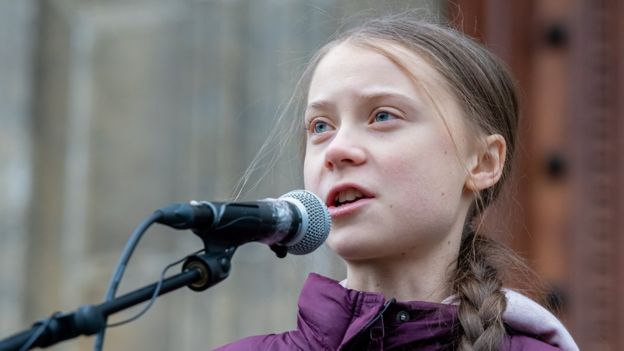
US President Donald Trump, teen climate activist Greta Thunberg and Uber boss Dara Khosrowshahi are among the guests.
Here are five things to look out for:
1. Trump trade tensions directed at Europe
The China-US trade ceasefire last week should hold temporarily, if only because it was so modest. So expect President Trump, facing an impeachment trial back home, to ramp up the pressure on the European Union, who he has long viewed as treating the US "unfairly".
This cold trade war has taken on a number of forms over the past year from Airbus and Boeing to steel and aluminium, the EU response to renewed sanctions on Iran, Carbon tax, digital tax and the willingness to deploy technology from the Chinese tech giant Huawei.
What we know is that the White House believes that European goods trade surpluses with the US are an example of an unfair rip off, especially car imports.
The new EU team was pretty aggressive in hitting back last week at the White House "Sabre rattling", "bluff" and "short term thinking". The stage is set for a turbulent new backdrop for world trade tumult.
Image copyrightGETTY IMAGESImage captionChancellor of the Exchequer Sajid Javis will attend Davos
2. The UK turns up, but which one?
Into this storm enters the UK, just about to reassert itself as an independent player on the world stage.
After some bluster about banning ministers from attending Davos, the Chancellor of the Exchequer, though not the PM, will be here with a message that "Britain is back", after three years of uncertainty with a government empowered with a healthy majority to act decisively.
But in what way, exactly? The World Economic Forum will host many of the sorts of British businesses most sceptical about the chancellor's plan for the UK to pull away from European regulations and standards.
If there is a vision for UK-specific regulations, divorced from the three global superpowers - EU, US & China - then it should be able to be sold to some of the players with billions to invest here. Then what about the bigger geopolitical picture?
Downing St has tried very hard to navigate between the EU and US on Iran, for example. But some choices are required on the trade-offs between maintaining existing business forged in the EU, and new trade links with the US.
The government believes it can skilfully leverage a great deal from both, simultaneously. The opposite might well be true, particularly if EU-US tensions truly flare up. Davos is the sort of place where such high wire acts fly or fall.
Image copyrightGETTY IMAGESImage captionGreta Thunberg has top billing at this year's conference
3. Climate honesty
Net zero carbon by 2050 is now being wired into the part of the global economy which matters most - the financial system.
Greta Thunberg is being given top billing in this year of crucial talks, but all around the world now, the banking and insurance systems that have financed carbonisation, are being turned to decarbonisation.
It seems a serious endeavour, stretching from changes to banks' capital requirements to the way government borrowing is calculated. The world's biggest companies will talk about going beyond being carbon neutral to being net carbon negative.
But how politically sustainable is it? Is the public really being taken along on the ride beyond high profile protest movements?
All across the world there has been a backlash against global trade, and yet that has benefited most countries' earnings.
Serious action against climate change required by 2050 net zero will involve lifestyle and livelihood changes that will look like up front sacrifices to benefit future generations or, at first, other regions of the world from the Ganges delta to Australia.
Are business and political leaders capable of being straight with their people about fewer flights, pricier fuel and energy, and perhaps higher taxes?
Image copyrightGETTY IMAGESImage captionData is now a powerful traded commodity
4. Tech titans toil
A decade ago the tech companies were the great capitalist hope at a place like this.
The sunny vision of technology connecting the world, and helping both to enlighten and to democratise, shone through from the speeches here of the Zuckerbergs, Pages and Gates.
It was a marked contrast to the post crisis backlash against the bankers. We are in a very different place right now. Tech companies making billions from your data have proved elusive for the world's top tax systems.
Their innovative business models are designed to put others out of business. These two facts have created a backlash, then given further fuel by deep concerns about the health impacts of mass consumption of social media on young minds in particular.
On top of that, for some at least, it is the targeting by factories of fake news through social media that has fuelled populism and political instability around the world.
Essentially, data is now a powerful traded commodity and factor of production in the global economy.
The tech giants' billions of wealth and impact across the globe has been created out of an era of immense innovation with little regulation. The nation states of the world asserted themselves over the past year, for example over the attempt by Facebook to create a currency.
There will be more of this to come, starting here. The rollout of 5G technology may offer an opportunity to tilt the scales.
Image copyrightGETTY IMAGES
5. Economic ammo shortage
The world economy is now a decade on from the financial crisis. We are due another crisis, though perhaps not quite so severe.
Except this time, the major central banks of the world have rather more limited room for manoeuvre on base interest rates at least, especially after providing further support to the economy in 2019.
Exceptionally low borrowing rates for major governments are sending a message to them to spend more, wisely, on helping productive investments.
It is a message that has been heard, for example, in the UK. And yet, the need for stimulus arises partly because of the brakes on growth from rising trade barriers.
One idea floating around policy circles, and so here in Davos, is that advanced economies prepare "contingent" stimulus packages of productive public spending, as well as more general investment in climate change alleviation.
There are some win-wins available here, but the sort of global cooperation required to achieve them is proving more rather than less difficult in this zero sum world.
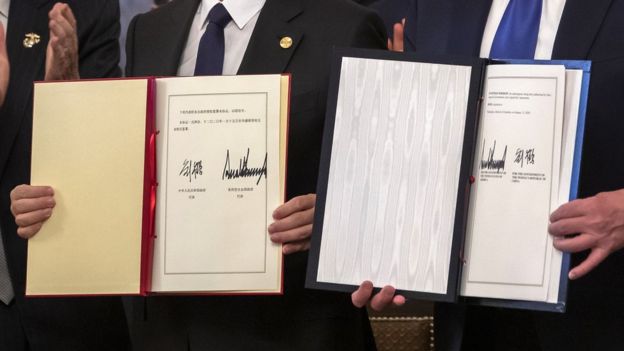
Image copyrightEPAImage captionChinese vice premier Liu He (L) and US president Donald J. Trump (R) sign a partial trade deal
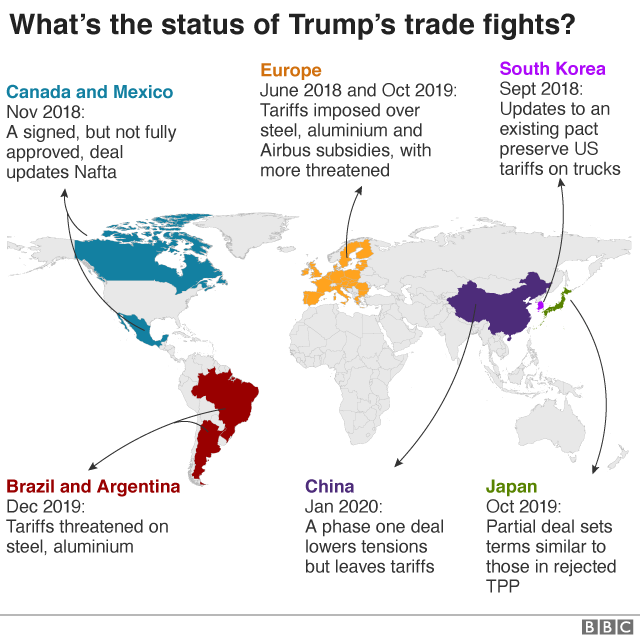
Most of the tariffs remain in place. The US will maintain levies of up to 25% on an estimated $360bn worth of Chinese goods while China is expected to keep tariffs on more than $100bn of US imports.
Even the Trump administration conceded it fell short of original goals, describing it as a "phase one" agreement.
The pact, which has been slowly making its way through the legislatures of the three countries, will replace the 1994 North American Free Trade Agreement (NAFTA) which Mr Trump has described as the "worst".
However, despite a name change, a lot of the terms remain the same.
There are some differences, including stronger labour provisions and tougher rules on the sourcing of auto parts.
But analysts say their significance remains to be seen. Many of the other updates were worked out in negotiations that pre-dated Mr Trump.
Japan and South Korea
One of Mr Trump's first moves as president was to withdraw the US from the Trans Pacific Partnership - a proposed 12-country deal that eventually went ahead without America, putting its exports at a disadvantage.
Mr Trump has since claimed two bilateral agreements in Asia, with Japan and South Korea, but the changes were so limited that Congressional researchers said they barely qualified as trade deals.
In the case of South Korea, the most notable provision actually preserved US tariffs on light duty trucks.
With Japan, the US won either levy cuts or complete elimination on $7bn worth of agricultural goods. But this was the same access America would have received under the Trans Pacific Partnership.
Europe
In the case of Europe, there is no trade deal in sight.
Image copyrightGETTY IMAGESImage captionPecorino, from Italy, is one of the cheeses affected
In that instance, Mr Trump's decision had the approval of the World Trade Organization, which had found that the European Union provided illegal subsidies to aircraft manufacturer Airbus.
Heads spun last month when Mr Trump announced on Twitter he wanted tariffs on steel and aluminium from Brazil and Argentina.
Those countries had been exempted from higher duty on both metals but Mr Trump claimed the two nations had been devaluing their currencies "which is not good for our farmers".
So far, there has been no follow-up announcement from his administration and the threats have not materialised.
Following a phone call with Mr Trump, Brazilian President Jair Bolsonaro said he had been assured they would not happen.
 AFP
AFP