South Korea has fallen into recession as the country reels from the impact of the coronavirus pandemic.
Asia's fourth-largest economy saw gross domestic product (GDP) fall by a worse-than-expected 2.9% in year-on-year terms, the steepest decline since 1998.
Exports, which account for nearly 40% of the economy, were the biggest drag as they fell by the most since 1963.
In recent weeks official figures have confirmed that both Japan and Singapore have also gone into recession.
But South Korea's finance minister Hong Nam-ki remains optimistic that the economy will recover swiftly.
"It's possible for us to see China-style rebound in the third quarter as the pandemic slows and activity in overseas production, schools and hospitals resume," Mr Hong said.
The South Korean government has so far implemented about 277 trillion won (£181bn; $231bn) worth of stimulus measures to tackle the effects of the pandemic on its economy.
However, authorities in the trade-reliant nation have very little control over exports, ranging from computer memory chips to cars.
In another indication of how Covid-19 has hit the region's exporters, Australia has reported its biggest budget deficit since the Second Word War.
The country has swung to a deficit of A$85.8bn (£48.1bn; $61.3bn) for the year ended in June 2020.
Treasurer Josh Frydenberg also said the shortfall is predicted to grow to A$184.5bn this financial year as the pandemic pushes Australia into its first recession in three decades.
TOKYO (Reuters) - Japan on Wednesday kicked off a national travel campaign aimed at reviving its battered tourism industry, but the effort has drawn heavy criticism amid a jump in new coronavirus cases.
“Go To Travel” - dubbed “Go To Trouble” by some local media - offers subsidies of up to 50% on trips to and from prefectures excluding Tokyo, which was removed from the programme last week after infections surged to new highs.
But many of Japan’s governors wanted the campaign delayed or amended out of fear it would spread the virus to rural areas with low infection numbers, while a Mainichi newspaper poll this week showed 69% of the public wanted the programme cancelled entirely.
The criticism underlines the public’s growing exasperation with what critics say are mixed messages as the government tries to boost the economy while containing the virus.
“There is no change to our stance to cautiously restart economic activity, while asking the public to cooperate in preventing the spread of the coronavirus,” Prime Minister Shinzo Abe told reporters on Wednesday when asked about the campaign.
Governor Yuriko Koike, however, urged Tokyo residents to stay home during a four-day weekend beginning Thursday.
“It’s essential for the elderly and people with pre-existing conditions to refrain from making unnecessary outings,” Koike said on Tuesday evening.
Many in the travel industry were frustrated with what they said was a lack of clarity.
“It’s clear the government is scrambling and was totally unprepared. It’s also so hard to get information about this scheme because things change a lot,” said a general manager of a mid-sized business hotel in Osaka, who declined to be named due to the sensitivity of the matter.
Hiroaki Gofuku, the president and general manager of Hotel Nikko Osaka, said he hoped that the campaign would be a boost for the ailing tourism industry, but that he was also cautious not to be overly optimistic.
“Tokyo is our big market,” he said. “With this mess, we’re actually seeing more cancellations.”
Economic Minister Yasutoshi Nishimura is also widely expected to announce a delay to the phased reopening of stadiums and events at a meeting on Wednesday.
The government was planning to ease restrictions for stadiums and concert venues starting in August, allowing them to operate at half of maximum capacity. But they are widely expected to reverse their plans with daily infections rising.
Tokyo announced on Wednesday morning that daily infections were expected to reach over 230.
Japan has not seen the kind of rapid spread of the coronavirus that has killed tens of thousands in other countries. But new cases in Tokyo and other cities have sounded alarm bells for a country that had thought it had the virus under control.
Reporting by Sakura Murakami; Editing by Chris Gallagher and Gerry Doyle
EU leaders have struck a deal on a huge post-coronavirus recovery package following a fourth night of talks.
It involves €750bn (£677bn; $859bn) in grants and loans to counter the impact of the pandemic in the 27-member bloc.
The talks saw a split between nations hardest hit by the virus and "frugal" members who were concerned about costs.
It is the biggest joint borrowing ever agreed by the EU. Summit chairman Charles Michel said it was a "pivotal moment" for Europe.
The deal centres on a €390bn programme of grants to member states hardest hit by the pandemic. Italy and Spain are expected to be the main recipients.
A further €360bn in low-interest loans will be available to members of the bloc.
The summit, which began in Brussels on Friday morning, saw more than 90 hours of talks and became the EU's longest since a 2000 meeting in the French city of Nice, which lasted for five days.
Mr Michel, the president of the European Council, tweeted "Deal" shortly after the 27 leaders reached the agreement at about 05:15 (03:15 GMT) on Tuesday.
The agreement followed a long weekend of talks between EU countries, during which tempers were often frayed.
Member states were largely split between those hit hardest by the outbreak and keen to revive their economies, and those more concerned about the costs of the recovery plan.
The self-proclaimed frugal four - Sweden, Denmark, Austria and the Netherlands - along with Finland, had opposed allowing €500bn to be offered in the form of grants to countries hardest-hit by Covid-19.
The group originally set €375bn as the limit, in addition to wanting conditions such as the right to block requests. Other members, such as Spain and Italy, did not want to go below €400bn.
At one point French President Emmanuel Macron reportedly banged his fists on the table, as he told the "frugal four" he thought they were putting the European project in danger.
The €390bn figure was suggested as a compromise, and "frugal" nations were reportedly won over by the promise of rebates on their contributions to the EU budget.
Another issue in the negotiations was how disbursements would be linked to governments respecting the rule of law. Hungary and Poland both threatened to veto the package if it adopted a policy of withholding funds from nations who do not meet certain democratic principles.
The European Commission will borrow the €750bn on international markets and distribute the aid. There will also be a means by which member states can reject a spending plan.
The deal was reached alongside agreement on the bloc's next seven-year budget, worth about €1.1tn.
How have EU European leaders reacted?
French President Emmanuel Macron said it was a "historic day for Europe".
"Never before did the EU invest in the future like this," Belgian Prime Minister Sophie Wilmès tweeted.
Mr Michel said: "We showed collective responsibility and solidarity and we show also our belief in our common future."
European Commission President Ursula von der Leyen tweeted. "Today we've taken a historic step, we all can be proud of. But other important steps remain. First and most important: to gain the support of the European Parliament. Nobody should take our European Union for granted."
Dutch Prime Minister Mark Rutte, who led the "frugal group", welcomed the agreement, but acknowledged the fractious nature of the talks. "We are all professionals, we can take a few punches," he told reporters.
Tough talks reflect power shifts
The deal was reached after marathon of negotiations that almost became the longest in EU history. The "EU enlargement" summit in Nice 10 years ago lasted only 25 minutes longer.
For leaders who had pushed for a far-reaching package, the deep frustration, including table-thumping anger from the French president, appears to have dissipated.
I asked Mr Macron whether he still felt that the "frugal four" had damaged the European project by their hard bargaining. He said, as had been reported: "It's legitimate that we have different sensibilities... If we don't take into account the realities, we'd put these leaders in a difficult spot and it would favour the populists."
The "Club Med" countries, Spain, Italy and Portugal, appear content with the smaller size of grants available. Portuguese PM Antonio Costa told us: "While it's true that it could have had a slightly bigger dimension, the recovery plan is robust enough to respond to the current estimates of the Coronavirus crisis."
As for Europe's most powerful leader, the German Chancellor Angela Merkel, I asked her about the new power balance in the EU. She said: "During the last negotiations [then UK Prime Minister] David Cameron's view loomed large. Now he is no longer with us, others have come to the fore."
LONDON (Reuters) - Britain has signed deals to secure 90 million doses of two possible COVID-19 vaccines from an alliance of Pfizer Inc (PFE.N) and BioNTech (22UAy.F), and French group Valneva (VLS.PA), the business ministry said on Monday.
Britain secured 30 million doses of the experimental BioNTech/Pfizer vaccine, and a deal in principle for 60 million doses of the Valneva vaccine, with an option of 40 million more doses if it was proven to be safe, effective and suitable, the ministry said.
With no working vaccine against COVID-19 yet developed, Britain now has three different types of vaccine under order and a total of 230 million doses potentially available.
“This new partnership with some of the world’s foremost pharmaceutical and vaccine companies will ensure the UK has the best chance possible of securing a vaccine that protects those most at risk,” business minister Alok Sharma said.
Financial terms were not disclosed.
The deals follow a previously announced agreement with AstraZeneca (AZN.L) for the firm to produce 100 million doses of its potential vaccine being developed in partnership with the University of Oxford.
Britain said it was the first such deal which Pfizer and BioNTech had agreed for the supply of their vaccine, which is being tested in early to mid stage trials.
The firms are aiming to make up to 100 million doses by the end of this year and potentially more than 1.2 billion doses by end of 2021, if the vaccine is successful.
It uses the so-called messenger RNA approach, in contrast to the more traditional, inactivated whole virus vaccine being developed by Valneva.
Valneva’s potential vaccine is still in pre-clinical trials, and the company is aiming to move into clinical trials by the end of 2020.
Britain also said on Monday it had secured treatments containing COVID-19-neutralising antibodies from AstraZeneca (AZN.L) to protect people who can’t be vaccinated.
Reporting by Alistair Smout; Editing by Richard Pullin and Peter Graff
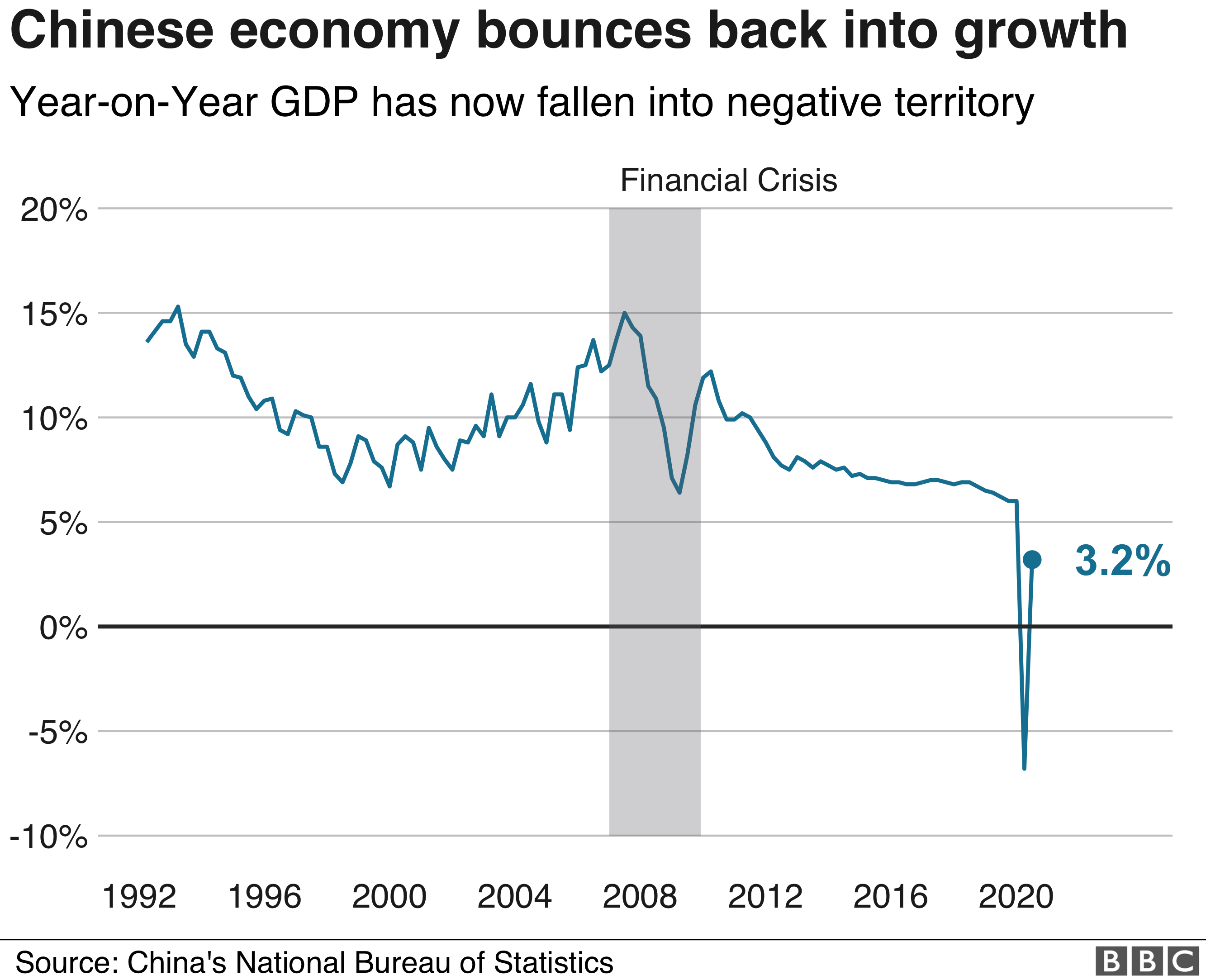
China's economy grew 3.2% in the second quarter following a record slump.
The world's second biggest economy saw a sharp decline in the first three months of the year during coronavirus lockdowns.
But figures released on Wednesday show China's Gross Domestic Product (GDP) returned to growth during April to June.
The numbers are being closely watched around the world as China restarts its economy.
The figure is higher than experts were predicting and points towards a V-shaped recovery - that is, a sharp fall followed by a quick recovery.
It also means China avoids going into a technical recession - signified as two consecutive periods of negative growth.
The bounce-back follows a steep 6.8% slump in the first quarter of the year, which was the biggest contraction since quarterly GDP records began.
The country's factories and businesses were shutdown for most of this period as China introduced strict measures to curb the spread of the virus
The government has been rolling out a raft of measures to help boost the economy, including tax breaks.
Is this a V-shaped recovery?
Analysis by Mariko Oi, BBC News, Singapore
The Chinese economy managed to grow more strongly than expected as it emerged from the lockdown.
All the stimulus measures announced by the authorities seem to be working - with factories getting busier, evident in growth in the industrial production data.
But one sector that hasn't recovered as quickly as they had hoped is retail sales.
They still fell in the second quarter - and getting people spending again will remain a challenge.
And just as the economy starts to recover, tensions with the US are flaring up - especially over Hong Kong.
That is why some economists are reluctant to call it a V-shaped recovery just yet.
A research note from Deutsche Bank said the "V-shaped recovery" was "largely completed".
"Consumer spending is still below its pre-Covid path, but the remaining gap is largely concentrated in a few sectors - travel, dining, leisure services-- where rapid recovery is unlikely," it added.
In May, China announced it would not set an economic growth goal for 2020 as it dealt with the fallout from the coronavirus pandemic.
It is the first time Beijing has not had a gross domestic product (GDP) target since 1990 when records began.
For the first six months of the year, China's economy fell 1.6%, its National Bureau of Statistics said.
(Reuters) - U.S. stocks climbed on Wednesday, with the S&P 500 approaching its highest level in more than four months after promising early data for a potential COVID-19 vaccine and a strong quarterly report from Goldman Sachs.
Moderna Inc surged 9.2% after a small-scale study showed its experimental COVID-19 vaccine produced high levels of virus-killing antibodies.
Travel-related stocks Carnival Corp, Royal Caribbean Cruises Ltd, Marriott International and Wynn Resorts rose between 7% and 20%, with the S&P 1500 airlines index up 10.0%.
The S&P 500 was on track to beat the technology-heavy Nasdaq Composite for a fourth straight session, a feat scored only twice since Wall Street launched its massive recovery last March.
Gains for the Nasdaq were capped by online retail giant Amazon.com Inc, video streaming platform Netflix Inc and Microsoft Corp which slipped after surging to record highs recently.
“The Moderna news woke everybody up again that this is not going to last forever, and there is light at the end of the tunnel. That is why you are seeing such a strong move today into those economically sensitive stocks,” said Tim Ghriskey, Chief Investment Strategist Inverness Counsel in New York.\
Adding to investors’ enthusiasm, the Federal Reserve’s Beige Book survey showed U.S. businesses saw an uptick in activity into the beginning of July as states eased restrictions to contain the novel coronavirus pandemic, but that but many were uncertain about the economic outlook.
However, the United States has failed to control the coronavirus and there is a high level of uncertainty over how much the pandemic will affect the economy, Philadelphia Federal Reserve Bank President Patrick Harker said, as a number of U.S. sunbelt states reported a surge in COVID-19 cases recently.
The three main U.S. stock indexes have recouped most of their losses from the coronavirus-led slump, with a raft of stimulus measures and encouraging economic data lifting the S&P 500 to about 5% below its record high hit in February.
At 2:28 p.m. ET (1828 GMT), the Dow Jones Industrial Average was up 0.79% at 26,854.26 points, while the S&P 500 gained 0.94% to 3,227.45.
The Nasdaq Composite added 0.66% to 10,558.29.
Goldman Sachs rose 1.2% after it said its trading revenue doubled in the second quarter, driven by big swings in stock and bond markets since March.
Morgan Stanley gained 1.2% and Bank of America rose 1.4% ahead of their results on Thursday. The broader banking index climbed 2.3%.
UnitedHealth Group Inc fell 2.3% after warning of rising costs later this year as Americans catch up on less urgent surgeries halted by the coronavirus pandemic.
Advancing issues outnumbered declining ones on the NYSE by a 5.03-to-1 ratio; on Nasdaq, a 4.35-to-1 ratio favored advancers.
The S&P 500 posted 29 new 52-week highs and no new lows; the Nasdaq Composite recorded 67 new highs and two new lows.
Additional reporting by Medha Singh and Devik Jain in Bengaluru; Editing by Marguerita Choy
The world's leading oil producers are expected to announce an increase in output this week amid signs that demand is rising.
Oil cartel Opec is due to hold a meeting on Tuesday and Wednesday to discuss its next move.
Analysts predict major producers will agree to ease supply cuts that were imposed in April to prop up prices.
Opec and its allies, known as Opec+, cut daily oil output by 9.7m barrels as the pandemic saw demand collapse.
That agreement was made to help ease the effects of an oil glut caused by the lockdowns and to stabilise prices.
Brent crude, which is the global benchmark for oil, is down around 30% this year, while US-traded West Texas Intermediate (WTI) fell below zero at one point in April.
Expectations are growing that from next month those curbs will be reduced to 7.7m a day, meaning that output will increase by 2m barrels a day.
The more optimistic outlook comes after the International Energy Agency (IEA) last week suggested that the worst of the impact caused by coronavirus lockdowns may now be over.
In its monthly global energy report the IEA predicted a slight improvement in global demand for crude oil this year.
However, it also cautioned that much still depends on how the pandemic develops.
The report also noted that the resurgence of cases in some parts of the world, including the US and Latin America, was “casting a shadow” over the outlook and threatened to derail a recovery in demand.
"The recent increase in Covid-19 cases and the introduction of partial lockdowns introduces more uncertainty to the forecast," it said.
Singapore-based oil expert Vandana Hari cautioned about a swift recovery for the commodity. "Global oil demand is currently expected to come close to pre-coronavirus levels only in the second half of 2021.
It may not reach the exact levels until much later, as international air travel and jet fuel demand is not seen normalizing for the next 2-3 years," she said.
In the US, Florida has registered a state record of 15,299 new coronavirus cases in 24 hours - around a quarter of all of the United States' daily infections.
The US as a whole has been exceeding new daily totals of 60,000 cases for the past few days. Other states including Arizona, California and Texas continue to see a rising cases.
 GETTY IMAGES