Thursday, July 21, 2016

Reuters News - German firms hold off UK investments ahead of Brexit talks

Some German companies are holding off making investments in Britain until they know more about the relationship the country will forge with the rest of Europe following the Brexit vote.
While big companies like Siemens (SIEGn.DE) and Bosch have the deep pockets to take a longer-term view about one of Europe's most lucrative markets, and weather uncertainty about how the divorce will play out, smaller firms are more cautious.
Britain is a major market for Germany, accounting for around 7 percent of its exports, and is likely to remain so regardless of Brexit. But Germany's VDMA association, which represents thousands of firms in the engineering industry, said many of its members were unwilling to make any financial commitments.
"Companies want to continue to do good business in Britain and most are likely now waiting to see how the exit negotiations go, once they start," said its head Thilo Brodtmann.
Family-owned industrial manufacturer Kemper, for example, has shelved plans to expand its British business.
Before the Brexit vote the company, which makes air filter systems and fume extraction units for the car and construction industries, had planned to invest in its UK marketing and servicing operations this year.
"We definitely won't do that now," CEO Bjoern Kemper told Reuters from his office in Vreden, close to the Dutch border in the state of North Rhine-Westphalia.
He said Kemper's British sales have fallen this year, partly because customers had put off spending decisions ahead of the June 23 referendum, and that he saw little prospect of a rebound in the short term following the decision to leave the EU.
The company, which has overall annual turnover of about 40 million euros ($44 million), said it expects to lose around 1 million euros in UK sales this year as a result of economic uncertainty before and after the Brexit vote.
COMPLEX TALKS
Little is clear about how Brexit will affect the British and German economies.
The Bank of England said on Wednesday it saw "no clear evidence" that a sharp economic slowdown was yet under way in Britain after last month's vote, though there were signs investment and hiring were being put on hold.
New Prime Minister Theresa May says her government is formulating its position for talks that will determine the country's relationship with the EU, and has appealed for time to work out how best to approach the complex Brexit negotiations.
British officials have stressed they believe investment will flow again once foreign businesses can see how Britain's post-Brexit ties with the EU are starting to shape up.
"People are not disinvesting, they are just on hold ... if by December or March they can see a decent landing point, they'll move ahead again," one senior economic official told Reuters.
Kemper is more exposed to Britain than most German companies, with the country accounting for a tenth of its turnover, but its experience nonetheless reflects some of the challenges the Brexit vote poses to Germany's economy.
In the first five months of 2016, German exports to Britain stagnated on the year, official data shows. The slowdown contrasts sharply with last year, when German shipments to Britain surged almost 13 percent to just under 90 billion euros, a record for German exports to Britain.
In 2015, Germany sold more goods only to the United States and France.
The VDMA engineering association said German exports from the sector to Britain fell by 4.2 percent in the first quarter, year-on-year.
In a further sign that political uncertainty has harmed economic ties, German foreign direct investment to Britain fell 6 percent on the quarter in the first three months of 2016, Bundesbank data show.
Markus Kerber, managing director of the BDI Federation of German Industries, told Reuters it expected a significant deterioration in economic relations with Britain in the coming months. "When it comes to new German foreign direct investment, it's looking bad," he said.
MARKET ACCESS
The immediate uncertainty is perhaps less problematic for big companies whose size and financial muscle allows them to plan further ahead.
Siemens said late last month that it was not scaling back investment in a British wind power factory due to go into production in a few months.
German car parts maker Bosch [ROBG.UL], which employs 5,300 people in UK factories, told Reuters last week that it was sticking to its plans and intended to invest 20-25 million euros in Britain this year, about in line with last year.
Much of the negotiations between London and Brussels, when they come, are likely to boil down to a trade-off between Britain's controls on immigration and its access to the EU single market. Tougher immigration controls will likely mean less market access.
Reduced market access for Britain could be damaging for trade flows between Britain and the EU. However, some German companies could profit from such a scenario.
Stephan Gais, CEO of German firm Mahr, which makes high-end measuring tools used in the auto and chemicals sectors, said uncertainty caused by Brexit was hurting his business. But he also scented opportunity should trade between Britain and the EU become more complicated as a result of the divorce.
"There are a few British competitors and if they have difficulties in Europe that would of course help us."
($1 = 0.9092 euros)

(Reporting by Michael Nienaber and Paul Carrel; Editing by Pravin Char)

Wednesday, July 20, 2016

BBC News - UK unemployment rate falls to fresh 11-year low


Jobs CentreImage copyright

The UK unemployment rate has fallen to 4.9%, the lowest since July 2005, according to official figures.
The unemployment total fell to 1.65 million in the March-to-May period, down 54,000 from the previous quarter, the Office for National Statistics (ONS) said.
The figures cover the period before the UK vote to leave the European Union.
But some analysts warned the outcome of the vote meant the positive trend was unlikely to continue for much longer.
"The vote to leave the EU will almost certainly now cause some firms to put hiring decisions on hold or cut back headcounts altogether.
"Indeed, we expect the unemployment rate to begin to drift up over the coming quarters. The upshot is that these may be the best set of labour market figures for a while," said Paul Hollingsworth, UK economist at Capital Economics.
The Bank of England had a similar view in its separate monthly summary of business conditions, which was also released on Wednesday.
It said: "A majority of firms spoken with did not expect a near-term impact from the result on their investment or hiring plans.
"But around a third of contacts thought there would be some negative impact on those plans over the next twelve months."

'Continued to strengthen'

In the March-to-May period, the number of people in work rose by 176,000, with the employment rate remaining at a record high of 74.4%.
Earnings, not adjusted for inflation and excluding bonuses, rose by 2.2% compared with last year.
There were 23.19 million people working full-time, 401,000 more than for a year earlier.
"The labour market continued to strengthen in spring 2016, with record employment and the unemployment rate at its lowest since 2005," said ONS statistician Nick Palmer.
The inactivity rate, the proportion of people of working age considered economically inactive, was the lowest since comparable records began in 1971 at 21.6%.

Change ahead

If the unemployment number does start to rise that could take the momentum out of wage growth, according to Samuel Tombs, the chief UK economist at Pantheon Macroeconomics.
"Rising unemployment and falling job vacancies [is likely to] ensure that wage growth does not respond fully to the looming pick-up in inflation," he said.

Tuesday, July 19, 2016

Bloomberg News - These Sicilian Mortgages Show How Difficult It Is to Rescue Italian Banks

Down the cobbled streets of Palermo, past baroque churches and gothic palaces, a lesson is lurking for Italy's government as it hatches a plan to save the country's banks.
Sicily’s biggest city is the focal point of a 2007 securitization of non-performing loans, or NPLs, that shows just how long it can take to resolve soured loans in the country. The deal, known as Island Refinancing, should also act as a warning for investors of the dangers of buying similar securities as Italian banks gear up to sell more of them.
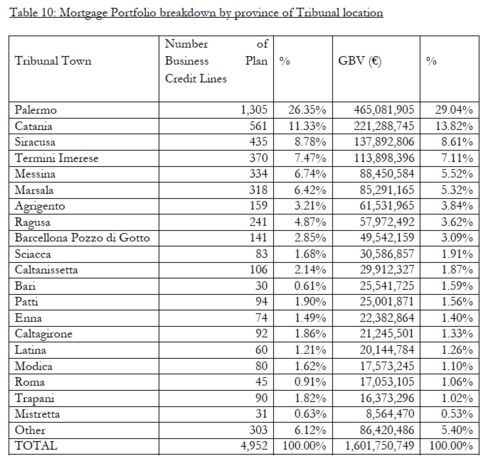
The Island bonds are backed by two portfolios of NPLs originated by a Sicilian bank that's now a subsidiary of UniCredit SpA. Just under half of the loans originated in the 1990s and they include residential mortgages as well as loans financing hotels and industrial buildings.

Source: Island Refinancing Prospectus

Unlike other asset-backed securities where interest and principal are paid through cash flows from mortgage or auto credit borrowers, investors in NPL securitizations depend on getting money back from soured loans — typically through the courts.
And that's where the problem lies. A court may auction the loan collateral and use the proceeds to pay the bonds, but that is a slow process.
Italy is almost as well known these days for its sluggish and cumbersome insolvency procedures as it is for the Leaning Tower of Pisa or the AC Milan soccer club. Italian bankruptcy proceedings last an average of 7.8 years, compared to an average of just overtwo years for the rest of Europe.

Efforts are currently being made to speed up the process, with Prime Minister Matteo Renzi saying recent reforms to insolvency laws will shorten recovery times on NPL collateral to as little as six months. 

Still, the thus-far glacial pace of cash collections from NPLs has resulted in multiple credit ratings downgrades for the Island Refinancing deal, which will expire in 2025.  
The most senior-ranking notes in the securitization — asset-backed bonds are divided into slices of differing risk and returns — were downgraded from an initial AAA grade to AA before being redeemed last year. The notes next in line to be paid were originally ranked A by Fitch Ratings and have since been downgraded to BB.
Fitch last cut its ratings on the notes a year ago when it said the rate of collections had worsened and there was such uncertainty around when funds tied up in Italian courts would be released that it couldn't assume the full amount would be available to pay off the bonds at maturity in 2025. 
Last week the ratings company affirmed its previous ratings and said it expects slow collections will result in the default of the 60 million-euro ($66.4 million) class C notes and the write-down of the 32 million-euro class D notes with zero recovery forecast.
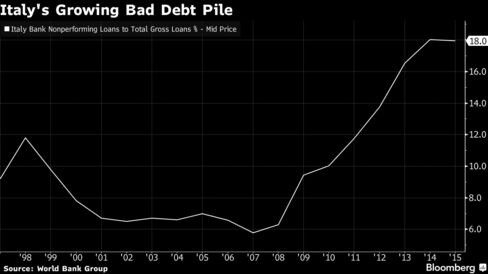
The pain felt by Island bondholders could be a foretaste of broader investor discomfort as Italy works to rescue a banking system burdened with 360 billion-euros of loans past due.

Source: Bloomberg

Securitization of NPLs — the process of taking bad loans from banks' balance sheets and selling them to investors — is a key plank in proposed efforts to help Italian lenders. Some banks can obtain state guarantees on senior-ranking notes under the so-called GACS initiative, while the Atlante rescue fund could be used to acquire junior portions of the debt. 
Island is not the only troubled Italian NPL transaction — meet Venus Finance.
The deal is a 2006 securitization of two portfolios of soured loans originated by Intesa Sanpaolo SpA with collateral spread across the country. Like the Island deal, it struggled with timely cash collections and the notes were downgraded multiple times.
Fitch warned last year that with so little cash coming in it was unlikely further principal repayments would be made before the bonds' maturity date in 2019. As if that wasn't bad enough for noteholders, the deal is being unwound and the collateral backing the securitization is being sold after an event of default of the underlying loans occurred when the so-called servicer agreements expired in December — they should have been extended to match the 2019 maturity.
As a result the senior-ranking class A notes in the Venus deal will suffer a significant write-down, while classes B to E will be written off entirely, Fitch said.
Last, but not least, we have Ares Finance 2 — a securitization of NPLs originated by Banca Nazionale del Lavoro SpA, a unit of BNP Paribas SA.  
The notes were issued in 2001 and scheduled to mature in 2011, yet in order to allow for more collections to be received the legal maturity was extended to July 2015. And even an extra four years proved not enough to save investors from pain — the 65 million-euro class D notes suffered losses totaling 17.3 million euros.
Italy's elaborate architecture and ancient monuments are an attraction for millions of tourists every year. It's less clear that the country's convoluted court system or byzantine history of NPL securitizations will prove as enticing for investors.

Monday, July 18, 2016

BBC News - Brexit 'will be horrible for UK economy' - fund manager


House buildingImage House prices may fall in the wake of the Brexit vote

The vote to leave the European Union will have a "horrible" impact on the UK economy, which could "judder to a halt", a leading fund manager has said.
Richard Buxton, chief executive of Old Mutual Global Investors (OMGI), described Brexit as "really bad news".
He told the Guardian he feared the move could lead to a recession.
Financial markets would remain volatile while the government negotiated an exit deal with the EU, Mr Buxton added.
OMGI has managed funds worth £26bn for both institutional and individual investors.
Speaking to the newspaper, Mr Buxton said the stock market had priced in a "pretty significant recession" for the UK given the slide in share prices of companies such as house-builders and banks.
Shares in two of the UK's biggest house-builders, Barratt Developments and Persimmon, have fallen almost 30% and 25% respectively since 24 June - the day the referendum result was announced.
"I think the economy is going to judder to a halt [or] have a mild recession, but I don't think it is going to be as severe as some of these shares are pricing in... The real economy is only going to gradually emerge over the next three to six months," Mr Buxton said.
House prices are expected to fall across the UK in the next three months, a survey by the Royal Institution of Chartered Surveyors has found.
The new chancellor, Philip Hammond, has said the Brexit vote has "rattled" financial markets and that the UK economy will face challenges following the "shock" of the referendum outcome.

Duty cuts

Mr Hammond was facing "one of the most unusual economic environments I have known in my 30-year investment career", Mr Buxton said.
He predicted the UK government would take steps such as cutting stamp duty on house purchases and fuel duty in the Autumn Statement to help compensate for the dramatic slide in the pound.
Sterling was trading as high as $1.50 on the day of the EU referendum, but collapsed to as low as $1.28 in the wake of the leave vote.
The currency is now worth just under $1.32, but several big banks predict the pound to fall to $1.25 or lower given the expectations of interest rate cuts and slowing economic growth.
Mr Buxton said some OMGI clients had asked for their money back, but one big foreign client had increased its investments on the belief that the slide in sterling and falling share prices meant there were bargains to be had.
However, many Old Mutual clients were still "slightly stunned" by the Brexit vote and were reluctant to take any action, he said.
"That will fade over time, but it's how can we get out to people and say 'look, we do still think there are some amazing investment opportunities here'," Mr Buxton said. "Our mood here is we're glass half full people."

Friday, July 15, 2016

Reuters News - Federal Reserve policymakers signal no rush to raise U.S. rates

Three Federal Reserve policymakers on Thursday expressed the view that there was no hurry to raise U.S. interest rates in the wake of the UK decision to leave the European Union, despite signs that the U.S. economy is near full employment.
Ahead of the next Fed policy meeting on July 26-27, a core group are now happy to keep interest rates unchanged, potentially for months, whereas just last month, most Fed officials signaled they expected to raise rates at least twice this year.
St. Louis Fed President James Bullard, speaking with reporters in St. Louis on Thursday, repeated his position that only a single rate rise is needed for the next couple of years unless some unexpected shock moves the economy to a better or worse state.
"In the aftermath of Brexit people want to wait and see and I'm happy to go with that for now," said Bullard, a voting member of the U.S. central bank's rate-setting committee. "There’s really no rush."
Dallas Fed President Robert Kaplan, also in St. Louis, renewed his call for a "patient, gradual" approach to raising rates.

And earlier on Thursday Atlanta Fed President Dennis Lockhart, at the Global Interdependence Center's Rocky Mountain Economic Summit, said that he wants to be "cautious and patient."
BREXIT VOTE IMPACT UNCERTAIN
Britain's vote on June 23 to exit the European Union sent investors scrambling for safe assets and cast a pall over the world economic growth outlook. Policymakers say it may take years to understand the fallout from Brexit.
Despite U.S. unemployment running at only 4.9 percent, policymakers are also worried about too-low U.S. inflation.
Traders are now betting the Fed will not raise the federal funds rate, currently targeted at 0.25 percent to 0.5 percent, until June of 2017 at the earliest.
Still, not everyone at the Fed has given up on the idea of raising rates.
Kansas City Fed President Esther George on Thursday said she will keep an eye on whether the recent market volatility and flight to safe assets by global investors could hit the U.S. economy but she signaled no retreat from her view, laid out earlier this week, that rates are too low for the strength of the economy.
And despite his dovish comments, Kaplan on Thursday said he worries low rates for too long can create distortions, and said it is "very important" to make the effort to normalize rates.
And even Lockhart, a non-voter this year at the Fed, on Thursday said it was possible the Fed could raise rates once, or even twice, this year, if data allowed it.
(Reporting by Ann Saphir; Editing by Diane Craft)
ST. LOUIS 

Thursday, July 14, 2016

BBC News - UK interest rates held at 0.5%

Pound signsImage copyright
The Bank of England has held the UK's main interest rate at 0.5% despite speculation that it would cut rates.
The Monetary Policy Committee (MPC) voted 8-1 to leave rates unchanged, but minutes of the meeting showed most members expect the Bank will take some action next month.
Sterling rose as high as $1.3480 following the decision before falling back to $1.3312.
Financial markets had priced in an 80% chance of the Bank cutting rates.
The Bank said: "Most members of the committee expect monetary policy to be loosened in August.
"The precise size and nature of any stimulatory measures will be determined during the August forecast and Inflation Report round."
The only member of the MPC to vote for a rate cut this month was Jan Vlieghe. He was a senior economist at Brevan Howard Asset Management before joining the committee last September.
Interest rates have remained on hold since the Bank cut its key rate to the record low of 0.5% in March 2009.

Analysis: Kamal Ahmed, BBC economics editor

The MPC is dealing with two competing forces. First, a slowdown in economic growth following the referendum vote, which many economists believe could tip the economy into recession.
Second, a possible increase in inflation sparked by the fall in the value of sterling. At the moment, the data on the former is limited.

The Bank said that some businesses were starting to delay investment projects and postpone recruitment decisions, while a "significant weakening" in activity in the housing market was expected.
Figures released earlier on Thursday showed interest among UK homebuyers fell to its lowest level since mid-2008.
"Taken together, these indicators suggest economic activity is likely to weaken in the near term," the Bank said.
It also said it expected "sizeable falls" in commercial real estate prices in the short term.
However, the MPC raised its expectation for economic growth in the three months to June to 0.5% from a previous forecast of 0.3%.

Rock bottom

Aberdeen Asset Management economist Paul Diggle said the Bank had decided that patience was a virtue.
"The next meeting is only three weeks away, and by then Carney and his colleagues will have a few extra post-referendum data points to digest, as well as a new set of forecasts," he said.
"The market should get its way then, with an interest rate cut likely and renewed quantitative easing possible."
Ben Brettell, senior economist at Hargreaves Lansdown, said: "It looks almost certain that looser policy will be necessary at some stage to counteract the economic uncertainty posed by the Brexit vote... Rates could conceivably remain at rock bottom for the next five to 10 years."
Philip HammondImage copyright
Image captionNew Chancellor Philip Hammond met Bank of England Governor Mark Carney on Thursday
However, Angus Armstrong, director of macroeconomics at the National Institute of Economic and Social Research, was more critical: "The lack of clear direction is more likely to add to economic uncertainty and therefore be detrimental to demand and the economy."
Returns on UK government bond yields rose sharply, with the 10-year yield rising about four basis points to 0.815% after the decision, before easing back to 0.8%.
Bank governor Mark Carney met the new Chancellor, Philip Hammond, on Thursday.
Earlier, Mr Hammond told the BBC he thought Mr Carney was doing an "excellent job".

Wednesday, July 13, 2016

Bloomberg News - ‘Brexit Means Brexit’ Doesn’t Apply to Scotland, Says Sturgeon

Scotland’s First Minister Nicola Sturgeon challenged Theresa May over her assertion that the new British government must prepare to leave the European Union.
Sturgeon, speaking in London on Wednesday, said that she would be seeking talks with the incoming prime minister within the next couple of days, and she would make the case that Scottish interests must be represented. Whereas the U.K. as a whole voted on June 23 to quit the EU, every district of Scotland voted to stay in the bloc.
“That mandate to say ‘Brexit means Brexit’ does not apply to Scotland because Scotland voted differently in this referendum,” Sturgeon told reporters. “As first minister of Scotland, just as Theresa May has a mandate, I too have a mandate and that mandate is to respect the wishes of the people in Scotland and now to find a way to keep Scotland in the European Union.”
May, the Conservative Party leader who is due to take over from David Cameron as prime minister later on Wednesday, has said she’ll appoint a Brexit czar to oversee the process of leaving the EU. Sturgeon, who met with Bank of England Governor Mark Carney earlier on Wednesday, said that she would be seeking a commitment from May that the Scottish government has “a very direct, full role in the process.”

‘Uncertain’ Period

“Our involvement in that process is not simply to prepare for an exit Scotland didn’t vote for,” said Sturgeon, who leads the pro-independence Scottish National Party.
“The U.K. is heading into a very uncertain and challenging and potentially unstable period,” she said. “It may be that the way for Scotland to chart our own way is through independence and that will be a very different debate.”
She said there are various arrangements under which parts of the British Isles are in the EU and others, such as the Isle of Man, are not. As a result, an outcome where Scotland remains in the EU “is possible,” she said.
“The uncertainty that the British economy now faces is severe and the impact of the referendum vote on the British economy is likely to be severe,” Sturgeon said. It’s “not just up to the Bank of England” to deal with the fallout. If Scotland concludes that independence is the best way forward, once the U.K. government triggers Article 50 “we will have a referendum within that two year process.”