Image copyrightImage captionECB president Mario Draghi has left interest rates alone
The European Central Bank has kept its main interest rate on hold at zero for another month.
The eurozone central bank's 25-member governing council left its benchmark borrowing rate at zero.
The rate on deposits from commercial banks was also unchanged at minus 0.4%.
The ECB decided against extending the duration of its two-year bond-buying stimulus scheme under which it has been making purchases of €80bn a month.
The central bank faces stubbornly low annual inflation of just 0.2% despite pumping €1 trillion in newly printed money into the banking system through bond purchases since March 2015.
Mario Draghi, president of the ECB, said he expected inflation rates to remain low for the next few months, adding: "We are monitoring developments in inflation expectations very closely and stand ready to act."
He said inflation would take a little longer than previously forecast to get to a level just below 2%, "but not much longer".
'Nervous'
The Bank anticipates annual inflation at 0.2% in 2016, 1.2% in 2017 and 1.6% in 2018, which it said remained broadly unchanged from previous projections.
Mr Draghi revealed that the governing council did not discuss extending its stimulus scheme, but analysts suggested the Bank would have to act sooner rather than later to support the eurozone.
Jennifer McKeown, senior European economist at Capital Economics, said it "will need to announce further policy stimulus before long".
Nick Kounis, head of macro and financial markets research at ABN Amro, said: "If the ECB waits too long, markets could get nervous."
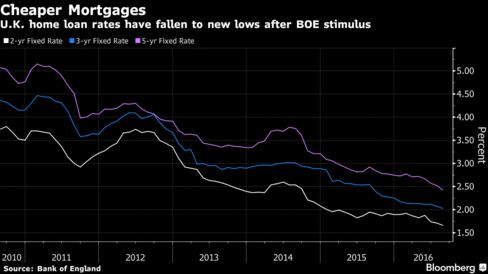
U.K. mortgage rates fell to records in August, a sign the Bank of England’s stimulus measures are reaching the economy.
The average rate on a home loan fixed for two years with a 25 percent deposit declined to 1.66 percent from 1.71 percent in July, the central bank said in London on Wednesday. That’s the lowest since the BOE began collecting the data in 1995.
The figures provide evidence that the BOE’s decision to cut its key rate to 0.25 percent on Aug. 4 is being passed on by lenders, after some banks initially declined to confirm they were going to reduce mortgage rates. While BOE Governor Mark Carney said institutions had “no excuse” not to pass on the reduction to customers, banks are finding it harder to offset the impact of record-low interest rates as their margins are squeezed.
Carney is due to testify to lawmakers at 2:15 p.m. London time and will probably face questions about the effectiveness of the central bank’s plans, as well as the Monetary Policy Committee’s assertion that most of its members would support a further rate cut this year, if the economy evolves as they predict after the decision to leave the European Union.
“The drop in mortgage rates through to August remains at least as large and quick as normal,” Allan Monks, an economist at JPMorgan in London, wrote in a note. “To the extent that the transmission of lower rates is working normally, even though the policy rate is at such low levels, the BOE is likely to feel emboldened in using this option further – if warranted by the macro backdrop.”
The rate on a three-year mortgage fell to 2.03 percent from 2.07 percent. On a mortgage fixed for five years, the cost decreased to 2.42 percent from 2.52 percent, and on a similar 10-year loan it declined to 3.02 percent from 3.05 percent. The average standard variable rate, a lender’s default rate, dropped 22 basis points to 4.33 percent.
Bank of England Governor Mark Carney claims the chances of a UK recession have receded due to its actions.
He told a committee of MPs the Bank took "timely, comprehensive and concrete" action to "support, cushion and help the economy to adjust".
Last month's rate cut to an historic low of 0.25% helped support house prices and the wider economy, he said.
He added he is "absolutely serene" about the Bank's preparations for the impact from the Brexit vote.
Mr Carney was being questioned by MPs on the Treasury Select Committee about how the Bank handled the referendum outcome and its decision to cut interest rates to a record low.
'Sailed through'
The Bank was criticised by Brexit supporters for saying the economy would be hit from a vote to leave the EU.
But Mr Carney said the Bank's decisions had so far been "validated".
The "extraordinary preparations" made by the Bank "cushioned" the economy and will help the UK "make a success of Brexit", he told MPs on the Treasury Select Committee.
He said the Bank's actions were made in an effort "to help make the leaving of the EU a success as quickly as possible".
"This financial system, under the oversight of the Bank of England, sailed through what was a surprise to the vast majority of financial market participants," Mr Carney said.
'Absolutely comfortable'
MPs questioned whether the Bank was too aggressive in supporting the economy after the vote.
The UK's services, manufacturing and construction industries have all showed signs of recovery in August after taking a hit in July.
However, Mr Carney said he was "absolutely comfortable" with the Bank's decision to cut interest rates to 0.25% and pump billions of pounds into the economy.
He added that it is "welcome there is a rebound" in the economy.
Considerable improvement
Mr Carney said there has been quite a considerable improvement in mortgage borrowing costs "and we are seeing pass through of our actions".
When Labour MP Rachel Reeves raised concerns that the majority of lenders had yet to pass on the full cut in rates, Mr Carney said the Bank expected "virtually" all the rate cut to be passed on to borrowers in the next few months.
It calls on Theresa May's government to deal with the companies' concerns in a "responsible manner".
Downing Street received the report earlier this week, the BBC understands.
Japanese firms employ an estimated 140,000 workers in the UK, with Nomura bank, manufacturing giant Hitachi and carmakers Honda, Nissan and Toyota all having major bases in the country.
The letter warns: "Japanese businesses with their European headquarters in the UK may decide to transfer their head-office function to Continental Europe if EU laws cease to be applicable in the UK after its withdrawal."
'Open question'
In an interview with the BBC, Japan's ambassador to the UK, Koji Tsuruoka, said: "We have a very huge stake in making Brexit a success that will not damage or hurt the global economy."
He said it was an "open question" whether Japanese firms would pull out of the UK, but that "those decisions have not been made".
Japan's Prime Minister Shinzo Abe will discuss Brexit with Mrs May at the G20 Summit in China. "Unless you have international cooperation Brexit is not going to be an easy task," Mr Tsuruoka said.
Image copyrigImage captionJapan's Nissan produced more than 500,000 cars in the UK in 2015
Specific companies are not mentioned, but the document states that it was written in response to "a variety of requests from Japanese businesses operating in the UK and the EU".
The report was published on Friday, but received widespread coverage on Sunday when Mrs May arrived in China for the G20.
G20 trade talks
The Prime Minister is explaining to leaders from the world's 20 largest economies what Britain's decision to leave the European Union might entail.
Mrs May said she would use the summit to scope out trade deals so they could be signed quickly after the UK's exit from the EU.
Image copyrightImage ionTheresa May and the US President discussed Brexit at the G20 summit
President Barack Obama, however, stressed that the US would prioritise trade talks with the Asia-Pacific region and the EU.
'Early as possible'
The Japanese report "strongly requests" that the UK government will consider Japanese investment into the UK and "respond in a responsible manner to minimise any harmful effects on these businesses".
It urged that Britain and the EU set out the details of the Brexit process "as early as possible".
In particular, the document says Japanese firms would like to see the following agreed between Britain and the EU:
Maintenance of trade in goods with no burdens of customs duties and procedures
Unfettered investment
An environment in which services and financial transactions across Europe can be provided and carried out smoothly
Access to workforces with the necessary skills
Harmonised regulations and standards
Ahead of the referendum, Japanese firms, including Hitachi and Nissan, and the country's Prime Minister Shinzo Abe warned investment could fall if the UK left the European Union.
Image copyrightJapanese Prime Minister Shinzo Abe made warnings about Brexit on a visit to the UK in May
'Sand in the engine'
Japanese car manufacturers account for more than 50% of the cars made in the UK.
The ministry's report came as something of a surprise to the UK car industry, even though it was consistent with its wish list from Brexit, according to BBC Business Editor Simon Jack.
The manufacturers want tariff-free access to the EU's single market as a starting point, as well as the freedom to move workers between plants, he said.
"All the car manufacturers have very integrated pan-EU supply chains and any interruption to that will be sand in the engine," he said.
However, Japanese car makers are not about to announce that a model destined for a UK plant will move elsewhere, he added.
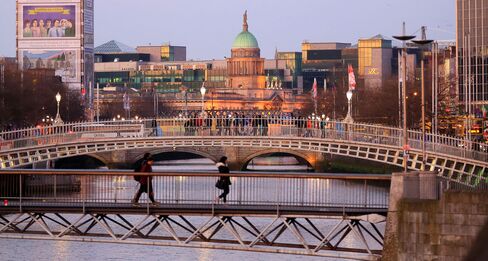
Irish authorities are seeking to hire experienced U.K. regulators before an anticipated influx of financial-services companies following Britain’s decision to exit the European Union, according to a person familiar with the matter.
Irish regulators and officials are tapping business and personal networks to identify potential hires who have Irish connections or may be open to moving to Dublin, said a second person, who didn’t want to be identified as the plans are not yet public. Among other roles, the nation’s central bank is seeking a banking risk analyst and enforcement lawyers.
Authorities are said to be keen on recruiting current and former staff at the Financial Conduct Authority, according to the person. Regulators may also seek staff from the U.K.’s Prudential Regulation Authority.
Dublin is one of the capitals fighting to attract banks that may move units from London after Brexit to retain the passporting rights which allow them to do business throughout the EU. While the regulatory frameworks in Ireland and the U.K. are broadly similar, Irish officials want to ensure they have enough expertise to cope with an influx of investment banks asking permission to set up shop. The central bank declined to comment.
IDA Ireland, the foreign investment agency, has already pitched to U.K. and international lenders including Standard Chartered Plc about relocating hundreds of traders and support staff in the event of a Brexit. A U.K. exit from the EU could push about 6 billion euros ($6.7 billion) of investment into Ireland, the nation’s debt office has estimated, adding Dublin would be an “obvious” choice for financial companies.
It was also a smaller rise than the average monthly increase of 204,000 seen during the previous 12 months.
Economists now think the chances of the US central bank raising interest rates this month have been reduced.
The official data for the country's "non-farm payrolls" shows that the number of people out of work was unchanged at 7.8 million in August.
The US economy has been expanding steadily since the end of the last recession in 2009.
Many US economists had expected a larger rise in the number of new jobs being created, more in line with the 190,000 jobs per month added during the previous three months.
But despite the apparent slowdown in August, the continued expansion of employment in the US still points to the possibility that the central bank, the Federal Reserve, could raise interest rates later in the year, most probably in December.
Last week Janet Yellen, the chairwoman of the Federal Reserve, said the country's economic growth and a stronger jobs market meant "the case for an increase in the federal funds rate has strengthened in recent months".
December rate rise?
Chris Williamson, chief economist at the financial data service Markit, said: "The data-dependent Fed will most likely see the payroll numbers as taking pressure off any immediate need to hike interest rates, significantly reducing the scope for further policy action in September."
"However, with survey data suggesting some of the recent slowdown in hiring and business activity is due to uncertainty ahead of the presidential election, a rate rise later in the year, most likely December, remains on the table providing the economic data flow picks up again in the fourth quarter."
This view was supported by Luke Bartholomew at Aberdeen Asset Management.
"This should cool speculation about a September hike," he said.
"December is once again shaping up to be the mostly likely date of the next [rate] hike.
Nearly two years after presidents Barack Obama and Raul Castro announced a thaw in relations, Cuba’s communist government is turning to foreign investors to boost renewable energy as it faces cutbacks in cheap oil imports from Venezuela.
The government formed by Fidel Castro in 1959 and led by his brother, Raul, is pitching large wind and solar projects and biomass plants that run on sugar cane to foreign companies at conferences like one opening Thursday in Havana. The goal: Bring billions of dollars into sectors that until recently were controlled by state-run entities, and lift the amount of electricity produced by renewables to 24 percent by 2030 from 4 percent today.
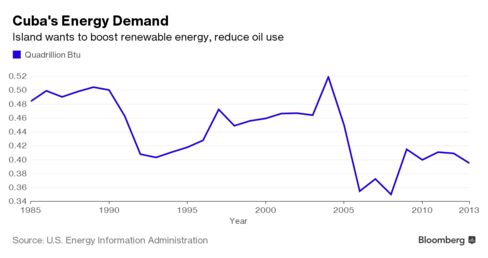
The shift is less about ideology than supply and demand. The island nation relies heavily on oil-burning power plants that run on subsidized imports from Venezuela. With an economic crisis in that country threatening those supplies, Cuban officials fear a return to the turbulence of the early 1990s when funding from the former Soviet Union began drying up.
“It’s unprecedented for the government to be making an open presentation of this scale to international companies like this,” said Andrew MacDonald, director and vice president of Havana Energy, which is building biomass plants at sugar refineries. “This is a top priority for the Cuban government.”
A decade-old initiative by Fidel Castro to improve energy efficiency and introduce renewable power has failed to reduce Cuba’s reliance on oil, natural gas and diesel fuel, which supply 95 percent of its electricity, according to a 2015 annual report from the government’s National Office of Statistics and Information.
A new goal to add 2.1 gigawatts of capacity from biomass plants, wind farms, solar projects and hydroelectric generators will cost about $3.5 billion, according to government estimates. To get there, Cuba recently said it will allow foreign companies in some circumstances to own projects rather than requiring them to form joint ventures with state-owned companies. The Obama administration has also carved out exemptions from a U.S. economic embargo to allow companies to export products and technology to the island.
“The opportunities there are huge,” said Bernardo Fernandez, Mexico director of operations for Hive Energy, a U.K. company that has agreed to build a 50-megawatt solar project in the Mariel Free Zone outside of Havana. “They don’t really need to attract anyone. They just need to clear the path for companies.”
Banking Challenge
Banking in the country remains a challenge. In June, Florida-based Stonegate Bank became the first U.S. bank to issue a credit card that can be used in Cuba.
“They have ambitious goals with respect to renewable energy and its going to involve heavy investment," said Lee Ann Evans, senior policy adviser at Washington-based Engage Cuba, a coalition of companies and organizations pushing to lift economic and travel restrictions. “It’s not as simple as replacing light bulbs.”
And, while Cuba also needs to reassure international investors, change is in the air. JetBlue flight 387 from Fort Lauderdale touched down in Santa Clara Wednesday, the first scheduled, commercial flight from the U.S. in more than half a century. Passengers included U.S. Secretary of Transportation Anthony Foxx, according to Cuban officials.
Oil Bounty
"Cuba needs to develop a clear plan for energy development that can serve as a guideline for investors," Ramon Fiestas Hummler, chairman of the Latin America Committee at the Global Wind Energy Council, said in an interview in Rio de Janeiro. "The country is changing its policies, but confidence still doesn’t exist."
Meanwhile Cuba, one of the largest beneficiaries of the late Venezuelan President Hugo Chavez’s policy of sharing his country’s oil bounty, may be facing a reckoning. Under an agreement with Venezuela, Cuba receives more than 90,000 barrels of oil a day, which it partially pays for by sending doctors, teachers, and military advisers to Venezuela.
In a July address to the Communist party, Raul Castro said Cuba has seen "a contraction in fuel shipments" from Venezuela, without detailing the size of the cut. It had racked up about $15 billion in debt as of the end of 2015, according to a February report by Bank of America Merrill Lynch.
The circumstances have rekindled memories of Cuba’s so called Special Period, a euphemism for the economic crisis that began in 1989 with the breakup of the Soviet Union characterized primarily by oil shortages. The crisis led to the introduction of sustainable agriculture, the decreased use of automobiles and other industry overhauls as people were forced to live without many goods they had become used to.
"Cuba wants to open its frontiers," said Jean-Claude Fernand Robert, general manager for renewables in Latin America for General Electric Co. "The country still has a lot of work to do."