Tuesday, October 18, 2016

BBC News - Why is globalisation under attack?


Protesters hold a giant snake with dollar notes in its mouth to demonstrate against the TTIP and CETA free trade agreements on Sept 17, 2016 in Berlin, Germany. The EU is currently negotiating with the US over TTIP and Canada over CETAImage copyright
Image captionA model of a giant snake is held aloft by protesters at an anti-globalisation rally in Berlin

Free trade and globalisation seem to be under siege from a broad and loud range of opponents.
For decades there has been a strong consensus that globalisation brought more jobs, higher wages and lower prices - not just for richer countries but also for developing and poorer nations.
But many people, including politicians, are now voicing their anger as they see jobs being taken by machines, old industries disappearing and waves of migration disturbing the established order.
You don't have to look far to see the effect of those concerns in recent events.
The Brexit referendum was dominated by concerns over immigration, the rise of Donald Trump has brought back the rhetoric of protectionismin the US and there have been mass protests in Europe over prospective international trade deals.
What is behind this backlash and what can be done to address this crisis of globalisation?

'Free trade is stupid trade'

The US presidential election has felt like the epicentre of the rising tide of disquiet against free trade and globalisation.
Donald Trump has accused China of wanting to "starve" the US population by manipulating their currency and "cheating" on international trade.
We talk about free trade. It's not free trade; it's stupid trade. China dumps everything that they have over here."
Donald Trump, US Republican presidential candidate
Getty Images
He has said he will impose massive tariffs on Chinese goods because it was economically "raping" the US.
Hillary Clinton has found herself surrounded by political challengers questioning the benefits of international trade and globalisation.
Bernie Sanders, Clinton's opponent in the race for the Democratic nomination, defined his campaign by arguing that globalisation had hollowed out the US middle class.
Clinton's response has been to tack towards the concerns expressed by Sanders and Trump, reneging on her previous support of TTIP (the Transatlantic Trade and Investment Partnership) - the trade agreement between the US and Europe.

US manufacturing's decline

Arguments over the decline of manufacturing in the United States have powered a lot of the heat of the 2016 US electoral cycle.
The sense of grievance is clear - the manufacturing sector in the US has seen six million jobs disappear between 1999 and 2011, according to the Bureau of Labor Statistics.

Workers at on a Chrysler assembly line at the Warren Truck Assembly Plant Sept 25, 2014 in Warren, MichiganImage copyrigh
The decline in manufacturing jobs has become an issue in the US presidential election campaign

Studies have shown that the decline in the US has been mirrored by gains in China.
Chinese imports explain 44% of the decline in employment in manufacturing in the US between 1990 and 2007, according to a report by the Institute for the Study of Labor in Bonn.
Part of that decline has been down to the outsourcing of jobs to other countries but automation and more efficient processes have also taken their toll.
"All countries end up with losers from technological development - whether it is telephone operators or bank tellers," says Gary Hufbauer, a trade expert from the Peterson Institute for International Economics.
"The problem in the US is that we don't do much to help those people who lose out through social security support or job retraining," says Mr Hufbauer.

Police keep watch as demonstrators demanding an increase in the minimum wage to $15-dollars-per-hour march in the streets on April 14, 2016 in ChicagoImage copyrigh
Image captionMany in the US, Europe and Japan have seen no increase in their household income in the past 10 years

Technological and economic change has hit specific geographical areas that have then found it hard to develop new industries and create jobs.
The anger that flows from this has found a home in the protectionist rhetoric of politicians like Donald Trump.
"There has been no growth in household income during the last decade in Europe, the US and Japan. People are not happy and if you have to blame someone, it is easy to blame foreigners,"' says Mr Hufbauer.

Flat-lining world trade

The rise of political opposition to globalisation has coincided with - and contributed to - a period of declining world trade growth since the financial crisis of 2008.

Global trade graph

Between 1986 and 2008 world trade grew at an average of 6.5%, according to the World Trade Organization.
Between 2012 and 2015 that rate has slowed to an average of 3.2% and is predicted to expand by just 1.7% in 2016.
That slowdown would make it the longest period of relative trade stagnation since the Second World War.
Since the financial crisis the slowing of the Chinese economy and political and economic stagnation in the eurozone have contributed to this flat-lining of world trade.
At the same time there has been a steady rise in the application of protectionist measures around the world.

G20 protectionist policies chart

In an attempt to protect companies and industries at home, politicians have turned to tariffs and restrictions on imports from other countries.
"Governments worldwide have almost doubled their resort to trade distortions in the last two years," says Prof Simon Evenett, a trade expert at St Gallen University.
"The recent surge in 'beggar-thy-neighbour' activity predates Trump and Brexit, suggesting that populist pressures are likely to exacerbate protectionism," he says.

Trade restrictions bar chart

Economists warn that while protectionism may seem appealing to politicians assailed by angry workers, they in fact only end up raising prices for consumers.
There was an outcry in 2012 when cheap Chinese tyres flooded into the US market, putting the viability of the domestic producers in question.
President Obama responded with punitive tariffs to get China "to play by the rules".
The protectionist measures were well received in the US, but a study by the Peterson Institute established that the tariffs meant US consumers paid $1.1bn more for their tyres in 2011.
Each job that was saved effectively cost $900,000 with very little of that reaching the pockets of the workers.

Free trade fightback?

With the economic and social benefits of free trade coming increasingly under attack, proponents of globalisation have tried to launch a counterattack.
"For six decades after the Second World War, unprecedented growth of trade in goods and services and spectacular expansion of foreign direct investment were powerful drivers of the best half-century in human history," says Gary Hufbauer.

Taking on inequality

1.1 billion
people have escaped extreme poverty since 1990
  • 100 million people were lifted out of extreme poverty between 2012 and 2013. That's the equivalent of:
  • 250,000 people a day
  • 200 people a minute
Thinkstock
The World Bank, World Trade Organization and International Monetary Fund have made the issue a central part of their meetings in Washington DC this week.
To emphasise the point, the World Bank has brought out a study of developing countries that shows that average incomes for people living in the bottom 40% increased between 2008 and 2013, despite the impact of the financial crisis.
There also seems to be a realisation amongst politicians that income inequality and economic stagnation, whatever the cause, is an issue that must be addressed.
"I think there is a realisation in rich countries and among rich elites that there are problems with globalisation," says Branko Milanovic, an economist whose work on income inequality has driven much of the debate.
"They realise that for their own political self-preservation they have to tackle them."
The problems that flow from this discontent may have been diagnosed but the solutions are not obvious, nor easy to implement.

Trucks transport containers at a port in Qingdao, ChinaImage copyrigh
Image captionCritics argue that the benefits of globalisation have been shared by only a few in many societies

"Most of the benefits of globalisation have been enjoyed by a relatively small group within each country," says Andrew Lang from the London School of Economics.
"The question is not whether there are benefits to globalisation - there clearly are. But the question is about who is enjoying those benefits," says Prof Lang.
Part of the anger might dissipate if economic growth was to stop its stubborn flat-lining trajectory, lifting incomes around the world.
"To help solve these problems you need to get the world economy revved up. Governments need to commit to fiscal stimulus to get their economies going again," says Gary Hufbauer.
Branko Milanovic points to the success of previous politicians in turning round seemingly intractably weak economies.
"It's not impossible for politicians to address these issues," he says.
"Thatcher and Reagan managed to effect change in relatively short periods of time - a presidential term of four years should be enough to start making a difference."

Criticism from right and left

The opponents of globalisation and world trade feel their movement is making inroads.
The TTIP negotiations seem to have ground to a halt, the US election has thrown the future of the Trans-Pacific Partnership (TPP) deal into question and the number of new free trade agreements has fallen.

Global free trade bar chart

There is a broad chorus of disquiet emphasising opposition to the old consensus of free trade.
With voices from the political right and left raising questions about the benefits of globalisation, there is a broad base of discontent
Globalisation may be under assault from all sides but its proponents insist its revival is the only way of alleviating the discontent that now fuels its unpopularity.

Find out more


Unfair Trade logo

The BBC is reporting from around the world on the impact of globalisation on people's lives and on the growing movement against free trade, with special coverage on TV, radio and online.

Monday, October 17, 2016

Bloomberg News - Swiss Immigration Fig Leaf Won’t Sate Hard-Brexit Believers

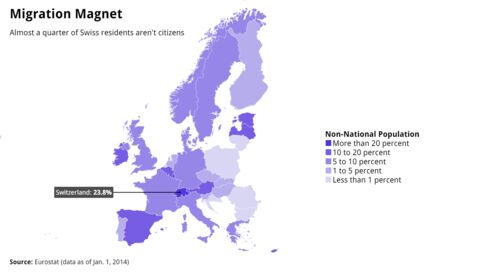
Switzerland is offering a stark lesson for the British politicians tasked with negotiating Brexit: the nation they admired for guarding its sovereignty within Europe has all but thrown in the towel.
More than two years after the Swiss electorate voted to limit immigration by European Union nationals, lawmakers last month sidestepped implementing curbs that threatened an economically vital set of treaties with Brussels. Instead, they backed a “light” proposal that merely stipulates job vacancies are advertised first in Swiss unemployment centers.
“It’s a complete fig leaf, as it won’t make any difference to the flow of EU citizens into the Swiss economy,” said Jacob Funk Kirkegaard, senior fellow at the Washington-based Peterson Institute for International Economics. “It does what it’s supposed to do, which is not to have any changes.”
While Kirkegaard expects the EU to respond favorably to Swiss realpolitik, even the diluted plan for implementing the 2014 plebiscite isn’t a done deal as Brussels and Bern haggle over the fine print. When European Commission President Jean-Claude Juncker meets Swiss President Johann Schneider-Ammann in Brussels on Oct. 28, the EU will be keen to avoid any concessions that could set a precedent for upcoming Brexit negotiations with the U.K.
If that solution falls apart, Switzerland also has a potential Plan B to ensure the economy doesn’t suffer a projected 32 billion-franc ($32.4 billion) a year shock from the cancellation of treaties covering everything from aviation to agriculture. The government will respond by the end of this month to recommend if voters should back or reject the so-called Rasa initiative that would annul the previous referendum on immigration.
The preference among key U.K. negotiators -- Brexit Secretary David Davis, Foreign Secretary Boris Johnson and trade chief Liam Fox -- for a so-called hard Brexit that prioritizes immigration controls over access to the 28-nation bloc’s single market will make it difficult for the U.K. to match Swiss pragmatism, according to Rene Schwok, director of the Global Studies Institute at the University of Geneva.
“They’re not well known for their diplomacy, but perhaps they can adapt,” said Schwok. “The lesson is that Switzerland gave up. It’s been the history of Switzerland for centuries; you make concessions to stronger neighbors.”
U.K. Prime Minister Theresa May, who is fond of holidaying in the Swiss Alps, has said Switzerland won’t be the U.K.’s post-Brexit model.
“May clearly defines Brexit as having more controls on immigration and the Swiss proposal is the opposite,” said Kirkegaard. “If she doesn’t deliver a hard Brexit, then she will be assailed as a sellout.”

Referendum Dilemma

When Johnson called for the creation of “Britzerland” as an outer tier of the EU four years ago, he was admiring the deal negotiated in the 1990s under which Switzerland gained market access while retaining a degree of sovereignty. Crucially, it also allowed EU citizens to take up jobs and reside in the country without a special permit.
That looked like it would change when the anti-immigration Swiss People’s Party, or SVP, sponsored a measure to impose quotas on EU nationals. It passed by fewer than 20,000 votes in February 2014.
With formal EU-Swiss talks failing to produce a settlement, lawmakers sought to end the impasse by voting on Sept. 21 to implement the referendum without imposing immigration quotas or national preference.
While the SVP lambasted the proposal, the partial implementation of plebiscites has a long history in Switzerland, according to Georg Lutz, a professor of political science at the University of Lausanne. One example was the Alpine Initiative to curb heavy truck traffic in the Alps.

Unilateral Solution

“The lawmakers found a unilateral solution because negotiating a deal with the EU would have been impossible,” said Lutz. “For the U.K. renegotiating an exit, it’s much harder to find a win-win situation because there isn’t much to gain, but a lot to lose.”
To be sure, the proposal faces EU scrutiny that could thwart it. Mina Andreeva, a spokeswoman for the bloc’s executive arm in Brussels, said any solution must be implemented “in a way that respects obligations under the free-movement agreement.” Tages-Anzeiger reported last week the EU had concerns about a passage in the proposal that would allow Switzerland to take additional steps to control immigration if the stream of newcomers increases.
Still, Juncker talked of a “Swiss-specific” solution when he visited Zurich last month and the Tages-Anzeiger report said EU ambassadors in Brussels don’t object “in principle” to the implementation plan.
Andreas Auer, a former law professor at the universities of Zurich and Geneva, isn’t taking any chances. He has helped collect the requisite 100,000 signatures for another vote to annul the immigration referendum.
“We have direct democracy and people have the right to review their own decisions at any time,” said Auer, noting that Swiss universities have already been locked out of EU research programs because of the immigration vote.
The U.K. could also have a second referendum if the government “makes a hash of Brexit” and the economy deteriorates, said the Peterson Institute’s Kirkegaard. The Swiss experience shows the EU is guided more by politics than economic considerations, he said.
“There are often no overlaps between what national politics wants and allows and what the EU wants and allows,” according to Anand Menon, a professor of European Politics and Foreign Affairs at King’s College London. “There won’t be a deal to have your cake and eat it.”

Friday, October 14, 2016

BBC News - Bank governor Mark Carney says inflation will rise

Mark CarneyImage copyright
Mark Carney has said that inflation will rise on products such as food because of the fall in the value of the pound.
The governor of the Bank of England made clear that sterling's fall "helps the economy adjust".
However, he said it was "going to get difficult [for those on the lowest incomes] as we move from no inflation to some inflation".
He said that food would be the first to experience price rises.
More broadly, Mr Carney said goods and services would see higher inflation over the next "few years".
"It will show up," he said.
Mr Carney, who was speaking at a public roundtable with charities and other third sector organisations in Nottingham, said it was not the Bank's job to target the value of sterling but that "we are not indifferent to it, it matters to the conduct of monetary policy".
He said the Bank had to "weigh increased inflation against supporting the economy" with low interest rates.
The pound recovered most of the days losses against the dollar following his comments.

Protecting jobs

Earlier, Mr Carney said that the Bank of England was willing to see an "overshoot" of its 2% inflation target if it meant supporting economic growth and protecting jobs.
Between 400,000 and 500,000 jobs could have been at risk if the Bank had not taken action after the referendum, he said.
"We are willing to tolerate a bit of an overshoot [on inflation] to avoid unnecessary unemployment. We moved interest rates down to support the economy."
The Bank cut interest rates and provided more monetary stimulus in August after the vote to leave the European Union.
Mr Carney said long-term economic prosperity could not be guaranteed by the Bank: "We can mess it up, we can't make it. We provide the foundations, not the end."

Inequality

With the fall in the value of sterling, some economists now predict that inflation will hit 3% by the end of next year as imports of products such as food and fuel become more expensive.
On the issue of inequality, Mr Carney said: "We care a lot about distribution. But we are not a political entity."
He said many people were still "scarred" by the financial crisis.
But he argued it was for the government to decide on policies to tackle issues such as globalisation, technological change and skills education.

Thursday, October 13, 2016

Reuters News - S&P, Dow touch three-month lows on weak China data


Traders work on the floor of the New York Stock Exchange (NYSE) shortly after the opening bell in New York, U.S., October 12, 2016.  REUTERS/Lucas Jackson
Traders work on the floor of the New York Stock Exchange (NYSE) shortly after the opening bell in New York, U.S., October 12, 2016.
By Yashaswini Swamynathan and Tanya Agrawal
The S&P 500 and the Dow Jones Industrial average touched three-month lows on Thursday, dragged down by weak Chinese economic data and a potential U.S. interest rate hike by the end of the year.
Data showed China's exports fell 10 percent in September, far worse than the markets had expected, while imports unexpectedly shrank, reviving concerns about the health of the world's second-largest economy.
The Fed on Wednesday released the minutes of its last rate-setting meeting that showed several policymakers felt a rate hike was warranted "relatively soon" if the U.S. economy continued to strengthen.
Losses were broad based, with ten of the 11 S&P sectors trading lower. The financial index fell the most in a month.
Berkshire Hathaway, Bank of America, Wells Fargo and JPMorgan were the biggest drags on the index, falling between 2.2 and 1.7 percent. JPMorgan, Citigroup and Wells Fargo are due to report quarterly results on Friday.
Traders are pricing in about a 70 percent chance for a December rate hike, data from the CME Group's FedWatch tool showed.
Prices of gold, a safe haven, ticked higher, while the dollar, which is near a seven-month high, fell 0.3 percent against a basket of major currencies.
"China's export numbers are putting pressure on the market while the Fed prepares to raise interest rates," said Robert Pavlik, chief market strategist at Boston Private Wealth.
"There are also concerns regarding Brexit and investors are waiting to see what banks report this quarter. It's like everything is happening at the same time."
The CBOE Volatility Index, a gauge of near-term investor anxiety, jumped as much as 13 percent and was near its one-month high.
At 10:56 a.m. ET (1456 GMT) the Dow Jones industrial average was down 166.96 points, or 0.92 percent, at 17,977.24, the Nasdaq Composite was down 54.00 points, or 1.03 percent, at 5,185.02.
The S&P 500 was down 19.2 points, or 0.9 percent, at 2,119.98.
The index had closed below the 2,140 mark on Thursday, confirming a break below its 100-day moving average, which had served as technical support over the past month.
Market valuations will be put to test during the earnings season, with profits of S&P 500 companies currently expected to fall 0.7 percent, according to Thomson Reuters data.
The benchmark S&P 500 index is trading at 17 times forward earnings, compared with its 10-year median of 14.7, according to StarMine data.
Utilities, perceived as safer equity assets, were the only gainers.
Deutsche Bank's Frankfurt-listed stock fell 3.4 percent after sources told Reuters that the bank was introducing a hiring freeze as it seeks to cut costs amid a deep strategic overhaul.
The bank's U.S. shares were down 3.2 percent.
Marriott Vacations plunged nearly 10.2 percent to $61.80 after reporting a sharp decline in quarterly revenue from Europe.
Declining issues outnumbered advancing ones on the NYSE by 2,276 to 599. On the Nasdaq, 1,943 issues fell and 626 advanced.
The S&P 500 index showed no new 52-week highs and six new lows, while the Nasdaq recorded 12 new highs and 64 new lows.

(Reporting by Yashaswini Swamynathan in Bengaluru; Editing by Anil D'Silva)

Wednesday, October 12, 2016

BBC News - Pound steadies after recent slump

Pound note coinsImage copyright
The pound has recovered some of its losses with analysts attributing the gains to the promise of a Commons debate on the Brexit process.
The pound is trading 0.8% higher from Tuesday's close at $1.2222, but down from its best levels for the day.
Sterling has been sliding since Mrs May announced on 2 October that the formal Brexit negotiation process would start by the end of March 2017.
Traders sold the pound on fears of the impact of leaving the single market.
However, MPs have been demanding to scrutinise the plan to leave the European Union before that date, and on Wednesday the government agreed there should be a "full and transparent debate".
But it added that the process should not "undermine" the government's negotiating position.
"After weeks of tough rhetoric pushing sterling into a trading environment closer to an emerging market currency, the government may aim to stabilise markets, with its rhetoric and suggestions now possibly shifting in tone," said Morgan Stanley's head of currency strategy, Hans Redeker.
"However, there is a fine line to walk as May's Conservative Party wants a clean split from Europe. In addition, giving in too much, even before Article 50 negotiations have started, shifts the negotiation advantage towards the EU. Hence, the pound's rebound should be limited and followed by a decline," he added.

Other analysts warned of further volatility ahead.
"It would appear that trying to find a floor for the pound is going to be difficult in the short term, simply due to the amount of political uncertainty being generated on both sides of the Channel, as both sides dance on the edge of the volcano, in laying out their negotiating positions, which for now appear a long way apart," said Michael Hewson, chief market analyst at CMC Markets.
Neil Wilson, markets analyst at ETX Capital said: "If traders think the mood is turning bullish for the pound, they're mistaken. The bears are still very much in control and this relief rally looks like a dead cat bounce. It could just be a short pause before sterling takes another leg lower towards $1.20."

Shares slide

The FTSE 100 share index has fallen back after a recent strong run, which has been partly helped by the weaker pound.
The fall in the pound has boosted the FTSE 100 as many of the companies in the index generate most of their revenues abroad.
A weaker pound means overseas revenues are worth more when they are converted back into sterling.
On Tuesday, the benchmark index hit an intraday high of 7,129.83, and on Monday the fell just short of registering a record close.
On Wednesday afternoon it was down 27.69 points at 7,043.19.

Analysis: Kamal Ahmed, BBC economics editor

Why does the fall of the pound matter?
On the upside, it matters for exporters which are boosted as their goods are far cheaper on foreign markets.
It matters for multinational companies like pharmaceutical firms which earn much of their income in dollars. It matters for the tourism industry in the UK, as foreign visitors flock here for bargains and good value holidays.
On the downside, it matters for tourists travelling abroad who will find everything they buy much more expensive.
It matters for the food and fuel this country imports as it becomes more expensive. It matters for inflation, as the rise in import costs feeds through to businesses and the High Street.
And remember, it does not need much of a rise in inflation to wipe out real income growth which at present is running at around 2%. If real incomes start falling, that is when the fall in sterling becomes a truly political issue.
Because the pound in your pocket will actually be worth less.