Thursday, March 9, 2017

Bloomberg News - Wind Power Blows Through Nuclear, Coal as Costs Drop at Sea

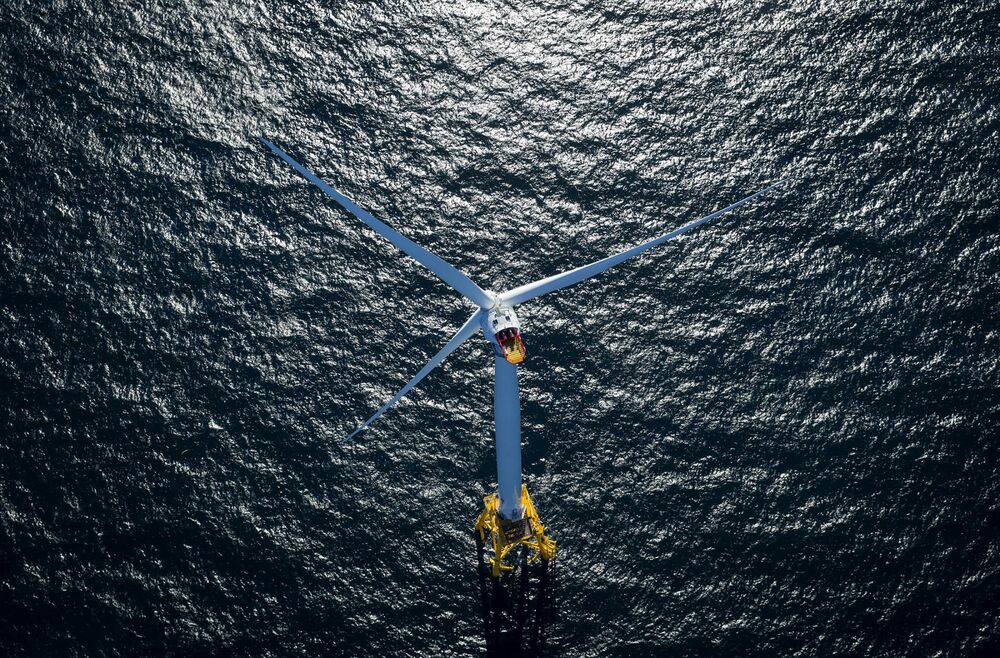
A wind turbine in the waters off Block Island, Rhode Island, U.S.
 Photographer: Eric Thayer/Bloomberg
Water and electric power plants don’t mix well naturally, unless you add some wind.
Water tends to corrode and short out circuits. So what’s happening in the the renewable energy industry, where developers are putting jumbo-jet sized wind turbines into stormy seas, is at the very least an engineering miracle. 
What might be even more miraculous to skeptics like those populating Donald Trump’s administration is that these multi-billion-dollar mega projects make increasing economic sense, even compared to new coal and nuclear power.
“If you have a sufficiently large site with the right wind speeds, then I do believe you can build offshore wind at least at the same price as new build coal in many places around the world including the U.S.,” said Henrik Poulsen, chief executive officer of Dong Energy A/S, the Danish utility that has pioneered the technology and has become the world’s biggest installer of windmills at sea.
Across Europe, the price of building an offshore wind farm has fallen 46 percent in the last five years -- 22 percent last year alone. Erecting turbines in the seabed now costs an average $126 for each megawatt-hour of capacity, according to Bloomberg New Energy Finance. That’s below the $155 a megawatt-hour price for new nuclear developments in Europe and closing in on the $88 price tag on new coal plants, the London-based researcher estimates.
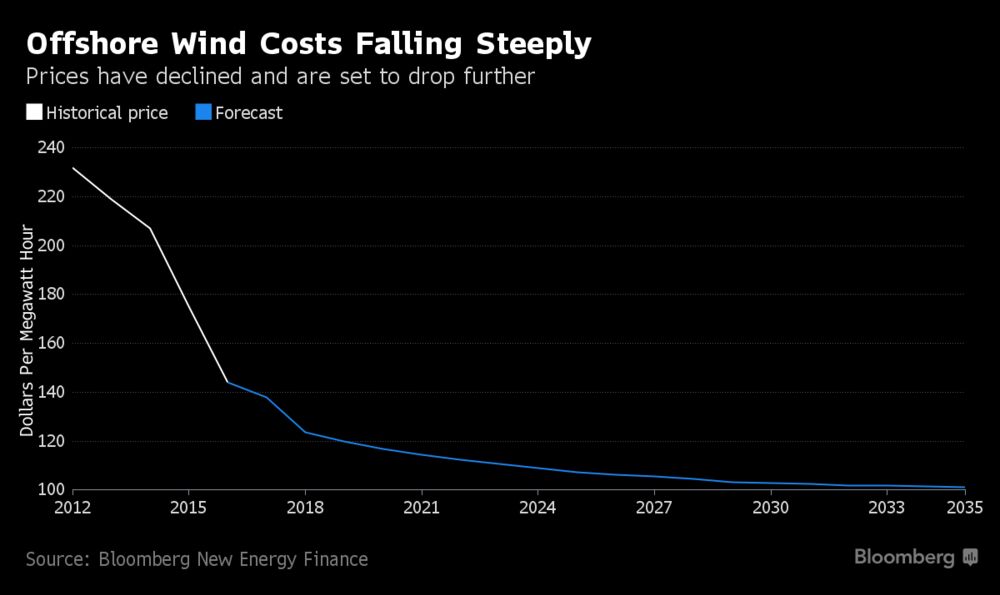
As nuclear power costs spiral, prompting a $6.3 billion writedown at reactor maker Toshiba Corp. and delays at Electricite de France SA’s plant in Flamanville, the investment needed to build offshore wind capacity is plummeting. 
In Denmark, where the government shoulders much of the development risk, Vattenfall AB last year agreed to supply power from turbines in the North Sea at 60 euros ($64) a megawatt-hour in 2020. Dutch and German auctions due this year provide “ample opportunity” to beat that record low price, says Gunnar Groebler, the utility’s head of wind.
The industry even is taking hold in the U.S., which for years shunned the technology as too costly for a place that historically enjoys lower power prices than Europe. 
A federal auction in December for rights to develop wind farms off the coast of Long Island resulted in a bidding war. Rhode Island has commissioned one plant, and developers are also considering work in Maryland, New Jersey and North Carolina. 
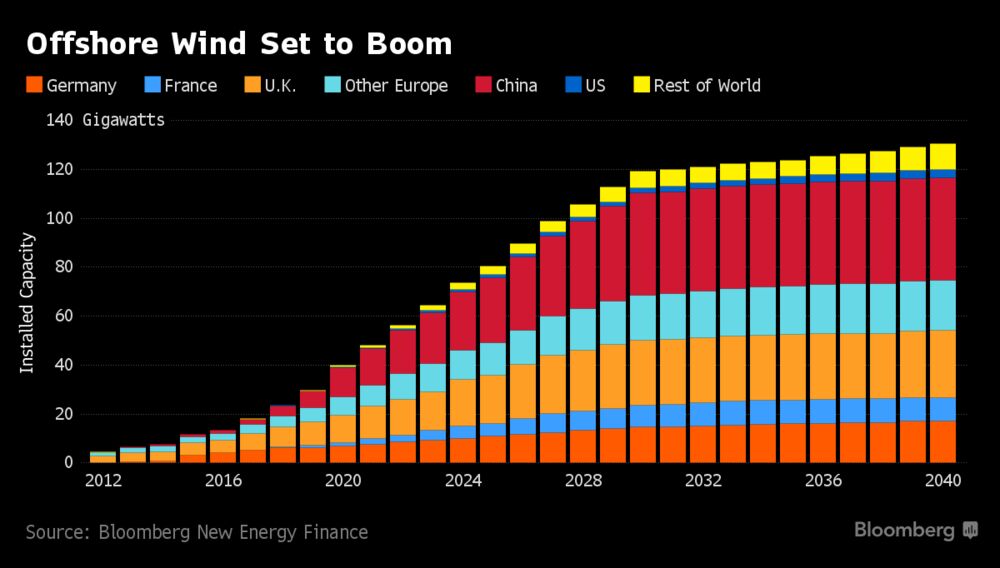
Although Trump said offshore wind was “monstrous” when it came into conflict with his golf course in Scotland, the U.S. government’s official goal for now is to install 86 gigawatts of turbines at sea by 2050. That’s six times the 14 gigawatts of capacity now in place worldwide, according to the Global Wind Energy Council.
The strength of the wind off the coast makes the sea a natural place to anchor turbines. In European waters, breezes average 22 miles per hour about 360 feet (110 meters) off the surface, a good baseline for the scale of many installations, according to The Crown Estate, which leases out areas of U.K. seabed belonging to the Queen to wind farms. That’s almost triple the average wind speed onshore.
While more steady gusts mean each turbine will yield more electricity, fixing the machines to the seabed requires deep concrete footings cast in often turbulent seas. 
The North Sea, the crucible of the modern offshore wind industry, suffers punishing storms and strong tides that batter turbines much of the year. Securing structures as tall as the Washington Monument in the ocean requires deep footings, specialized ships and cranes capable of lifting equipment that can weigh tons. Salt water eats away at machinery and fittings. Cables must be rugged enough for the worst weather. And if equipment breaks, it can take weeks before the seas are calm enough for a work vessel.
Oil majors that have spent decades building skills to work in those conditions are turning their attention to offshore wind as petroleum production subsides in the North Sea. Royal Dutch Shell Plc and Statoil ASAare among companies that won contracts to build offshore wind projects last year.
All told, a record $29.9 billion was invested in offshore wind in 2016, up 40 percent from the year before, according to Bloomberg New Energy Finance. It expects investment to grow to $115 billion by 2020. What’s driving installations is an expected 26 percent drop in the costs, making offshore wind increasingly competitive with land-based turbines and solar and nuclear power -- even without subsidy.
In years past, grid managers were reluctant to rely on fickle winds for power that flows only about 45 percent of the year. That’s changing too. Batterycosts have fallen 40 percent since 2014, making them a realistic way to help balance fluctuating flows of renewable energy to the grid.
Offshore wind projects coming online today are already delivering power at almost half the price of those finished in 2012 thanks to larger turbines and greater competition. That’s emboldening developers to promise supplying power for even less, suggesting the industry will break more records this year starting the a contest in Germany in April, said Deepa Venkateswaran, analyst at Sanford C. Bernstein Ltd.
Europe’s lingering low-interest environment may add downward pressure on bids in Germany’s offshore auctions, EON SE Chief Executive Officer Johannes Teyssen said on Jan., 25. The utility will join bidders as it seeks to add as much as 1.5 billion euros ($1.58 billion) a year to its clean energy portfolio.
The U.K. remains one of the hottest markets owing to the need to replace ageing power plants. Bids may reach as little as 80 euros a megawatt-hour in the next auction due to start in April, she said. That’s comparable to about 68 pounds a megawatt-hour for the global onshore wind average, and well below the government’s 2020 goal to bring costs below 100 pounds ($125.55) a megawatt-hour.
It’s also much cheaper than EDF’s new nuclear power program at Hinkley Point in Somerset, which last year won a 35-year contract to provide power at a cost of 92.50 pounds a megawatt hour once it begins generating. It’s currently due to come online in 2026, even though EDF originally planned it to be cooking Christmas turkeys for British households in 2017.
“In this auction it is possible that the price achieved could be below 90 pounds,” said Keith Anderson, chief corporate officer of Scottish Power Ltd., a unit of Spain’s Iberdrola SA.
by Jess Shankleman and Brian Parkin

Wednesday, March 8, 2017

BBC News - Budget 2017: Hammond's 'upbeat' message over Brexit future

Chancellor Philip Hammond will use his first Budget to help prepare Britain for a "new chapter" in its history after Brexit, the Treasury has said.
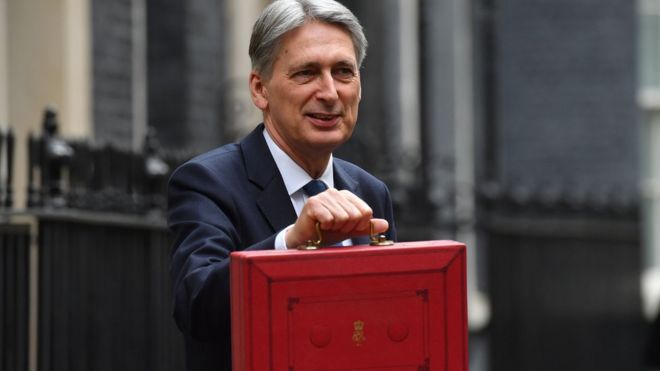
Philip Hammond
The chancellor posed with his red box before leaving Downing Street to head to Parliament
In an "upbeat" speech, he is expected to say the economy has proved resilient since the referendum but admit that many families are "feeling the pinch".
Extra money is expected for social care in England and to help firms facing steep business rate rises.
Labour demanded a break from the Tories' "failed economic policies".
With the public finances proving stronger in recent months than expected, and defying forecasts of a post-EU referendum downturn, economists say the chancellor has more room for manoeuvre than he might have expected at the time of last November's Autumn Statement.
Several spending announcements have been made ahead of the Budget statement, which begins at about 12:30 GMT in the House of Commons after Prime Minister's Questions.
These include:
  • A £5m fund to mark the centenary of female suffrage next year
  • An extra £500m for vocational and technical education in England
  • A one-off £320m for 140 new schools in England, which could include grammars
  • Measures to protect people who inadvertently end up subscribing for servicesafter signing up for free trials
  • Plans aimed at helping the North sea oil and gas industry
  • £500m support for electric vehicles, robotics and artificial intelligence
But Mr Hammond has distanced himself from talk of wider giveaways, stressing the need for the UK to reduce borrowing in the long term and to ensure the country is prepared for future global economic uncertainty and any short-term turbulence arising from its withdrawal from the EU.
The Treasury said Mr Hammond would give an "upbeat assessment" of the UK's economic prospects and offer a "positive backdrop ahead of the start of new chapter for the country outside of the EU".
It suggested the chancellor's focus would be on equipping the UK to meet the challenges of a "rapidly changing economy" by ensuring every child could go to a good school and get the qualifications and skills they needed.
"He will say that in building the foundations of a stronger, fairer, better Britain, outside the EU - the government understands the concerns of those who worry about their children's ability to access the opportunities they themselves enjoyed," it said.
"He will go on to say he knows that many are still feeling the pinch, almost 10 years on from the financial crash and that the government will do everything it can to help ordinary working families to get on."
Mr Hammond received an eve-of-Budget boost when the Organisation for Economic Co-operation and Development (OECD) upgraded its forecasts for the UK's economic growth this year from 1.2% to 1.6%, although it also warned that rising inflation could soon begin to squeeze the cost of living.
In January, the Office for Budget Responsibility (OBR) reported that stronger than forecast income tax, VAT and corporation tax revenues meant that borrowing was £13.6bn lower than forecast in the first 10 months of the financial year and was likely to undershoot predictions for the year as a whole.
This has led to speculation that Mr Hammond will have money to spend on key priorities, including helping cash-strapped councils meet the rising costs of social care in England, having been criticised for not making extra resources available in the Autumn Statement.
The Local Government Association says councils with responsibility for social care are facing a funding gap of £2.6bn by 2020 and the entire system stands on the "brink of collapse" without an immediate cash injection and a commitment to a long-term solution.
"The measures taken by government, such as the ability for councils to raise council tax to pay for social care, will not bring in enough funding to solve the social care funding crisis," said Izzi Seccombe, chair of the LGA's Community Wellbeing Board.
"Genuinely new government money is now the only way to protect the services caring for elderly and disabled people."
Prime Minister Theresa May has acknowledged acute pressures in social care and across the health service as a whole.
But she has rejected Labour claims that the NHS - which ministers say will receive £10bn in extra funding between 2016/17 and 2020/21 - is facing its worst financial crisis since its inception.
Mr Hammond is also expected to find money to alleviate the impact of increased business rates on many of the 500,000 firms facing them, following the government's first re-valuation of commercial property values since 2010.
Business groups have called for a hardship fund for firms facing, in some cases, increased bills of more than £1,000 a year and for more small business to be excluded entirely from having to pay rates.
The government has said the vast majority of businesses will not see their bills rise and many will actually pay less but the prime minister said last month that those set to be "particularly adversely affected" deserved assistance.

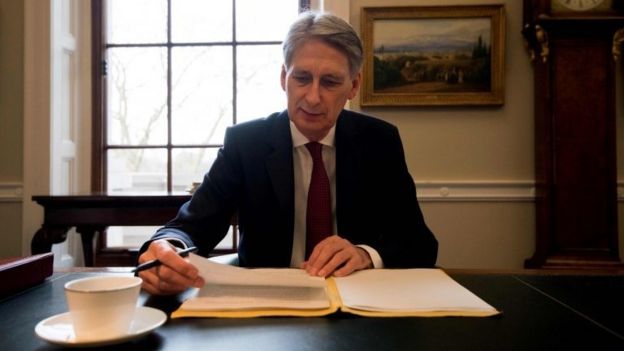
Philip Hammond working on his Budget speech in his officeImage copyrightAFP

In the run-up to Wednesday's statement, the last Spring Budget before it moves to the autumn, there has been speculation that the chancellor could pay for a boost to social care by raising national insurance rates for the self-employed.
Tobacco and some alcohol duties are also tipped to rise.
For Labour, shadow chancellor John McDonnell said the UK was "at a crossroads" ahead of Article 50 and called on Mr Hammond to deal with rising living costs.
"It cannot be a Budget, where like his predecessor, he over-claims on the government's economic record, and under-delivers on its promises," he said.
Mr McDonnell said "adequate" funding was needed for the NHS and social care, and that women should no longer "bear the brunt of Tory tax giveaways for a wealthy few".
For the SNP, Scottish Finance Secretary Derek Mackay called on the chancellor to provide some "financial relief" for struggling families and public services, and said extra spending cuts could be "disastrous".
Aside from the Budget, several previously-announced changes come into force in April, including an increase in the personal tax allowance to £11,500, a new inheritance tax allowance, a rise in the annual ISA limit to £20,000 and the introduction of a levy to fund apprenticeships.

Tuesday, March 7, 2017

Reuters News - U.S. trade deficit jumps to five-year high on imports

A mule truck moves a container in the Port of Miami in Miami, Florida, U.S., May 19, 2016. REUTERS/Carlo Allegri
A mule truck moves a container in the Port of Miami in Miami, Florida, U.S., May 19, 2016. REUTERS/Carlo Allegri


The U.S. trade deficit jumped to a near five-year high in January as cell phones and rising oil prices helped to push up the import bill, suggesting trade would again weigh on economic growth in the first quarter.
The Commerce Department said on Tuesday the trade gap
increased 9.6 percent to $48.5 billion, the highest level since March 2012. The deficit was in line with economists forecasts. December's trade shortfall was unrevised at $44.3 billion.
When adjusted for inflation, the trade deficit rose to $65.3 billion from $62.0 billion in December. Both the inflation-adjusted exports and imports were the highest on record in January.
The wider trade gap added to weak data such as housing starts, consumer and construction spending in suggesting the economy struggled to regain momentum early in the first quarter after growth slowed to a 1.9 percent annualized rate in the final three months of 2016.
The economy grew at a 3.5 percent pace in the third quarter.
Trade cut 1.7 percentage points from gross domestic product in the fourth quarter. The Atlanta Federal Reserve is forecasting GDP rising at a 1.8 percent rate in the first quarter.
The dollar was trading marginally higher, while prices for U.S. government bonds were little changed. U.S. stock index futures were slightly lower.
The Trump administration is eyeing trade as it seeks 4 percent annual GDP growth. President Donald Trump has vowed
sweeping changes to U.S. trade policy, starting with pulling out of the 12-nation Trans-Pacific Partnership trade pact.
Trump also wants to renegotiate the North American Free Trade Agreement (NAFTA), which was signed in 1994 by the United States, Canada and Mexico. Economists, however, warn that the America-first or protectionist policies being pursued by the administration are a threat to the country's economic health.
OIL IMPORTS SURGE
In January, imports of goods and services increased 2.3 percent to $240.6 billion, the highest level since December 2014. The import bill in part reflected higher oil prices.
The country imported 259 million barrels of crude oil in December, the largest amount since July 2013. The value of petroleum imports was the highest in two years.
The price of imported oil averaged $43.94 per barrel in January, the highest since August 2015. Imports of cell phones and other household goods rose $1.0 billion. There were also increases in imports of automobiles, which hit a record high.
Imports of industrial supplies and materials were the highest since July 2015, while capital goods imports were the highest in nearly two years.

Goods imported from China increased 5.1 percent to $41.4 billion in January, while those from Japan tumbled 13.9 percent to $10.5 billion. There was a 9.2 percent drop in merchandise sourced from Germany.
Exports of goods and services climbed 0.6 percent to $192.1 billion, the highest level since December 2014. There were increases in exports of industrial supplies and materials, which hit their highest level since December 2014. Petroleum exports were the highest since May 2015.
A strong dollar remains a constraint to export growth.
The dollar gained 4.4 percent against the currencies of the United States' main trading partners last year.
The bulk of the increase in the trade-weighted value of the greenback occurred in the final months of 2016 and will probably take a while to reflect in the trade data.
Exports to Germany tumbled 10.7 percent. A Trump trade adviser has accused Germany of unfairly benefiting from a weak euro. Shipments of goods to China, also singled out by the Trump administration, dropped 13.4 percent.
The politically sensitive U.S.-China trade deficit increased 12.8 percent to $31.3 billion in January, while the trade gap
with Germany fell 8.0 percent to $4.9 billion. The United States also saw its trade deficit with Mexico shrink 10.1 percent to its lowest level since July 2015.
(Reporting By Lucia Mutikani; Editing by Andrea Ricci)

Monday, March 6, 2017

BBC News - UK economy 'loses momentum' as services growth slows

Restaurant
Growth in the UK's service sector eased to a five-month low in February, according to a closely watched survey.
The Markit/CIPS purchasing managers' index (PMI) for services fell to 53.3, down from 54.5 in January. However, it remains above the 50 threshold that separates growth from contraction.
Markit estimates the economy will grow by 0.4% in the first quarter of 2017.
The economy has "lost momentum" after "impressive" growth at the end of 2016, said Chris Williamson of IHS Markit.
Services, which include areas such as finance and hospitality, make up more than three-quarters of the UK economy.
Markit said the sector had been stung by the steepest rise in costs for more than eight years as a result of the weak pound.
This is likely to mean that inflation faced by consumers "has significantly further to rise", said Chris Williamson, chief business economist at IHS Markit.
Latest official figures showed that inflation hit 1.8% in January, but Mr Williamson said the rate was expected to hit 3% over the next year.

Economic headwinds

The services PMI figure was slightly below expectations, with analysts forecasting a reading of 54.1.
Earlier in the week, a similar survey of manufacturers had also suggested a slowdown last month.
"A further slowdown in UK business activity growth in February adds to evidence that the economy has lost momentum after the impressive expansion seen at the end of last year," said Mr Williamson.
"Inflationary pressures remained the highest for six years as firms struggled with rising costs associated with the weak pound, but optimism about the year ahead remained elevated by recent standards."
Paul Hollingsworth, UK economist at Capital Economics, said: "The economy faces a number of headwinds including higher inflation and uncertainty surrounding the future relationship with the EU as formal negotiations get underway."
"However, we continue to think that the UK will weather these well, and expect GDP growth of 1.8% in 2017 and 2.5% in 2018."
The pound declined after the news was released. Sterling fell 0.3% against the dollar to $1.2233 and was 0.5% lower against the euro at 1.1621.
Samuel Tombs, chief UK economist at Pantheon Macroeconomics, said: "We continue to expect quarter-on-quarter GDP growth to average just 0.2% this year, ensuring that the [Bank of England's Monetary Policy Committee] holds back from raising interest rates despite high inflation."
The combination of lower growth with higher expected inflation could herald a period of "stagflation", he added.

Friday, March 3, 2017

Reuters News - Dollar rises, global stocks hold highs on March Fed rate hike bets

European stocks held near 15-month highs and the dollar strengthened against other top global currencies on Thursday on growing expectations the U.S. central bank will raise interest rates later this month.
Wall Street looked set to open barely changed after touching a record high on Wednesday, partly on the rates outlook, which was seen as a sign of confidence in the world's largest economy.
Federal Reserve Governor Lael Brainard became on Wednesday the latest central bank official to signal that a hike may be in the offing, saying an improving global economy and a solid U.S. recovery meant it would be "appropriate soon" to raise rates.
Federal fund futures prices suggest markets see a 72 percent chance of a 25 basis point hike at the March 14-15 meeting.
European shares held steady after Wednesday's strong showing and gains on Asian bourses, that helped push MSCI's global stocks index .MIWD00000PUS to another record high.
Although higher interest rates would raise U.S. companies' costs, they are also being viewed as a sign of confidence in the economy. Fed Chair Janet Yellen is due to speak on the economic outlook in Chicago on Friday. [FED/DIARY]
The pan-European STOXX 600 index was unchanged after adding 1.5 percent on Wednesday and hitting its highest since December 2015, as losses on real estate companies offset gains in utilities.
MSCI's broadest index of Asia-Pacific shares outside Japan .MIAPJ0000PUS rose 0.1 percent, while Japan's Nikkei .N225 closed up 0.9 percent after hitting a 14-month high as a weaker yen helped exporters.
The dollar index .DXY, which measures the greenback against a basket of six major currencies, hit a seven-week high, up 0.3 percent.
The euro fell 0.3 percent to $1.0514 EUR=, the yen fell 0.6 percent to 114.40 per dollar and sterling GBP=D4 was flat at $1.2286, having earlier touched a six-week low at $1.2257.
In fixed income markets, U.S. Treasury yields pushed higher.
Rate-sensitive two-year yields US2YT=RR matched Wednesday's peak of 1.308 percent, their highest since 2009.
German 10-year yields DE10YT=TWEB were higher on the day after data showing euro zone inflation hit the European Central Bank's 2 percent target last month, as expected.
Some analysts said the pick-up in inflation could fuel talk of a scaling back, or tapering, of the ECB's stimulus program, which has driven euro zone bond yields lower.
"Psychologically, 2 percent inflation could be important and there will be more pressure building on the ECB to taper -- especially if the economy continues to grow," said KBC strategist Piet Lammens.
Oil prices fell for a third consecutive day after a record build-up in U.S. crude inventories and data showing Russian oil production was unchanged last month, signaling a pause in Moscow's efforts to curb production under a deal struck with the OPEC producers' club. Brent crude LCOc1 fell 79 cents to $55.57 a barrel.

"There is a very stale smell hanging over the market," Ole Hansen, head of commodity strategy at Saxo Bank in Copenhagen, told Reuters Global Oil Forum.
"I still see the risk of $50 a barrel before $60 on Brent, but have to acknowledge that we have so far seen very limited selling appetite."
The stronger dollar weighed on metals prices, which wee buoyed however, by signs of growing demand. Chinese factory activity expanded faster than expected in February, purchasing manager data showed on Wednesday.
Copper CMCU3, a key Chinese import, fell 0.8 percent to $5,964 a tonne.
Gold XAU= fell 0.7 percent to $1,239 an ounce.
(Additional reporting by Hideyuki Sano in Tokyo, John Geddie, Dhara Ranasinghe and Christopher Johnson in London; Editing by Hugh Lawson)

Thursday, March 2, 2017

BBC News - 'Long shadow' of financial crisis hits incomes

Shoppers on Oxford Street
Typical household incomes in the UK will not grow for the next two years due to the "long shadow" of the financial crisis, a report suggests.
In five years' time, median income will be 4% higher than it is now, the Institute for Fiscal Studies predicts.
The recession and tepid recovery mean that from the start of the crisis to 2021, households will suffer the worst income squeeze for 60 years, it says.
They will be £5,000 a year worse off than they might have expected.

Winners and losers

The IFS has produced a report on living standards for the Joseph Rowntree Foundation, which campaigns to reduce poverty.
It suggests, based on official forecasts produced for the government by the Office for Budget Responsibility, that long-term income growth is a relatively slow 2% a year.
"If the OBR's forecast for earnings growth is correct, average incomes will not increase at all over the next two years," said Tom Waters, an author of the report.
"Even if earnings do much better than expected over the next few years, the long shadow cast by the financial crisis will not have receded."
This was generally the result of small increases in wages, low productivity levels, tax and benefit policies and the state of the UK economy.
The squeeze would be felt worst by low-income households with children, he said, owing primarily to the four-year freeze in working-age benefits.

'Teetering on a precipice'

In contrast, pensioners would see their income growing faster than working-age households - a reversal of the position a decade ago.
"Once you account for their lower housing costs and smaller household size, median income is projected to be nearly 8% higher for pensioners than for non-pensioners by 2021-22, having been nearly 10% lower in 2007-08," the report said.
Campbell Robb, chief executive of the Joseph Rowntree Foundation, said: "These troubling forecasts show millions of families across the country are teetering on a precipice, with 400,000 pensioners and over one million more children likely to fall into poverty."
He added: "It is essential that the prime minister and chancellor use the upcoming Budget to put in place measures to stop this happening. An excellent start would be to ensure families can keep more of their earnings under the Universal Credit."
Liberal Democrat Treasury spokeswoman Baroness Kramer also called for the Government to take action in next week's Budget.
"For all the talk about the 'just about managing' we have seen no real help for them," she said.
A Treasury spokesman said: "We are taking action to support families with the costs of living by cutting taxes for millions of working people, doubling free childcare for nearly 400,000 working parents and introducing the National Living Wage - a significant pay rise for the lowest earners."

Wednesday, March 1, 2017

Bloomberg News - Nigeria Economy Contracts in 2016 for First Time in 25 Years

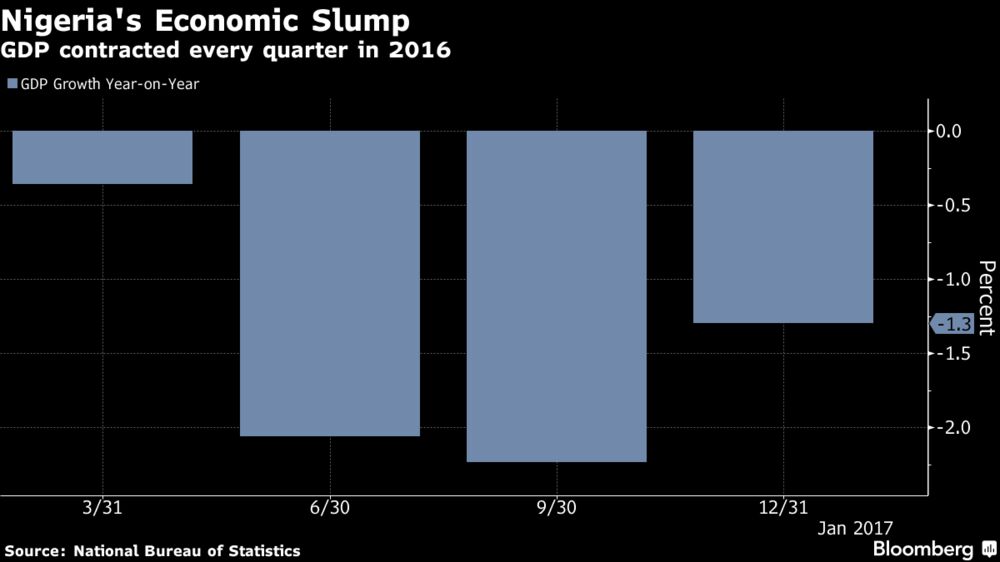
Nigeria’s economy shrank for a fourth consecutive quarter in the three months through December and contracted for the whole year, the first such move since 1991.
Gross domestic product in Africa’s most-populous country declined 1.3 percent in the quarter from a year earlier, after shrinking 2.2 percent in the previous three months, the National Bureau of Statistics said in an e-mailed statement Tuesday. The median of 10 economist estimates compiled by Bloomberg was for the economy to shrink by 1.4 percent. GDP contracted 1.5 percent for all of 2016. It was the first full-year drop in 25 years, according to International Monetary Fund data.
Lower prices and output of oil, Nigeria’s biggest export, cut government revenue by about half and reduced the foreign currency available to import refined fuel and factory inputs. A weakening naira contributed to inflation accelerating to the highest level in more than a decade, prompting the central bank to increase its key lending rate to a record 14 percent. Nigeria’s economic woes were further exacerbated by a five-month delay in approving spending plans for 2016 needed to stimulate business activity.
“GDP was hit by a declining oil sector and a tight foreign-exchange situation,” Pabina Yinkere, the Lagos-based head of research at Vetiva Capital Management Ltd., said by phone.

2017 Prospects

The government said improving crude prices, and the restoration of stability in the Niger River delta -- where militants blew up pipelines, cutting crude production to almost three-decade lows in 2016 -- will help the economy rebound this year. The IMF forecasts the economy will grow by 0.8 percent in 2017.
Fourth-quarter GDP increased 4.1 percent from the preceding three months, the statistics agency said.
Output by the oil sector in 2016 contracted 14 percent from a year earlier, and shrank 12 percent in the fourth quarter from the same period in 2015, the agency said. Oil production averaged 1.9 million barrels a day in the fourth quarter compared with 1.6 million barrels a day in the third.
The non-oil sector contracted by 0.3 percent in the three months through December, and by 0.2 percent in 2016. A decline in real estate, manufacturing, construction and trade weighed most on the non-oil sector, according to the agency.

Currency Shortages

“The poor performance of the non-oil sector is due to weak demand and a crippling foreign-exchange shortage,” according to John Ashbourne of London-based Capital Economics. “Higher oil prices will boost incomes and demand in 2017, but we don’t expect a quick turnaround.”
Vice President Yemi Osinbajo has promised to increase development projects in the Niger delta, including plans to build a $20 billion industrial gas park in the region, and create 250,000 jobs. That, and “resumption of compensation to some of the militants will bring some stability to the delta and increase oil output,” according to Yinkere.
The economy may contract by less than 1 percent in the first three months of 2017, before resuming expansion in the second quarter, Yinkere said. Yvonne Mhango, an economist at Renaissance Capital, and Capital’s Ashbourne predict growth of 0.5 percent and 2 percent this year respectively.
The Central Bank of Nigeria said last week it will increase the supply of foreign currency for Nigerians to pay school and medical fees at an exchange rate not more than 20 percent above the interbank market price. While the regulator removed a currency peg in June, it continues to block importers of items it deems non-essential from the official foreign-exchange market, forcing them to buy dollars on the black market, where the currency is about 30 percent more expensive.

Exchange Rates

Nigeria isn’t “ready to embrace a liberalized exchange rate or depreciation that would prove highly attractive to portfolio investors,” and the spread between the naira’s black market and official rates will probably remain wide, JPMorgan analysts Sonja Keller and Yvette Babb wrote in an e-mailed note to clients before the data was released.
Lawmakers have pledged that they will approve 2017 spending plans next month focused on increasing investments in roads, ports, and power in order to boost factory and farming output. The 7.3 trillion-naira ($23.2 billion) budget has a deficit of 2.36 trillion naira, almost half of which the government plans to plug with foreign borrowing. The state sold $1 billion of Eurobonds earlier this month, and may return to the markets for an additional $500 million.