Tuesday, April 11, 2017

Bloomberg News - Gold, Yen Climb to 5-Month Highs as Refuges Sought: Markets Wrap

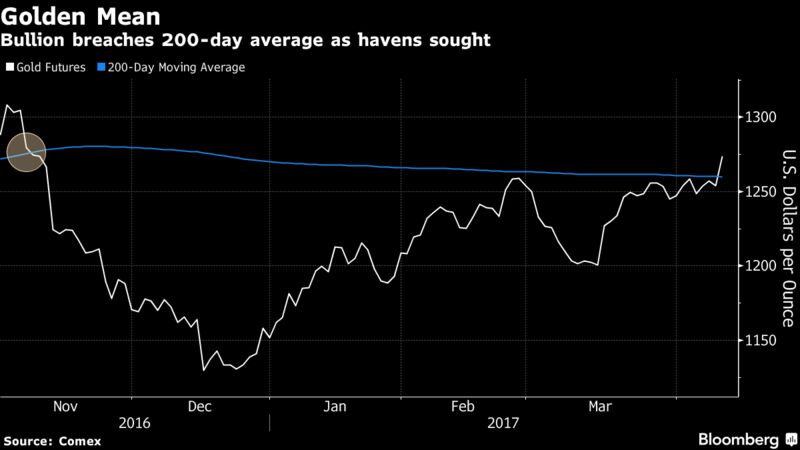
Gold and the yen rallied to five-month highs while Treasury note yields approached the lowest levels of the year as investors sought out traditional havens from geopolitical risks. The U.S. equity market’s standard fear gauge rose to the highest since November.

The yen strengthened versus all of its G-10 peers as tensions in Asia ratcheted higher, with North Korea warning of a nuclear strike if provoked and President Donald Trump saying on Twitter that the U.S. would “solve the problem” with or without China. U.S. Secretary of State Rex Tillerson said during a Group of Seven meeting in Italy that Russia must abandon its support of Syrian President Bashar al-Assad’s regime.


“It seems like a perfect storm of factors re-pricing the reflation trade that we’ve seen since the election,” said Michael Lorizio, a Boston-based senior trader at Manulife Asset Management, which oversees about $343 billion. “As the global macro picture gets muddied a bit by some strong words from North Korea and the president’s tweets, that’s spooked markets that were already in a bit of a risk-off tone to begin with.”
Nine of 11 sectors were lower in the S&P 500, with real estate related stocks the only sector trading significantly higher. The widespread decline sent the the CBOE Volatility Index, or VIX, to the highest level since the U.S. presidential election.
What investors are watching:
  • U.S. Secretary of State Rex Tillerson visits Moscow in an effort to persuade Russia that its alliance with Bashar al-Assad is no longer in its strategic interest.
  • Federal Reserve Bank of Minneapolis President Neel Kashkari will participate in a Q&A at a meeting of the Minnesota Business Partnership.
  • U.K. data on Wednesday is likely to show employment has remained steady while wage growth slowed.
  • U.S. bank earnings begin with Citigroup, JPMorgan Chase & Co. and Wells Fargo early Thursday.
Here are the main moves in markets:
Currencies
  • The yen gained 1.1 percent to 109.77 per dollar at 1:51 p.m. in New York, breaching 110 for the first time since November.
  • The Bloomberg Dollar Spot Index fell 0.2 percent, while the euro rose 0.1 percent.
  • The British pound was 0.6 percent stronger at $1.2484; data showed U.K. inflation’s upward trajectory paused in March.
Stocks
  • The S&P 500 Index dropped 0.4 percent to 2,348.99. The benchmark gauge climbed less than 0.1 percent on Monday, while the VIX rose to the highest level this year.
  • The MSCI All-Country World Index dropped 0.1 percent. Volumes in markets are down in a week that’s shortened in many countries by Easter holidays.
  • The Stoxx Europe 600 Index finished little changed after trading at the highest since December 2015.
Bonds
  • Treasuries climbed, with the yield on the 10-year note dropping six basis points to 2.31 percent after dropping as low as 2.29 percent.
  • The yield on French 10-year bonds increased three basis points to 0.95 percent.
Commodities
  • West Texas Intermediate oil rose 0.4 percent to $53.31 after jumping 1.6 percent on Monday.
  • Gold rose for a third day, adding 1.4 percent to $1,272.47 an ounce.
Asia
  • Chinese equities traded in Hong Kong fell to a one-month low while Japan’s Topix slipped as the yen gained. Shares in Seoul extended the longest losing streak since June as tensions over both Syria and North Korea remain in focus.

Monday, April 10, 2017

BBC News - US stocks up as spotlight falls on banks

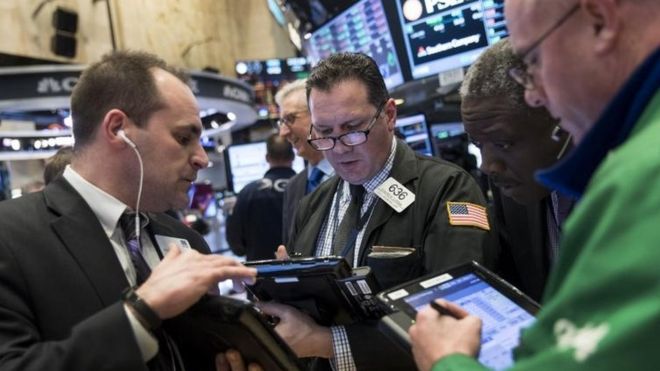
NYSE traders
(Open): Stocks on Wall Street opened higher on Monday as investors awaited the start of the big banks' earnings reporting season.
In early trade, the Dow Jones was up 56.71 points at 20,712.81, while the S&P 500 rose 8.94 points to 2,364.48.
The tech-heavy Nasdaq was 23.12 points higher at 5,900.93.
JP Morgan, Citigroup and Wells Fargo are all set to unveil their first-quarter results on Thursday, with the banking industry in the spotlight.
Speculation continues that President Donald Trump's administration plans to relax banking legislation introduced to curb the excesses of the financial crisis.
The price of Brent oil was up 1.1% to $55.83 a barrel at one point, helping to boost shares of oil companies, with Chevron up 1% and Exxon Mobil adding 0.5%.

Friday, April 7, 2017

Reuters News - At U.S.-China summit, Trump presses Xi on trade, North Korea; progress cited

By Steve Holland and Koh Gui Qing | PALM BEACH, FLA.
President Donald Trump pressed Chinese President Xi Jinping to do more to curb North Korea's nuclear program and help reduce the gaping U.S. trade deficit with Beijing in talks on Friday, even as he toned down the strident anti-China rhetoric of his election campaign.
Trump spoke publicly of progress on a range of issues in his first U.S.-China summit – as did several of his top aides – but they provided few concrete specifics other than China's agreement to work together to narrow disagreements and find common ground for cooperation.
As the two leaders wrapped up a Florida summit overshadowed by U.S. missile strikes in Syria overnight, Xi joined Trump in stressing the positive mood of the meetings while papering over deep differences that have caused friction between the world's two biggest economies.
Trump's aides insisted he had made good on his pledge to raise concerns about China's trade practices and said there was some headway, with Xi agreeing to a 100-day plan for trade talks aimed at boosting U.S. exports and reducing China's trade surplus with the United States.
Speaking after the two-day summit at Trump's Mar-a-Lago resort in Florida, U.S. Secretary of State Rex Tillerson also said that Xi had agreed to increased cooperation in reining in North Korea's missile and nuclear programs – though he did not offer any new formula for cracking Pyongyang's defiant attitude.
Trump had promised during the campaign to stop what he called the theft of American jobs by China. Many blue-collar workers helped propel him to his unexpected election victory on Nov. 8 and Trump is under pressure to deliver for them.
The Republican president tweeted last week that the United States could no longer tolerate massive trade deficits and job losses and that his meeting with Xi "will be a very difficult one."
On Friday, the unpredictable Trump not only set a different tone but also avoided any public lapses in protocol that Chinese officials had feared could embarrass their leader.
"We have made tremendous progress in our relationship with China," Trump told reporters as the two delegations met around tables flanked by large U.S. and Chinese flags. "We will be making additional progress. The relationship developed by President Xi and myself I think is outstanding.

"And I believe lots of very potentially bad problems will be going away," he added, without providing details.
"AGREE WITH YOU 100 PERCENT"
Xi also spoke in mostly positive terms.
"We have engaged in deeper understanding, and have built a trust," he said. "I believe we will keep developing in a stable way to form friendly relations ... For the peace and stability of the world, we will also fulfill our historical responsibility."
"Well, I agree with you 100 percent," Trump replied.
China's official Xinhua news agency said Xi had encouraged the United States to take part in the "One Belt, One Road" plan, Xi's signature foreign policy imitative aimed at infrastructure development across Asia, Africa and Europe, seen in some policy circles as a partial answer to the pivot to Asia strategy of Trump's predecessor Barack Obama.
Xi also hailed military to military exchanges and said China and the United States should "make good use of the dialogue mechanism to be established between the two countries' joint staffs of the armed forces", although Xinhua did not give further details.
Chinese state media on Saturday cheered the meeting as one that showed the world that confrontation between the two powers was not inevitable and established the tone for the development of U.S.-China relations.
But in a sign that rough spots remained, Tillerson afterwards described the discussions as "very frank and candid."
"President Trump and President Xi agreed to work in concert to expand areas of cooperation while managing differences based on mutual respect," he said.
After the meeting, Trump took Xi on a walk around the manicured grounds of his lavish Spanish-style complex. Trump could be seen chatting and gesturing to Xi, who did the same.
Tillerson said Trump had accepted Xi's invitation to visit China and that they also agreed to upgrade a U.S.-China dialogue by putting the two presidents at the head of the forum.
U.S. Commerce Secretary Wilbur Ross said the Chinese had expressed an interest in reducing China's trade surplus as a way of controlling their own inflation. "That's the first time I've heard them say that in a bilateral context," he said.
Ross declined to say whether the United States was ready to designate China a currency manipulator, however, referring to an upcoming report in which that issue would be addressed.
Although Trump during the presidential election campaign had pledged to label China a currency manipulator on the first day of his administration, he has refrained from doing so.
The highly anticipated U.S.-China summit was upstaged by U.S. missile strikes overnight against a Syrian air base from which Trump said a deadly chemical weapon attack had been launched earlier in the week. It was the first direct U.S. assault on the Russian-backed government of Syrian President Bashar al-Assad in six years of civil war.
The swift action in Syria could be interpreted as a signal especially to defiant nuclear-armed North Korea – and by extension, its ally China – as well as other countries like Iran and Russia of Trump's willingness to use military force. North Korea is developing missiles capable of hitting the United States.
Tillerson said Xi agreed with Trump that North Korea's nuclear advances had reached a "very serious stage."
He said Trump also raised U.S.concerns about China's activities in the South China Sea. Beijing is building and fortifying islands in pursuit of expansive territorial claims in the strategic waterway.
(Additional reporting by Roberta Rampton and Ayesha Rascoe in Washington; and Michael Martina in Beijing and Brenda Goh in Shanghai; Writing by Matt Spetalnick and David Brunnstrom; Editing by Leslie Adler, Richard Pullin and Michael Perry)

Thursday, April 6, 2017

BBC News - UK services sector beats forecasts buoyed by new work

New Covent Garden Market
Activity in the UK's dominant services sector rose at a faster-than-expected pace in March.
The Markit/CIPS purchasing managers' index (PMI) for services rose to 55, compared with economists' expectations of a slight increase to 53.5.
The services sector, which accounts for three-quarters of the UK economy, said business activity and new work grew at the strongest rate so far this year.
However, cost pressures led to the fastest rise in prices since late 2008.
The pound rose 0.3% against the dollar to $1.2478 after the survey found that business activity expanded at the quickest rate since December.
Respondents were also optimistic about the year ahead, while there was evidence that the fall in the value of sterling since the Brexit vote had led to new sales inquiries from abroad and demand for overseas clients, especially in the US.
However, jobs growth was "only marginal", with some companies saying tighter margins and rising wage bills meant that they were not replacing those who had left.

Slower growth

Despite the rise in services activity, data out earlier this week showed that growth in the manufacturing and construction sectors eased in March.
Meanwhile, productivity figures released on Wednesday showed output per hour rose by 0.4% in the final quarter of 2016, and by 1.2% compared to the same period in 2015.
However, the Office for National Statistics said the rate remained below the pre-financial crisis average.
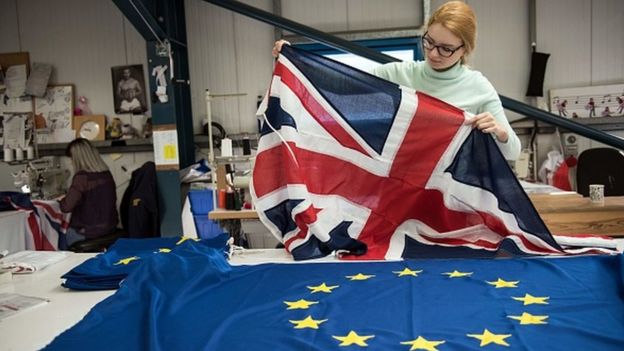
Flag maker in Chesterfield
Chris Williamson, chief business economist at IHS Markit, believed that economic growth for the first quarter of 2017 would slow.
"The upturn fails to change the picture of an economy that slowed in the first quarter," he said.
"The relative weakness of the PMI survey data compared to that seen at the turn of the year suggests the economy will have grown by 0.4% in the first quarter, markedly lower than the 0.7% expansion seen in the fourth quarter of last year."
Ruth Gregory, economist at Capital Economics, estimates that UK GDP will grow by about 0.5% in the first three months of the year.
"Granted, the full adverse impact on the consumer of the forthcoming rise in inflation has yet to be felt. This was evident in the rise in the prices charged balance, which picked up once again to its highest since September 2008," she said.

'Impressive' rate

"However, we continue to think that the support provided by the lower pound and rock-bottom interest rates should prevent growth from slowing too sharply in the quarters ahead. Our forecast is for annual GDP growth of about 2% for the year as a whole."
Meanwhile, the PMI figure for eurozone's services sector industry came in at 56 - below a flash estimate of 56.5. That was still above the final 55.5 figure for February and was the highest since May 2011.
The final composite PMI figure for the continent, which is regarded as a good guide to growth, rose to a near-six year high of 56.4 in March from February's 56. The flash reading, at 56.7, had suggested a sharper rise.
Chris Williamson at IHS Markit said: "The expansion recorded by the final PMI numbers was not quite the growth spurt indicated by the flash release, but still points to an impressive rate of economic growth."

Wednesday, April 5, 2017

Bloomberg News - Oil's Slide Drives 50% Drop in Angola Capital Office Rents

The cost of renting an office in the Angolan capital Luanda has almost halved in two years as a slide in oil prices damages what had been one of Africa’s fastest-growing economies.
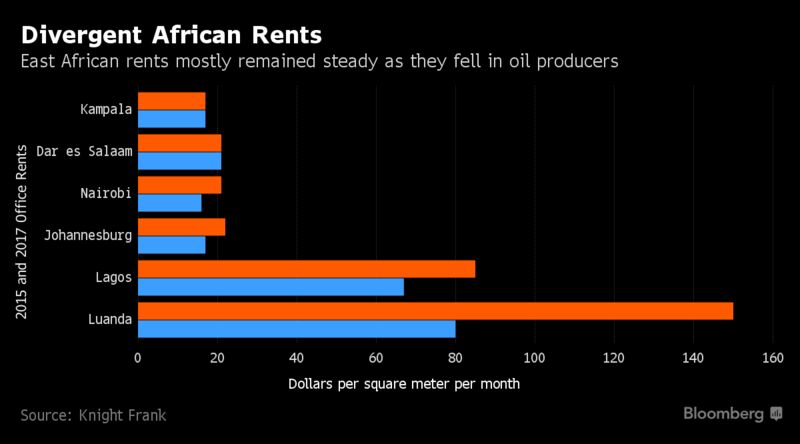
More than 20 percent of new office buildings in the city are empty, and there’s also oversupply in the Nigerian centers of Lagos and Abuja, Knight Frank LLP said in a report. While oil-exporting nations are suffering, some of the smaller east African economies such as Tanzania have seen their real estate markets benefit from the drop in crude, with rents in Dar es Salaam relatively high and vacancy rates low, according to the consultancy.

“There has been a divergence between the growth rates of commodity importing and commodity exporting countries since 2015,” said Peter Welborn, the London-based head of Knight Frank’s Africa unit. “Falling oil prices have had a dramatic impact on Angola. Luanda still has the highest office rents in Africa, but demand has virtually ground to a halt.”
Investors who flocked to Africa to take advantage of the world’s fastest-growing population and an expanding middle class are being forced to reassess the continent’s potential following crude’s more-than 50 percent drop since mid-2014. Nigeria, the region’s biggest oil producer after Angola, is in recession, while South Africa -- though a net importer of the commodity -- has been hurt by a mining and manufacturing slump as well as a drought.
Monthly prime office rents in Luanda fell to an average of $80 per square meter this year from $150 in 2015, while rates dropped 45 percent to $33 in Abuja and 21 percent to $67 in Lagos, according to Knight Frank. Johannesburg prices dropped 23 percent, while those in Dar es Salaam held steady.
The Angolan capital is still the world’s second most expensive city for expats, after first-placed Hong Kong, according to a cost of living survey by consulting firm Mercer.
Apart from Tanzania, other hot spots in this “multi-speed Africa” include Kenya, Ethiopia and Rwanda, with Ivory Coast and Senegal in the west also benefiting from improved political stability and infrastructure investment, Welborn said.

Tuesday, April 4, 2017

Bloomberg News - South Africa Cut to Junk for the First Time Since 2000

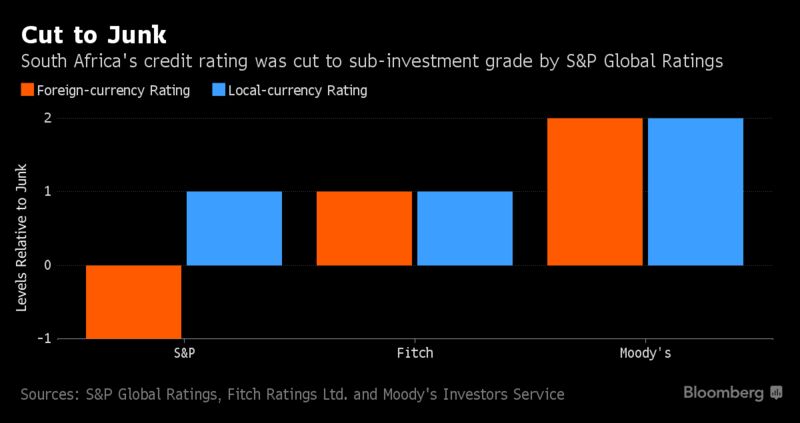
South Africa lost its investment-grade credit rating from S&P Global Ratings for the first time in 17 years in response to a cabinet purge by President Jacob Zuma that’s sparked increasing calls for him to resign. The rand weakened.
S&P cut the foreign-currency rating to BB+, the highest junk score, on Monday and warned that a deterioration of the nation’s fiscal and macroeconomic performance could lead to further reductions. The local-currency rating was reduced to BBB-, still investment grade, from BBB. The outlook on both ratings was kept at negative, signaling that the next move could be downward. Moody’s Investors Service, which rates the nation at two levels above junk with a negative outlook, said the rating is under review for a downgrade.
Zuma sacked Finance Minister Pravin Gordhan, who pushed for budget restraint, in a stunning cabinet reshuffle last week that’s ignited South Africa’s worst political crisis in almost a decade. Investors regard the firing as a blow to an economy growing at the slowest pace since the 2009 recession and grappling with 27 percent unemployment. The downgrade may further galvanize Zuma’s opponents within the ruling party to push for him to step down after unprecedented criticism from other African National Congress leaders.
“The downgrade reflects our view that the divisions in the ANC-led government that have led to changes in the executive leadership, including the finance minister, have put policy continuity at risk,” S&P said. “This has increased the likelihood that economic growth and fiscal outcomes could suffer.”

Rand Slide

New leadership of the ministry doesn’t mean that government policy will change, the National Treasury said in an emailed statement after the announcement.
“South Africa is committed to a predictable and consistent policy framework, which responds to changing circumstances in a measured and transparent fashion,” it said. “Open debate in a democratic society should not be a cause for concern, but reflects an important means to accommodate differing views.”
The rand slumped to the weakest level since January, declining as much as 2.5 percent, and was at 13.6719 per dollar at 4:55 p.m. in New York. Yields on the country’s dollar bonds due October 2028 jumped 10 basis points to 5.12 percent, a three-month high, while rates on benchmark government rand bonds due December 2026 rose 13 basis points to 9.02 percent.
Investors already demand a bigger premium over Treasuries to hold South African dollar-denominated debt than Russia or Brazil, both junk credits.
The announcement was quick and “more potent, given the timing,” Razia Khan, head of macro research at Standard Chartered Plc in London, said by email. “It substantially raises the risk of ratings action from Moody’s which had assigned a higher rating to South Africa.”
The timing and scope of the reshuffle raises questions over the signal they send regarding the prospects for ongoing reforms, Moody’s said Monday. Recovery is fragile and higher growth in future will be highly dependent on domestic and external investment, according to the rating company, which is scheduled to publish its review on April 7.
Former President Kgalema Motlanthe on Monday urged Zuma to resign, joining calls by the ANC’s ally in government the South African Communist Party.
Zuma doesn’t understand how his actions can influence decisions by rating companies, and his decisions showed a “recklessness” that ruined South Africa’s credibility, Motlanthe said in an interview at Bloomberg’s offices in Johannesburg.
Gordhan, who was replaced by former home affairs minister Malusi Gigaba, was removed after a months-long battle with Zuma over government spending. He’d been trying to ward off a downgrade with plans to narrow the budget shortfall to 2.6 percent of gross domestic product by the fiscal year ending in March 2020, from the current 3.4 percent.

Budget Slippage

“The rating action also reflects our view that contingent liabilities to the state, particularly in the energy sector, are on the rise,” S&P said. “Higher risks of budgetary slippage will also put upward pressure on South Africa’s cost of capital, further dampening already-modest growth.”
Pressure within the ANC has been growing on Zuma to step down after he recalled Gordhan from a trade trip in London March 27 where he was holding meetings with investors and ratings companies. Gigaba, who has no financial or business experience, is the nation’s fourth finance minister in 15 months.
“A downgrade wouldn’t be permanent,” Gigaba told reporters Monday in the capital, Pretoria, before the ratings announcement.
South Africa, the continent’s most-industrialized country, has enjoyed investment-grade standing at Moody’s since 1994, when the ANC came to power under Nelson Mandela. The other two ratings companies upgraded it above junk in 2000.

Monday, April 3, 2017

BBC News - Trump trade crackdown 'not about China

President Donald Trump has signed two executive orders targeting the US trade deficit, ahead of Chinese President Xi Jinping's state visit.
One order includes a study looking at causes of the deficit by examining unpaid duties and foreign trade abuses.
The second will initiate a review of the American trade deficit and rules Mr Trump says harm US workers.
Administration officials said Beijing was not the focus, but China is the largest source of the US trade deficit.
President Trump signed the orders on Friday at the White House.
"We are going to get these bad trade deals straightened out," he told reporters during the signing.
"These actions are designed to let the world know that this is a president taking another step to fulfil his campaign promise," Commerce Secretary Wilbur Ross said on Thursday night, previewing the executive orders.
Mr Trump spent a large part of his presidential campaign railing against the US trade deficit and foreign trade deals.
Mr Ross will lead a comprehensive review accounting for the sources of the $502.3bn trade deficit and report back to the White House after 90 days.
The study will look at whether cheating, trade deals, lax enforcement and World Trade Organization rules play a role in the deficit, according to Mr Ross.
The orders also will focus on stricter enforcement of the US anti-dumping laws and countervailing duties, or the penalties imposed on foreign governments who violate trade rules, as well as pirated and counterfeited intellectual property owned by US companies.
The pair of orders come one week before Mr Trump meets the Chinese president at his Mar-a-Lago estate in Florida.
Director of the White House National Trade Council Peter Navarro told reporters that the orders had nothing to do with Mr Xi's visit.
But China is the source of America's highest trade deficit, at $347bn a year.
"Nothing we're saying tonight is about China. Let's not make this a China story. This is a story about trade abuses, this is a story about an under-collection of duties," Mr Navarro said.
Mr Trump tweeted on Thursday night that his first meeting with Mr Xi would "be a very difficult one in that we can no longer have massive trade deficits...and job losses".
"American companies must be prepared to look at other alternatives," he added.
The half trillion-dollar deficit slightly increased from 2015, according to the Commerce Department.
The trade gap reached a record level since 2012 last year, though the imbalance remains below its previous high in 2006