Wednesday, July 19, 2017

BBC News - China's second quarter growth beats expectations at 6.9%

Shanghai skyline
China's economy grew at an annual rate of 6.9% between April and June according to official figures, slightly higher than forecast.
The growth rate, which compares expansion with the same three months in the previous year, was the same as in the first quarter of 2017.
Beijing is trying to rein in debt and a housing bubble with tough measures on the property sector and lenders.
Many analysts expected China's economy to slow as those policies kicked in.
But the latest data is well above Beijing's 6.5% growth target for 2017.

Limited impact

Despite efforts to slow down the housing market, property investment grew by 8.5% in the first half, which is up from the same period in 2016.
Some analysts are predicting that tighter lending rules may not have the cooling effect that many expected.
"Property prices will have an impact in the second half, but the impact might not be as big as we thought. It is only on prime cities. The third-tier and fourth-tier cities might catch up a little bit and that will offset some of the slowdown in first tier cities," said Iris Pang, Greater China Economist with ING.
China's economy grew at its weakest pace in 26 years during 2016, but other data released on Monday added to the picture of rebounding growth for the Chinese economy.
Industrial output for June grew by 7.6%, well above the forecast 6.5%.
Retail spending grew 11% last month compared with June 2016.
And growth in both imports and exports also came in above expectations.

Tuesday, July 18, 2017

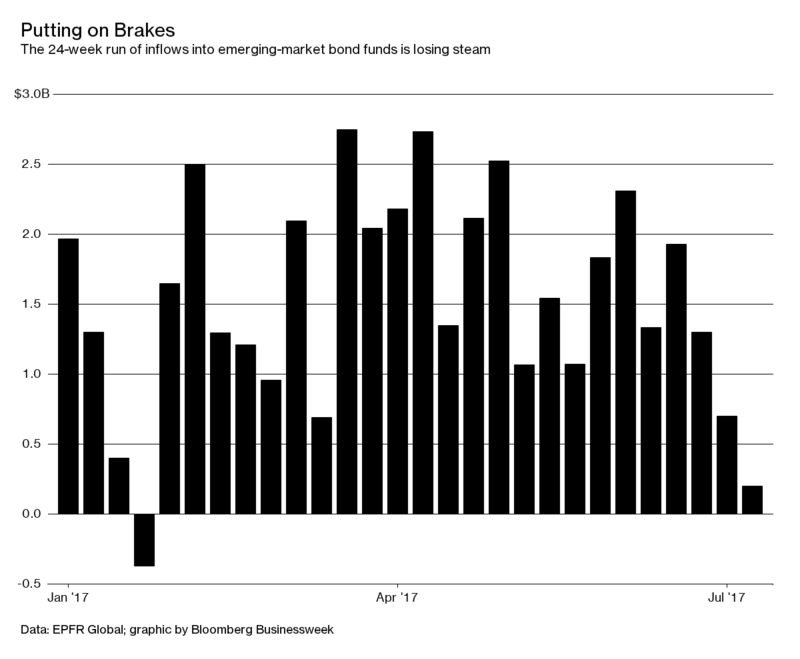
Bloomberg News - Investor Love Affair With Emerging Bonds Is Losing Momentum

Monday, July 17, 2017

Reuters News - Major tech firms urge U.S. to retain net neutrality rules

WASHINGTON (Reuters) - A group representing major technology firms including Alphabet Inc (GOOGL.O) and Facebook Inc (FB.O) urged the U.S. Federal Communications Commission on Monday to abandon plans to reverse the landmark 2015 rules barring internet service providers from blocking or slowing consumer access to web content.
The Internet Association said in its filing with the FCC that dismantling the net neutrality rules "will create significant uncertainty in the market and upset the careful balance that has led to the current virtuous circle of innovation in the broadband ecosystem."
The rollback will harm consumers, said the group, which also represents Amazon.com Inc (AMZN.O), Microsoft Inc (MSFT.O), Netflix Inc (NFLX.O), Twitter Inc (TWTR.N) and Snap Inc (SNAP.N).
In May, the FCC voted 2-1 to advance Republican FCC Chairman Ajit Pai's plan to reverse the former Obama administration's order reclassifying internet service providers as if they were utilities.
Pai has asked if the FCC has authority or should keep its rules barring internet companies from blocking, throttling or giving "fast lanes" to some websites, known as "paid prioritization."
Pai, who argues the Obama order was unnecessary and harms jobs and investment, has not committed to retaining any rules, but said he favors an "open internet."
The Internet Association said there was "no reliable evidence" provider investment had fallen.
More than 8.3 million public comments have been filed on the proposal. Pai will face questions on Wednesday on the issue at a U.S. Senate hearing.
Broadband providers AT&T Inc (T.N), Verizon Communications Inc (VZ.N) and Comcast Corp (CMCSA.O) opposed the 2015 order, saying it discouraged investment and innovation.
Providers say they strongly support open internet rules and will not block or throttle legal websites even without legal requirements. They separately plan to file comments with the FCC on Monday.
But some providers have said paid prioritization may make sense at times, citing self-driving cars and healthcare information.
Internet firms say opening the door to prioritization could enable providers to "destroy the open nature of the internet that allows new or smaller streaming video providers to compete with larger or better-funded edge providers."
Internet providers want Congress to resolve the decade-old dispute and pass open internet protections, but narrowly tailor rules to exclude a future FCC from imposing rate regulations.
The Internet Association said it was "open to alternative legal bases for the rules, either via legislative action codifying the existing net neutrality rules or via sound legal theories offered by the commission."
But it said Pai's proposal "offers no clear alternatives."

Friday, July 14, 2017

BBC News - Weak pound sees surge in tourists visiting UK

By Brian Milligan
scene in WalesImage copyright
Image captionThe delights of Wales proved a particular attraction to visitors
The weakness of sterling was behind a surge in the number of tourists visiting the UK in the first three months of 2017, according to the Office for National Statistics (ONS).
The number of holidaymakers coming to the UK rose by 21.1% - although the number of business visitors declined.
Overall there were a record 8.3 million visits in the quarter, a rise of nearly 10% on the same period in 2016.
The visitors spent £4.4bn while in the country, also a record amount.
But at the same time the fall in the value of the pound did not discourage Britons from travelling overseas.
UK residents made 14.1 million trips abroad over the three months, a rise of 8.1% on 2016.
The decline in sterling makes it cheaper for foreign visitors to come to the UK, but more expensive for Britons going the other way.

Brits abroad

The number of American visitors was particularly significant. Their numbers were up by 16%, while their spending grew 29% to £604m.
There were a record 54,000 visits from Chinese nationals, who spent a record £91m, and there was strong growth in the number of Australian and French visitors too.
Wales appears to have been one of the most popular destinations, with the number of overnight visits increasing by 28%.
But the "visitor balance of payments" remains tilted against the UK.
While visitors spent £4.4bn in Britain over the quarter, Britons spent nearly twice as much - £8.6bn - on trips abroad. a figure that has risen by 11.7% over the past year.

Thursday, July 13, 2017

Reuters News - Trump envoy announces Israeli-Palestinian water deal, silent on peace prospects

by Jeffrey Heller

JERUSALEM (Reuters) - U.S. President Donald Trump's Middle East envoy announced an Israeli-Palestinian water agreement on Thursday but dodged questions on whether he was making headway on reviving peace talks.
At his first news conference in Jerusalem since launching a series of visits in March, Jason Greenblatt declined to say if he was any closer to a return to negotiations between the two sides that collapsed in 2014.
"Let me interrupt you to save time. We are only taking questions about the Red-Dead (water) project," said Greenblatt, who was a legal adviser to Trump's businesses before being appointed Special Representative for International Negotiations.
He was referring to a World Bank-sponsored plan to build a nearly 200-km (120-mile) pipeline from the Red Sea to the Dead Sea and a desalination plant in the Jordanian port of Aqaba that was agreed in principle in 2013.
Under that deal, which aims to increase fresh water supplies for Jordan, the Palestinians and Israel and revitalize the Dead Sea's falling water levels, Israel agreed to increase water sales to the Palestinian Authority by 20 million to 30 million cubic meters a year.
Israeli Regional Cooperation Minister Tzachi Hanegbi, estimated it would take another four to five years to complete the $900 million endeavor.
The desalination plant will produce at least 80 million cubic meters of water annually. Under an agreement signed with Jordan in 2015, Israel will buy up to 40 million cubic meters of that at cost each year.
Greenblatt said Israel, whose own desalination plants have led to a water surplus, would sell up to 33 million cubic meters to the Palestinian Authority as part of the finalised agreement signed on Thursday.
Palestinian Water Authority head Mazen Ghoneim put the figure at 32 million and said 22 million would go to the Israeli-occupied West Bank and 10 million to the Gaza Strip.
"We hope that this deal will contribute to the healing of the Dead Sea and that it will help not only Palestinians and Israelis but Jordanians as well," Greenblatt said.
"I am proud of the role that the United States and our international partners have played in helping the parties reach this deal and I hope it is a harbinger of things to come."
The idea of a canal from the Red Sea to the Dead Sea was first talked about by the British in the 1850s, as an alternative to the Suez Canal.
Many plans have since been proposed, mainly aiming to preserve the Dead Sea, whose minerals are used in ointments and cosmetics.
Editing by Jeffrey Heller and Robin Pomeroy

Wednesday, July 12, 2017

BBC News - Oversight of Greek spending to be lifted

The Temple of Poseidon
Special oversight of Greek government spending should be lifted, the European Commission has recommended.
The EU imposed disciplinary measures against Greece when its deficit ballooned after the financial crisis.
Years of austerity have seen the country repair its finances and last year it posted a small budget surplus.
The European Commissioner for economic affairs, Pierre Moscovici, said it was a "very symbolic moment" for Greece.
Member states still need to approve the ending of the so-called excessive deficit procedure.
Greece is likely to be in deficit again in 2017, but it will be comfortably within the EU limit of 3% of GDP.
Although the government's finances have improved, Greece still has huge debts and many economists question whether the country will ever be able to pay them off.
The years of austerity have hurt the economy and contributed to an unemployment rate of 21.7% - the highest among European Union member states.
The Greek economy is expected to grow by 2.1% this year, above the eurozone average. If the restrictions are lifted, the country will be able to resume selling government debt, or bonds.

Tuesday, July 11, 2017

Bloomberg News - Bitcoin and Blockchain

By Olga Kharif & Matthew Leising
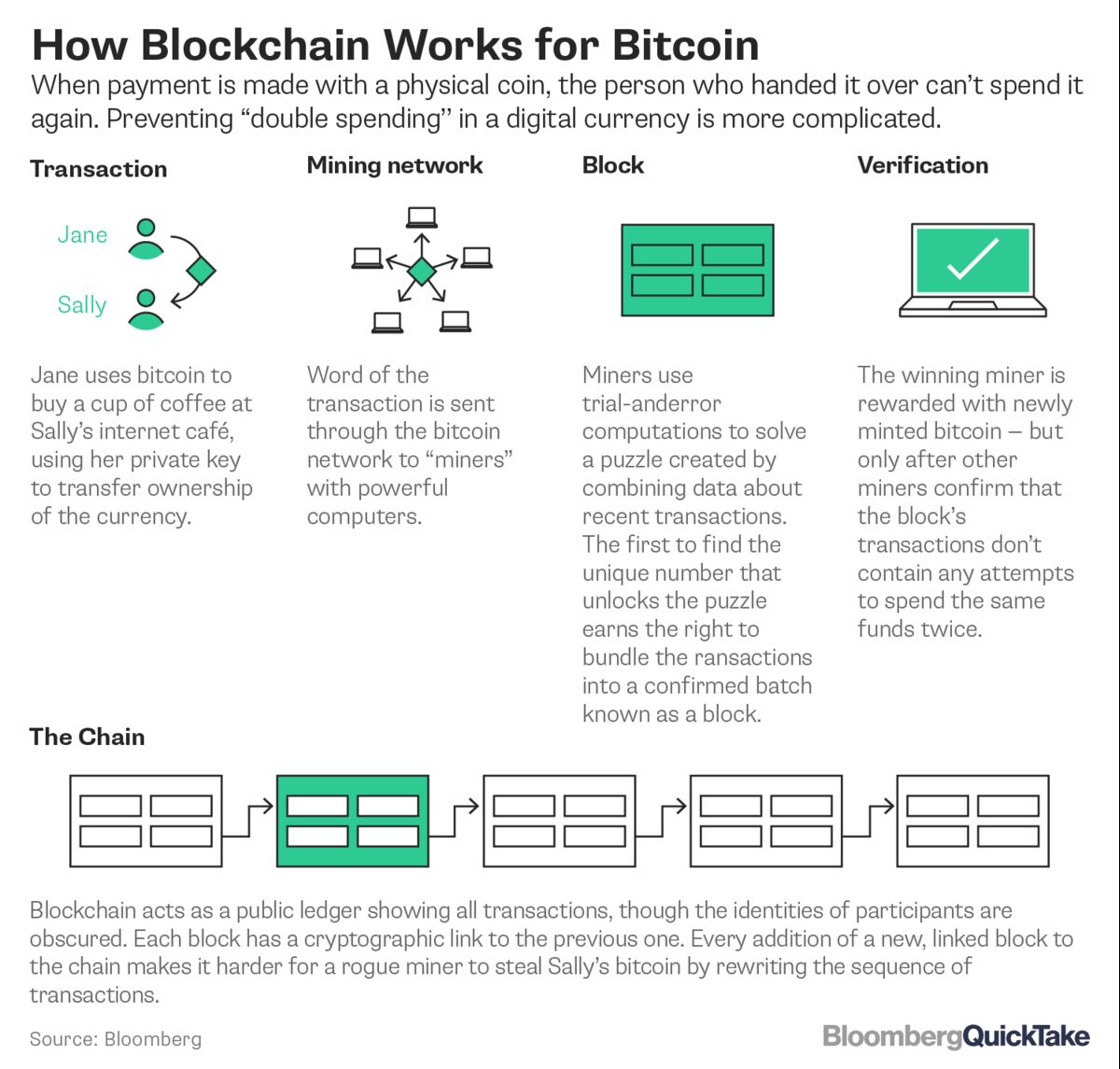
When bitcoin broke into public consciousness in 2013, it couldn’t have been sexier: a digital currency being used to buy everything from drugs to cupcakes. Now there’s a new wave of excitement about an aspect of bitcoin that is a bit less sexy: public online ledgers. Blockchain — the technology used for verifying and recording transactions that’s at the heart of bitcoin — is seen as having the potential to reshape the global financial system and possibly other industries.

The Situation

After years of volatility, the price of bitcoin reached a new high in early 2017, a surge tied in part to increased interest in China, where bitcoin is seen as protection against currency controls. But efforts to bring investing in the digital currency into the mainstream were set back when the U.S. Securities and Exchange Commission rejected an application to open a bitcoin-based exchange-traded fund that would have opened the field to more retail investors. Meanwhile, more than 50 banks including Barclays Bank Plc and JPMorgan Chase & Co. have joined the R3 consortium, created to find ways to use blockchain as a decentralized ledger to track money transfers and other transactions. R3 has made its software code publicly available, which could hasten its broader adoption. Nasdaq Inc. is already using blockchain — with help from startup Chain.com — for trading securities in private companies. The Australian Stock Exchange is working with blockchain startup Digital Asset Holdings to speed up its clearing and settlement services in the cash equities market. Blockchain is also being tested by retailers like Wal-Mart Stores Inc. for ensuring food safety, as industries ranging from healthcare to natural-resource management are exploring what advantages the technology might hold over traditional databases. Meanwhile, ether, a newer digital currency tied to the etherium blockchain, began to take a bigger share of the cryptocurrency market, and more than 40 new types of digital coins were issued in the first five months of 2017.

The Background

Virtual currencies aren’t new — online fantasy games have long used them — but the development of a secure digital currency without a central issuer rightly turned heads. The person or people who created  the bitcoin system under the pseudonym Satoshi Nakamoto solved a problem central to any currency —preventing counterfeiting — and did it without relying on a government’s authority. The software also solved one specific hurdle for digital money — how to stop users from spending the same unit of currency twice. The breakthrough idea was blockchain, a publicly visible, anonymous online ledger that records every single bitcoin transaction. It’s maintained by a network of bitcoin “miners” whose computers perform the calculations that validate each transaction, preventing double-spending. The miners earn a reward of newly issued bitcoin. The pace of creation is limited, and no more than 21 million will ever be issued.

The Argument

Since bitcoin first boomed, there’s been no shortage of critics to call its rise a bubble and to argue that the currency has no intrinsic value. But entrepreneurs in the field say that focusing on the price of bitcoin is missing the point — its value is as proof of concept for a new kind of payment system not reliant on third parties like governments, big banks or credit-card companies.  Promising applications of blockchain include moving money abroad, signing contracts, clearing complex financial transactions and as a medium for micro-payments in emerging countries. Others say blockchain advocates are hyping what amounts to no more than a new kind of database. Proponents of ether respond that the etherium blockchain does far more than let bitcoin users send value from one person to another. Its advocates think it could be a universally accessible machine for running businesses, as the technology allows people to do more complex actions in a shared and decentralized manner.

The Reference Shelf