Thursday, August 17, 2017

BBC News - UK unemployment falls to new 42-year low

Unemployment in the UK fell by 57,000 in the three months to June, official figures show, bringing the jobless rate down to 4.4% - its lowest since 1975.
The squeeze on real incomes continues to grow, though at a slower pace.
Average weekly earnings increased by 2.1% compared with a year earlier - slightly higher than last month's 2% increase.
But with inflation standing at 2.6%, real earnings still fell by 0.5%, the ONS figures showed.
At 75.1%, the proportion of people in work is the highest it has been since 1971 - partly due to the introduction of a later state pension age for women.
There were 32.07 million people in work in the three months to June - 338,000 more than for the same period last year.
A decade of pay and prices

  • Annual % change in average earnings
  • CPI annual % inflation
  • "The employment picture remains strong, with a new record high employment rate and another fall in the unemployment rate. Despite the strong jobs picture, however, real earnings continue to decline," said Office for National Statistics senior labour market statistician Matt Hughes.

    Analysis
    Andy Verity, economics correspondent
    Pay rises improved, up by 2.1% (excluding bonuses) compared with a consensus prediction of 2%. Maybe the economic theory was right after all - and pay is now ticking up because labour markets are tight.
    It remains, however, a long way short of what would be required to trigger the sort of wage-price spiral about which central bankers have been hyper-vigilant since the 1970s.
    That employees are prepared to accept wages that shrink by a tiny bit less than they did the last time these figures came out does not exactly bespeak a dramatic new assertion of workers' bargaining power.

    Jobs were created in the construction, accommodation and food services sectors and transport and storage industries.
    Pay rises improved, up by 2.1% (excluding bonuses) compared with a consensus prediction of 2%.
    The increase prompted some economists to suggest that wages may finally be responding to an economy which is closing in on full employment.
    It remains, however, a long way short of what would be required to trigger the sort of wage-price spiral about which central bankers have been hyper-vigilant since the 1970s.
    That employees are prepared to accept wages that shrink by a tiny bit less than they did the last time these figures came out does not exactly bespeak a dramatic new assertion of workers' bargaining power.
    Ruth Gregory, UK economist at Capital Economics said the figures gave some signs that the tighter labour market was leading to a recovery in wage growth.

    Productivity slips

    "Inflation is likely to fall back next year as the impact of the drop in the pound dwindles. What's more, the tightness of the labour market should deliver further rises in nominal wage growth over the coming quarters," she said.
    The pound rose rose against both the dollar and the euro following the positive news on jobs, recovering some of the ground lost on Tuesday, before losing most of those gains.
    However, productivity - or output per worker - continued to decline, the ONS said, issuing preliminary figures for the second quarter. Productivity was 0.1% lower than in the first quarter and "remains at around the same level as its pre-downturn peak".
    The number of non-UK nationals employed in the UK workforce continued to increase, rising 109,000 to 3.56 million compared to a year earlier.
    Within that non-UK nationals from in the EU continued to rise, while workers from outside the EU decreased by 18,000 from a year ago.
    The number of people on zero hours contracts as their main job fell 20,000 compared to a year earlier to 883,000 people.

    Wednesday, August 16, 2017

    Reuters News - China says it will defend interests if U.S. harms trade ties

    BEIJING (Reuters) - China will take action to defend its interests if the United States damages trade ties, the Ministry of Commerce said on Tuesday, after U.S. President Donald Trump authorized an inquiry into China's alleged theft of intellectual property.
    Trump's move, the first direct trade measure by his administration against China, comes at a time of heightened tension over North Korea's nuclear ambitions, though it is unlikely to prompt near-term change in commercial ties.
    U.S. Trade Representative Robert Lighthizer will have a year to look into whether to launch a formal investigation of China's policies on intellectual property, which the White House and U.S. industry groups say are harming U.S. businesses and jobs.
    The United States should respect objective facts, act prudently, abide by its World Trade Organization pledges, and not destroy principles of multilateralism, an unidentified spokesman of China's Ministry of Commerce said in a statement.
    "If the U.S. side ignores the facts, and disrespects multilateral trade principles in taking actions that harms both sides trade interests, China will absolutely not sit by and watch, will inevitably adopt all appropriate measures, and resolutely safeguard China's lawful rights."
    The ministry said the United States should "treasure" the cooperation and favorable state of China-U.S. trade relations, and warned that any U.S. action to damage ties would "harm both sides trade relations and companies".
    China was continuously strengthening its administrative and judicial protections for intellectual property, the ministry added.
    China's policy of forcing foreign companies to turn over technology to Chinese joint venture partners and failure to crack down on intellectual property theft have been longstanding problems for several U.S. administrations.
    Trump administration officials have estimated that theft of intellectual property by China could be worth as much as $600 billion.
    Experts on China trade policy said the long lead time could allow Beijing to discuss some of the issues raised by Washington without being seen to cave to pressure under the threat of reprisals.
    China repeatedly rebuffed attempts by previous U.S. administrations to take action on its IP practices, and has insisted it rigorously protects intellectual property.
    State news agency Xinhua said the U.S. investigation is a unilateralist "baring of fangs" that will hurt both sides.
    Jacob Parker, vice president of China operations at the U.S.-China Business Council said Trump's memo is only the beginning of the process, but that he expected a decision on how to move forward from the administration in 60-90 days.
    "I think it will be much faster than a year," Parker said.
    Coming to terms on a bilateral investment treaty would be a better way to get China to address the IP issues, he added.
    "This isn't a surprise. Our companies have been honing their crisis communications and internal planning processes since the election. The rhetoric that came up during the campaign led them to take proactive action then. They are prepared, aware and ready for these types of actions going forward."
    The investigation is likely to cast a shadow over U.S. relations with China, its largest trading partner, just as Trump is asking it to put more pressure on North Korea to give up its nuclear programm.
    Trump has suggested he would be more amenable to going easy on China over trade if it were more aggressive in reining in North Korea.
    China has said the issues of trade with the United States should not be linked to the North Korea problem.
    Ken Jarrett, president of the American Chamber of Commerce in Shanghai, said in a statement on Tuesday that trade and North Korea should not be linked, but that the investigation was a "measured and necessary step".
    "The president's executive order reflects building frustration with Chinese trade and market entry policies, particularly those that pressure American companies to part with technologies and intellectual property in exchange for market access," he said.
    "Chinese companies operating in the United States do not face this pressure."
    Reporting by Michael Martina; Additional reporting by Ben Blanchard, and David Stanway and John Ruwitch in Shanghai; Editing by Michael Perry, Robert Birsel

    Tuesday, August 15, 2017

    BBC News - German growth slows but remains robust

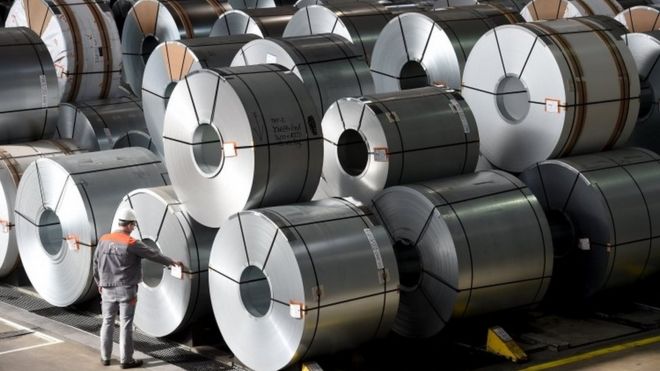
    Steel works
    Germany's economic growth slowed in the second quarter of the year but remained robust, according to official data.
    The country's gross domestic product rose by 0.6% in the three months to June, the Federal Statistics Office said, which was slightly lower than analysts' forecasts.
    Growth was driven by consumer and state spending plus company investment.
    However, the strong domestic economy sucked in a higher rate of imports dampening overall growth.

    'Staying power'

    The Federal Statistics Office, Destatis, said that "the development of foreign trade... had a downward effect on growth because the price-adjusted quarter-on-quarter increase in imports was considerably larger than that of exports".
    Alexander Krueger, an economist at Bankhaus Lampe, said: "The German economy is proving its staying power, the upswing continues."
    He said the European Central Bank's low interest rates were boosting the eurozone's largest economy.
    Destatis also revised upwards its growth estimate for the first quarter of the year to 0.7% from the initial estimate of 0.6%.
    Carsten Brzeski, analyst at ING Bank, said Germany's economic success just went "on and on and on" but he cautioned that exports could be dented by a stronger euro, weaker-than-expected US growth and Brexit uncertainty.
    The French economy, the second largest in the eurozone, grew 0.5% in the second quarter, helped by stronger exports according to preliminary data.
    Spain's economy grew by 0.9% in the April-to-June quarter, while Italy's preliminary data is expected on Wednesday.

    Monday, August 14, 2017

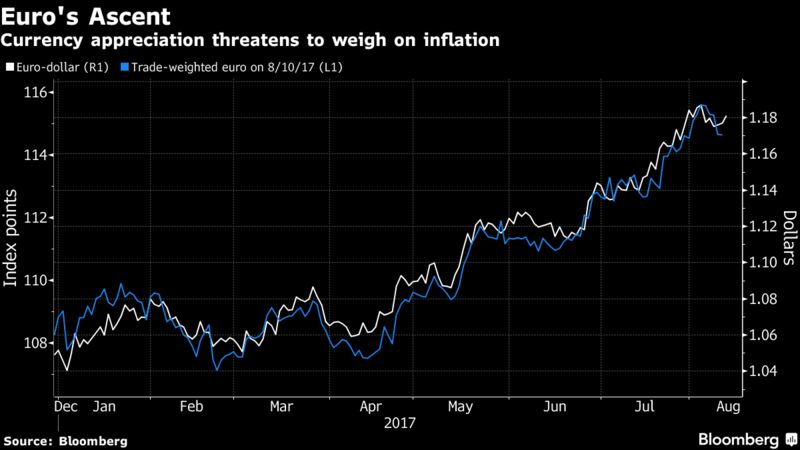
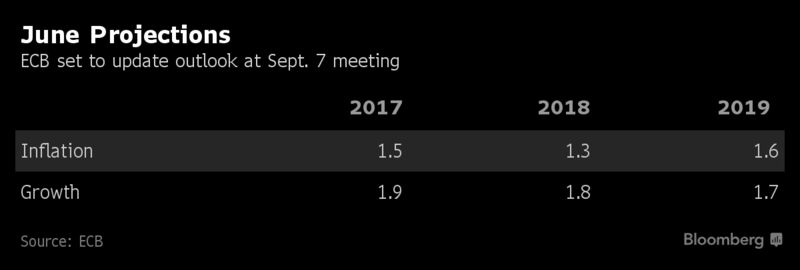
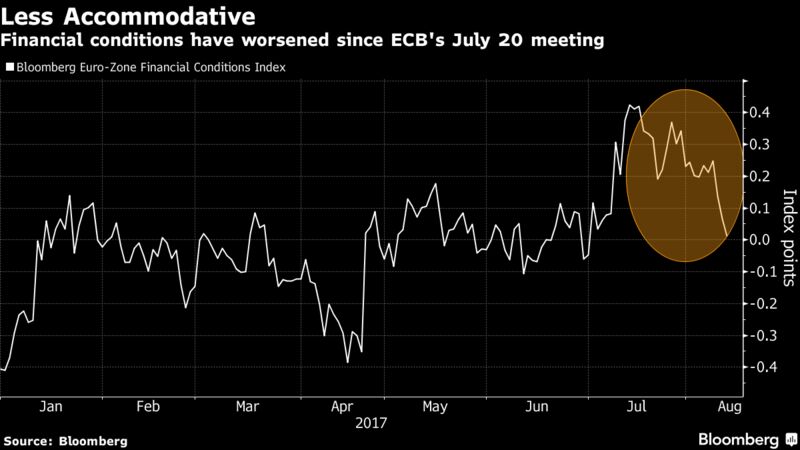
    Bloomberg News - Draghi Unfazed About the Strength of the Euro

    Friday, August 11, 2017

    BBC News - Rogoff: Rising interest rates 'threaten global economy'

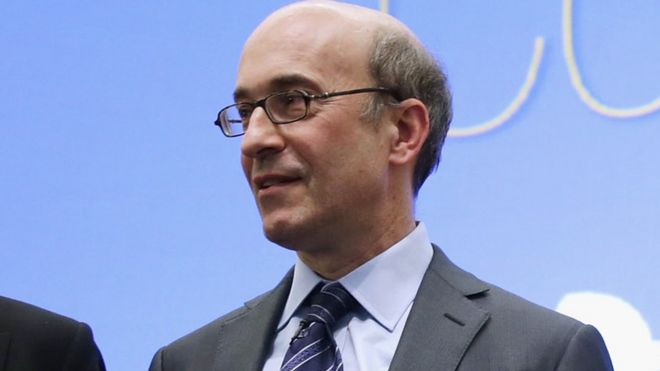
    Ken Rogoff, economistImage copyrightGETTY IMAGES
    Image captionKen Rogoff previously said China was the biggest threat
    A sudden rise in interest rates poses the greatest threat to the global economy, the IMF's former chief economist has told the BBC.
    Ken Rogoff, who famously predicted a big bank would collapse during the financial crisis, warned that people had got used to ultra-low interest rates.
    He also said the economic policies of the Trump administration posed a risk.
    Previously the economist had said China was the number one threat.
    Talking to the BBC's World at One Mr Rogoff said that levels of personal and corporate debt had risen in the global economy.

    'Start to unravel'

    This was while interest rates had been held at historic lows in many countries, to encourage investors to borrow and spend after the financial crisis.
    "If something was to happen that pushes interest rates up, we could see a lot of soft spots - places where there is high debt - start to unravel," Mr Rogoff said
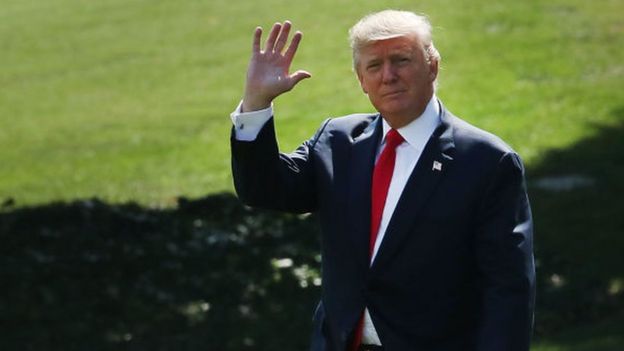
    US president Donald Trump
    Mr Rogoff said the White House posed a greater threat to the world economy than China.
    He also said that the economic policies of the White House were creating uncertainty, without naming specific policies.
    President Donald Trump is pursuing a more protectionist trade agenda and trying to relax regulations brought in to protect the financial system after the crash.
    He has also pledged to slash taxes and boost infrastructure spending.
    "The risk is that the White House or the US will do something really irrational. That may seem hyperbolic but we are all holding our breath," Mr Rogoff said.

    'Scarred generation'

    He added that China, the world's second largest economy, remains a threat due to its own debt problems, political instability and dependency on exports.
    Speaking ten years on from the start of the financial crisis, Mr Rogoff said the US had substantially recovered from the downturn of 2007-8.
    But he said a generation had been "scarred" by the crash and many young people had struggled to find work as a result.
    "I think the crash greatly amplified this wave of populism that the world's feeling right now," he said.
    "The US would not have had Donald Trump as president without the crash."

    Thursday, August 10, 2017

    Reuters News - Asia stocks snap back into the red on simmering North Korea tensions

    TOKYO (Reuters) - Asian stocks turned lower on Thursday as investors fretted about the simmering tensions between the United States and North Korea, sending Seoul shares skidding to two-month lows even as the previous day's rush into safe-haven assets appeared to slow.
    Spreadbetters expected European stocks to follow suit, forecasting Britain's FTSE to open down 0.6 percent and Germany's DAX and France's CAC to start a shade lower.
    MSCI's broadest index of Asia-Pacific shares outside Japan slipped 1 percent, snapping a brief foray into positive territory early in the day and extended losses from Wednesday.
    Japan's Nikkei also handed back earlier gains to shed 0.1 percent.
    Shanghai fell 1.1 percent and Hong Kong's Hang Seng lost 1.6 percent. South Korea's KOSPI dropped as much as 1.2 percent to a two-month low to move further away from record highs set at the end of July.
    "Some investors had wanted reasons to unwind their long positions built up in emerging market equities, and they found an opportunity in the latest bout of Korean tensions," said Kota Hirayama, senior emerging markets economist at SMBC Nikko Securities in Tokyo.
    "At the moment, it is unclear how the Korean situation will play out and that is hampering the markets. But as past incidents involving the Korean Peninsula have shown, the impact on financial markets tends to fade away over a span of few days."
    The declines in some Asian bourses, like Japan's Nikkei, were limited after Wall Street shares closed barely lower overnight, trimming losses, as investors appeared to brush off geopolitical concerns. [.N]
    The flight-to-safety into U.S. Treasuries also abated overnight. The 10-year Treasury note yield initially fell to a six-week low of 2.212 percent as bond prices rose, but climbed back to 2.248 percent.
    "U.S. equities managed to cut its losses towards yesterday's close and while the VIX (volatility index) did pop higher, it still remains at an overall low level. Furthermore, the benchmark Treasury yield also climbed away from lows," said Junichi Ishikawa, senior forex strategist at IG Securities in Tokyo.
    "These developments suggest that risk aversion caused by geopolitical tensions in North Asia are temporary in nature, as long as it does not involve military conflict."
    Bids into the Japanese yen and Swiss franc, currencies that find demand in times of geopolitical anxiety, also tapered.
    The dollar was steady at 110.030 yen after going as low as 109.560 overnight, its weakest in eight weeks.
    The Swiss currency slipped 0.2 percent against the dollar to 0.9655 franc after surging more than 1 percent the previous day.
    The euro inched down 0.2 percent to $1.1737 while the dollar index against a basket of major currencies added 0.1 percent to 93.662.
    Currency markets focused on the U.S. producer price index data due later in the session. Investors will study the numbers to get a feel for the U.S. inflation trend and any impact the data could have on the Federal Reserve's monetary policy.
    The New Zealand dollar slipped to a near one-month low of $0.7300 after Reserve Bank of New Zealand Governor Graeme Wheeler said he would like to see the local dollar fall and noted the central bank had the capability to intervene.
    The RBNZ had held rates at a record low of 1.75 percent on Thursday and reiterated that policy would stay loose for a considerable time to come.
    In commodities, crude oil lost momentum after rising overnight on data pointing to declining U.S. inventories. [O/R]
    Brent crude was flat at $57.70 a barrel.
    Gold prices were nudged away from recent highs as broader risk aversion receded somewhat. Spot gold was 0.1 percent lower at $1,276.40 an ounce after having spiked the previous day to a near two-month peak of $1,278.66.
    Reporting by Shinichi Saoshiro; Editing by Eric Meijer & Shri Navaratnam