Monday, May 14, 2018

BBC News - Interest rates on hold as Bank cuts growth outlook

The Bank of England said the UK economy has hit a "temporary soft patch" as it kept interest rates on hold at 0.5%.
The Bank cut its growth forecast for the year to 1.4%, down from the forecast of 1.8% made in February.
The Bank says that cut is almost entirely due to the disruption to the economy caused by bad weather in March.
However, Bank governor Mark Carney said in an interview with BBC economics editor Kamal Ahmed that "it's likely" rates will rise this year.
In a press conference after the rates decision was announced, Mr Carney said the "underlying pace of growth remains more resilient than the headline data suggests".
As recently as February economists were expecting the Bank to raise interest rates this month.
That view changed after figures released last month showed that the economy grew by just 0.1% in the first three months of the year.
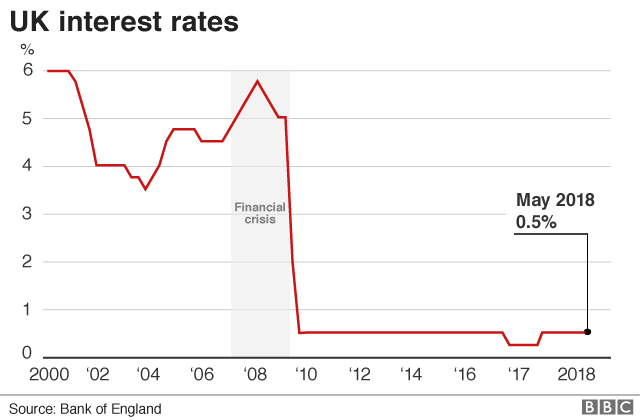
Interest rates
The slowdown was caused by the Beast from the East - severe weather which shut down construction sites, kept shoppers at home and caused transport chaos.
However, the Bank described that as a "temporary soft patch" with "few implications" for the outlook for the economy.
The financial markets are now indicating there will be an interest rate increase towards the end of the year followed by another in 2019, and a further one in 2020.
Movements in the Bank's official rates can have big effects on UK households. A rise would mean that about four million households with variable or tracker rate mortgages would see an increase in their monthly payments, while an increase would benefit the nation's 45 million savers.
Mr Carney sets interest rates with a team of eight other experts that form the Monetary Policy Committee (MPC).
At the latest meeting, seven members voted to keep interest rates on hold and two, Ian McCafferty and Michael Saunders, voted for an increase.
"It looks like the 2018 rate hike has been delayed not cancelled," Fitch Ratings chief economist Brian Coulton said.
However, former MPC member Andrew Sentance said the Bank had "totally misunderstood" the economic slowdown. He said persistent low interest rates and uncertainty over their future direction were undermining the pound and hurting consumers by causing inflation.

Presentational grey line

Analysis: Kamal Ahmed, BBC economics editor
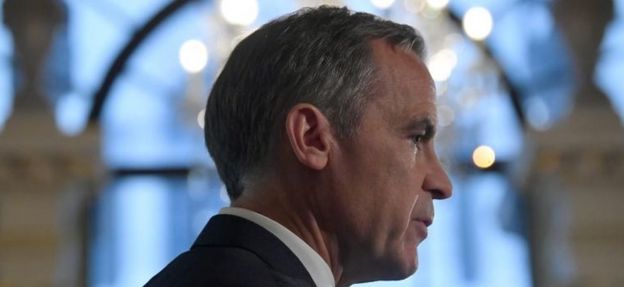
Mark CarneyImage copyrightREUTERS
Is Mr Carney revealing once again his "unreliable boyfriend" tendencies, promising that interest rate rises are just around the corner, only to pull back?
He might suggest that he and the other eight members of the MPC are less the unreliable partners, more the "sensitive" listeners.
Sensitive to changes in the data which effect a decision based on fine margins and delicate judgements.
It was John Maynard Keynes who said that when the facts changed, so, sir, did he.
Today the Bank has changed tone. Let's wait and see, it is saying.
Let's wait and see how the economy develops until we give any firm guidance on the path of interest rates beyond the Bank's often used formulation of some limited rises "over the forecast period" of the next three years.
Yes, they will rise at some point. But the chances of that happening sooner rather than later has receded.

Presentational grey line
The minutes from the meeting show the MPC wants to wait and see how the economy performs over the coming months.
While they expect it to recover from a weak start to the year, there is a risk that the slowdown could be more persistent.

Rate rise?

The Office for National Statistics appears to be more pessimistic than the Bank of England.
The ONS released data today showing that industrial production expanded just 0.1% in March from February. It said the economy was "sluggish" in the first quarter, but said the bad weather had "little impact overall", suggesting it thinks the economy has underlying problems.
Later on Thursday, in an interview with the BBC's economics editor, Mr Carney said: "It's likely over the course of the next year rates will go up... that's the most likely thing to happen."
But any rate rises would be at a "gentle pace", the governor said. He added that there could be shocks to the UK economy from protectionist trade policies or from Brexit, in which case: "If the economy slows... then we will adjust policy."
The course of interest rates depends on inflation falling in line with the Bank's expectations.
In March, inflation was running at an annual rate of 2.5%, which is above the Bank's target of 2%.
But in its most recent Quarterly Inflation Report, the Bank blames above-target inflation on higher prices of imported goods caused by a weaker pound.
The Bank expects that effect to fade over the coming years, bringing inflation back to 2% by early 2021.
It also forecast that the unemployment rate would fall further, to 4% by 2020, the Bank's lowest forecast since the financial crisis.

Wednesday, May 9, 2018

Bloomberg News - Lords Defeat May, Vote to Remove Brexit Date From Key Bill


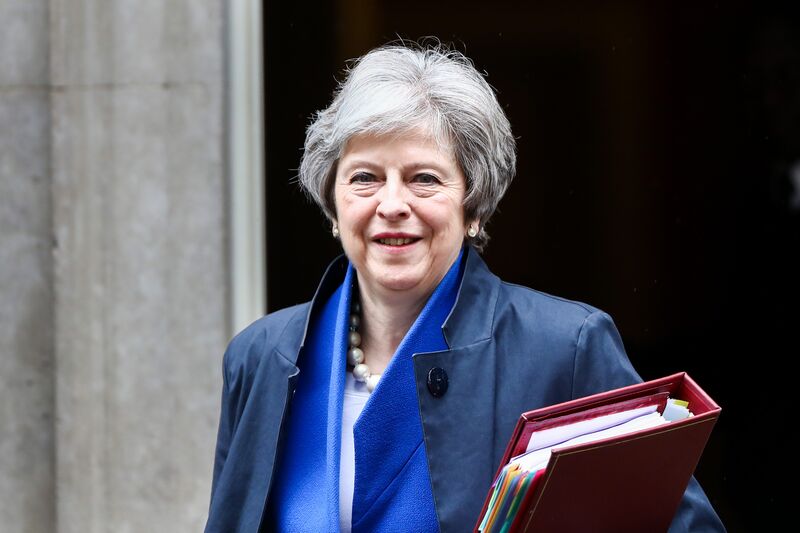
Theresa May Photographer: Simon Dawson/Bloomberg

The House of Lords inflicted another defeat on the U.K. government over its key piece of Brexit legislation, voting to strip out the fixed timing for Britain to leave the European Union.
The government in November inserted 11 p.m. on March 29, 2020 into its own bill to “remove any confusion or concern about what ‘exit day’ means,” Brexit Secretary David Davis said at the time. It was viewed as an attempt to pacify Brexit supporters who feared exit talks dragging on, but critics said it removed the flexibility to extend discussions if needed. Those seeking to thwart Brexit also want to be able to extend membership to give them time to maneuver.
EU member states would have to agree unanimously to any extension.
“What is the point of putting the date on the face of this bill when it may have to be changed in circumstances which we cannot foresee?” Conservative peer Charles Wellesley, the Duke of Wellington, told lawmakers on Tuesday. “This date should not be defined and specified on the face of the bill in case it becomes necessary and in the national interest to agree an extension” to talks.

Earlier, peers voted against the government on an amendment that would allow Britain to participate in EU agencies after leaving the bloc.
The defeats are another Brexit setback for Prime Minister Theresa May, who has suffered a string of losses at the hands of the unelected chamber. In the past three weeks, peers have voted to compel ministers to seek a form of customs union with the EU, curtail ministerial powers and expand the scope of a meaningful parliamentary vote on the final deal. In total, they have voted through 12 amendments against government wishes.
Though all of the changes can be reversed when the legislation returns to the House of Commons, it’s not clear there’s a majority in the lower chamber to do so. At least 10 Conservative lawmakers have put their names to an amendment on a separate piece of legislation in support of staying in a customs union -- enough to defeat the government on the Lords amendment on the same topic.
Tory rebels in the Commons also helped defeat the government to insert the provision for the meaningful vote on the final Brexit deal, before the bill moved to the Lords.
Parliament’s upper chamber voted by 311 to 233 to strip out the Brexit date, and by 298 to 227 for the change on EU agencies. Both amendments were sponsored by peers from across the political spectrum.
The amendment on EU agencies is designed to “give some element of shape to what now seems formless and void,” said Nicholas Baines, The Lord Bishop of Leeds. The government opposed the change even though what it calls for is quite similar to what May has herself proposed.
“The government considers its inclusion in the bill to be both completely unnecessary and totally inappropriate,” Brexit Minister Martin Callanan told the Lords. The legislation as currently worded didn’t prevent any future government or parliament from mirroring EU law, or choosing to participate in EU agencies, he said.
After Tuesday’s sixth and final debate at the “report stage” of the bill in the Lords, it will have a so-called third reading on May 16. Further amendments are still possible at that stage: Labour has said a debate on environmental protections is “one to watch.”
It then returns to the Commons, where lawmakers must decide whether to accept the amendments or send it back to the Lords for further consideration.

Tuesday, May 8, 2018

Reuters News - Wall Street drops in choppy session on uncertainty over Iran deal

(Reuters) - Wall Street was lower in choppy trading on Tuesday afternoon, as oil prices slid on uncertainty over whether President Donald Trump would withdraw the United States from the Iran nuclear deal.

Stocks were lower for most part of the morning before sharply paring losses after CNN reported Trump was expected to impose sanctions on Iran, but may also allow for “a grace period that may offer the deal’s proponents an opening to negotiate.”
But those moves evaporated just as quickly after the New York Times reported that Trump told French President Emmanuel Macron the United States was going to pull out.
Macron’s office later said Trump had not given the French leader any indication of his decision. The announcement will be made at 2 p.m. ET (1800 GMT).
“We’re getting conflicting reports about the Iran deal. The market will struggle until we get clarity on this,” said Michael Antonelli, managing director, institutional sales trading at Robert W. Baird in Milwaukee.
Crude prices CLc1 LCOc1 were down more than 2 percent, easing from steeper losses after the CNN report. The S&P energy sector .SPNY, which led a rally on Wall Street in the past two days, was down 0.7 percent.
“There’s just a lot of uncertainty right now with respect to what the announcement will be and what the effect on oil prices could be as a result, so people are trading every which way,” said John Carey, portfolio manager at Amundi Pioneer Asset Management in Boston.
At 12:36 a.m. EDT the Dow Jones Industrial Average .DJI was down 77.12 points, or 0.32 percent, at 24,280.20, the S&P 500 .SPX was down 8.27 points, or 0.31 percent, at 2,664.36 and the Nasdaq Composite .IXIC was down 18.18 points, or 0.25 percent, at 7,247.03.
The CBOE Volatility Index .VIX rose 0.28 points to 15.03, gaining for the first time in four sessions.
The S&P financial sector .SPSY was up 0.6 percent, and along with the industrials group .SPLRCI, was the only other gainer among the 11 major S&P sectors.
Citigroup (C.N) rose 3.4 percent after activist investor ValueAct invested $1.2 billion in the bank, citing its low risk and reliable revenue.
Comcast (CMCSA.O) fell 4.8 percent after Reuters reported the cable operator is preparing to make an all-cash offer for media assets that Twenty-First Century Fox (FOXA.O) has agreed to sell to Disney (DIS.N) for $52 billion.
Disney, which is due to report its results after markets close, was down 1.4 percent. Fox’s shares rose 0.1 percent.
The Dow Jones Transport Index .DJT jumped 0.8 percent on boost from logistics company Expeditors (EXPD.O), which jumped 7.8 percent after reporting strong first-quarter earnings.
Declining issues outnumbered advancers for a 1.54-to-1 ratio on the NYSE and a 1.05-to-1 ratio on the Nasdaq.
The S&P index recorded 15 new 52-week highs and seven new lows, while the Nasdaq recorded 96 new highs and 32 new lows.
Reporting by Medha Singh and Sruthi Shankar in Bengaluru; Additional reporting by Savio D'Souza, Sinead Carew and Caroline Valetkevitch; Editing by Anil D'Silva

Monday, May 7, 2018

BBC News - UK-EU customs partnership 'still on table'

A new "customs partnership" with the EU - which is fiercely opposed by some Tory Brexiteers - is still on the table, the business secretary says.
Greg Clark warned about the effect of border checks on manufacturing jobs, saying whatever replaces the customs union was of "huge importance".
He added whichever option was chosen would "take some time" to put in place.
Eurosceptic backbencher Jacob Rees-Mogg criticised "Project Fear" warnings about job losses after Brexit.
He said if the partnership model was adopted, "we would not in effect be leaving the European Union".
But Mr Clark was supported by former home secretary Amber Rudd, while Remain-supporting Tories criticised pro-Brexit "ideologues", saying they did not represent the party at large.
All EU members are part of the customs union, within which there are no internal tariffs (taxes) on goods transported between them. There is also a common tariff agreed on goods entering from outside.
The UK government has said it is leaving the EU customs union so that it can strike its own trade deals around the world, something it cannot do as a member. But ministers have not yet agreed how to replace it.
The UK is under pressure to make progress on the issue before next month's EU summit.

Clark's Toyota warning

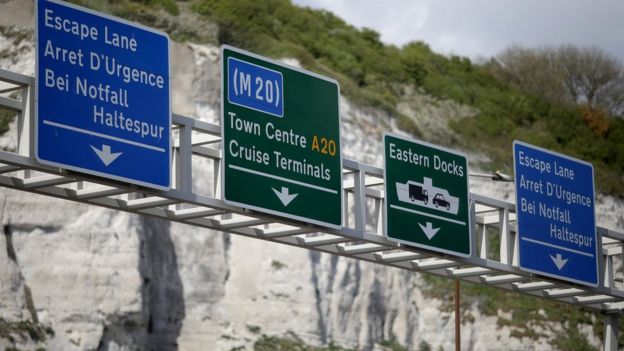
Signs at Dover PortImage copyrightGETTY IMAGES
Image captionHow to avoid customs checks has become a key Brexit debating point
Speaking on the BBC's Andrew Marr Show, Mr Clark said the UK would leave the customs union in 2019 with Brexit, and that finding the right replacement was of "huge importance", pointing to the needs of manufacturers like Toyota to avoid friction at the borders.
At last week's Brexit sub-committee meeting of senior ministers, several are believed to have voiced concerns about one of the two options put forward by the government - whereby Britain would collect tariffs on behalf of the EU for goods destined for member states.
Mr Clark said the ministers had had "a much more professional, collegiate discussion" than reports suggested.
And he said the partnership proposal had not been killed off, saying it offered the "very important" feature of avoiding paperwork at UK-EU borders.
But he added that this model was "not perfect" because arrangements would be needed to refund firms if they were only liable for lower UK rates.
He said this, and an alternative proposal of using technology and advanced checks to minimise border disruption, needed "further work", and that whichever was chosen, "it will take some time to have them put in place and available".
The business secretary said it was "possible" this could take two or three years after the UK leaves the EU, suggesting that different elements of the plan could be implemented at different times.
Former home secretary Amber Rudd - who resigned last Sunday over a deportations row - backed Mr Clark's comments.
Ms Rudd, a leading voice in the 2016 campaign to stay in the EU, tweeted that the business secretary was "quite right" to argue for a "Brexit that protects existing jobs and future investment".

The government's two customs options

  • A 'highly streamlined' customs arrangement - This would minimise customs checks rather than getting rid of them altogether, by using new technologies and things like trusted trader schemes, which could allow companies to pay duties in bulk every few months rather than every time their goods cross a border
  • A customs partnership - This would remove the need for new customs checks at the border. The UK would collect tariffs set by the EU customs union on goods coming into the UK on behalf of the EU. If those goods didn't leave the UK and UK tariffs on them were lower, companies could then claim back the difference.

Opposition from Brexiteers

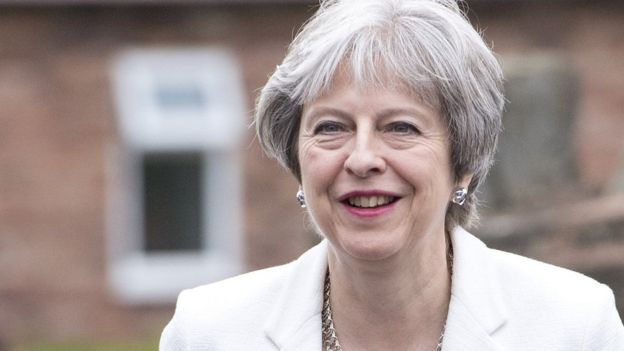
Theresa MayImage copyrightREUTERS
Image captionSome Tory MPs are urging Theresa May to drop one of her customs proposals
Mrs May has been repeatedly urged by Brexiteers to abandon the partnership option, which critics say would keep the UK tied to EU rules.
The Sunday Telegraph quoted a cabinet source saying it would be "unimaginable for the prime minister to press on with the hybrid model after it has been torn apart by members of her own Brexit committee".
Speaking on ITV's Peston on Sunday, influential backbench MP Jacob Rees-Mogg - who has previously labelled the proposal "cretinous" - dismissed warnings about the impact on jobs if it is rejected.
"This Project Fear has been so thoroughly discredited that you would have thought it would have come to an end by now," he said.
"We will have control of goods coming into this country - we will set our own laws, our own policies, our own regulations, and therefore we will determine how efficient the border is coming into us."
The customs debate is central to the question of border between Northern Ireland and the Republic, with supporters of a customs union saying anything else will mean checks and a "hard border".
But Arlene Foster, who leads the Democratic Unionist Party, said a "free flow" of trade did not require a customs union, adding that a border was already in place between the two different jurisdictions.
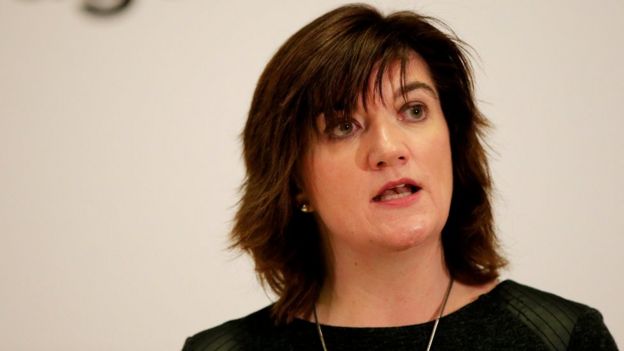
Nicky MorganImage copyrightPA
Image captionNicky Morgan criticised Brexiteer voices inside the Tory party
However, some pro-EU Tories are still pushing for much closer economic ties to the EU.
Asked about Mr Rees-Mogg and other Brexiteers, former education secretary Nicky Morgan told Pienaar's Politics on BBC Radio 5 live people who "shout loudest" did not necessarily represent the majority of Conservatives.
She said Tory rebels on her side of the debate would be prepared to defy the party whip in key votes "in the national interest" but that the MPs who were "sabre-rattling about leadership" were those who wanted "the hardest of hard Brexits".
And ex-business minister Anna Soubry told The Sunday Politics Mrs May had to "see off" those who operate a "party within a party" who do not represent "the country at large".
"These are ideologues," she added.
The CBI welcomed Mr Clark's commitment to "frictionless" trade, saying the customs union should remain in place "unless and until an alternative is ready and workable".

Labour Brexit splits

Labour, meanwhile, faced criticism of its position on Brexit from pro-EU voices in the party.
The leadership was accused of "complete cowardice" by Labour peer Lord Alli for not supporting a Lords amendment aimed at keeping the UK within the European Economic Area (EEA), like Norway, after Brexit.
EEA members get access to the single market - with free movement of people, goods, service and money - without being EU members.
But shadow international trade secretary Barry Gardiner said such an arrangement would reduce the UK to being a "rule taker" without a seat at the table when decisions on regulations are made.
Labour says it would seek to draw up a new customs union with the EU after Brexit, and would try to persuade Brussels to change the rules and allow it to strike deals around the world.
Shadow chancellor John McDonnell told the Marr show that despite the criticism, the party had not lost votes by not being "anti-Brexit" or "trying to reverse the referendum".
"What people want is a traditional British compromise," he said.
"Respect the referendum result, but get the best deal you can to protect our economy and protect our jobs."

Wednesday, May 2, 2018

Reuters News - U.S. extended EU tariff exemption because of good trade discussion: Ross

WASHINGTON (Reuters) - U.S. Commerce Secretary Wilbur Ross on Tuesday said the one-month extension of the exemption from new steel and aluminum tariffs granted to the European Union was the result of promising discussions to reduce trade tensions, and he does not anticipate granting exemptions to become a continuing practice.
“We’re having some potentially fruitful discussions about an overall reduction in trade tensions,” he said in a CNBC interview. “I don’t think we have any intention to grant protracted extensions, that defeats the whole purpose.”
Reporting by Lisa Lambert and David Lawder; Editing by Chizu Nomiyama

Tuesday, May 1, 2018

BBC News - Consumer borrowing slows ahead of interest rate decision

Cash
Growth in unsecured lending - including loans, credit cards and overdrafts - slowed sharply in March, further easing pressure on interest rate policymakers.
The chances of a Bank rate rise in May have receded in recent days amid signs of slowing economic growth.
Bank of England figures now show that consumers' unsecured borrowing slowed from a 9.4% annual rise in February to an 8.6% increase in March.
Manufacturing growth was also slower than expected, a survey suggested.
The latest manufacturing purchasing managers' index from Markit/CIPS fell to a 17-month low of 53.9 in April from 54.9 the month before, although a figure above 50 still indicates the sector is expanding.
The weaker-than-expected data led to a further fall in the pound, with sterling at a three-and-a-half-month low against the dollar on Tuesday morning, dropping below $1.37.
A series of lacklustre economic data raises the question of whether the Bank of England will go ahead with an interest rate rise when its Monetary Policy Committee meets next week.
Growing consumer borrowing has been one of the factors that policymakers have taken into consideration. However, annual growth has been falling, owing in part to the bad weather curtailing potential spending on credit cards on the High Street.
Until recently, analysts had expected policymakers to raise interest rates in May, and possibly then again later in the year.
That would have brought some cheer to savers who have witnessed years of low returns.
However, official figures released last week suggested the UK economy grew at its slowest rate since 2012 in the first quarter of the year, expanding by just 0.1%.