Wednesday, August 8, 2018

Bloomberg News - Uganda Has Big Plans for New National Airline About to Take Off

by Benjamin D Katz
Uganda’s fledgling national airline will be a candidate for an initial public offering and closer cooperation with other carriers if the launch goes as planned.
Uganda Airlines, which last month signed deals for Airbus SE wide-body jets and Bombardier Inc. regional planes, is due to begin operating 19 routes in January, Transport Minister Monica Azuba Ntege said in an interview.
Monica Azuba Ntege, right, at Farnborough, July 19.
Source: Airbus
“The first step is to get the airline up and moving,” she said. “It is owned 100 percent by the Ugandan government, but after that the plan is to work with other airlines and in future we will float shares.”
Uganda is working to establish a new flag carrier after the last collapsed amid mounting debts in 2001. Ntege said the chief role for the airline, to be based at Entebbe airport outside Kampala, will be in boosting travel links and introducing competition to bring down fares. It will also have a cargo arm to serve areas of the economy such as flower exports and a growing oil sector.
“Our people have been charged exorbitant prices for tickets because there was no competition,” the minister said. “We’re moving progressively, but we’re getting there. We had a national airline and it went down. We don’t want to make the same mistakes.”

Possible Partners

Prospective partners include airlines already operating to Entebbe, including Dubai-based EmiratesQatar Airways, the Dutch division of Air France-KLM GroupDeutsche Lufthansa AG’s Brussels Air arm, South African AirwaysKenya Airways and Ethiopian Airways.
Ethiopian, Africa’s only consistently profitable carrier, has emerged as a major consolidator, with units in Malawi and Togo and plans for equity deals or managements contracts with new carriers in Zambia, Chad, Mozambique, Guinea, Eritrea, Nigeria, Equatorial Guinea and Democratic Republic of Congo.
Initial flights at Uganda Air will use four 76-seat Bombardier CRJ900 jets for regional trips. Services to cities such as Dubai and Accra, Ghana, and long-haul destinations including London and Guangzhou, China, will be possible with the delivery of two 261-seat Airbus A330neo jets from the fourth quarter of 2020.
The expansion will coincide with the opening of a new international airport at Kabaale close to the Congolese border in 2021, a hub that will serve Uganda’s expanding oil industry. The carrier will also provide links to four regional airfields that are being expanded to encourage tourist visits.
Further planes could be added every two years depending on the performance of the business, with profitability coming “at a later stage,” Ntege said.
-With assistance by Fred Ojambo

Monday, August 6, 2018

BBC News -Carney: No-deal Brexit risk 'uncomfortably high'

The possibility of a no-deal Brexit is "uncomfortably high" and "highly undesirable", Bank of England governor Mark Carney has told the BBC.
Mr Carney said the prospect of the UK leaving the EU without a deal was "a relatively unlikely possibility, but it is a possibility".
He said it was "absolutely in the interest" of the EU and UK to have a transition period.
Critics poured scorn on the comments, calling them part of "Project Fear".
Mr Carney's warning came ahead of Theresa May's meeting with French President Emmanuel Macron at his summer retreat on a small island off the French Mediterranean coast.
The prime minister is cutting short a holiday in Italy as she continues to seek support among European leaders for her Brexit plans.
The Bank governor told the BBC that the financial system was robust and could withstand any post-Brexit shocks.
"We have made sure that banks have the capital, the liquidity that they need and we have the contingency plans in place," he told the BBC's Today programme.
"There is a very broad range of potential outcomes to these Brexit negotiations and we are entering a crucial phase."
The pound declined on the currency markets in the wake of Mr Carney's comments, falling below the $1.30 mark, but had recovered by early afternoon.
Mr Carney said that if a no-deal Brexit were to happen, it would mean disruption to trade and economic activity, as well as higher prices for a period of time.
"Our job in the Bank of England is to make sure that those things don't happen. It's relatively unlikely but it is a possibility. We don't want to have people worrying that they can't get their money out," he said.
Mr Carney added: "We've put the banks through the wringer to make sure that they have the capital. Whatever the shock could happen from, it could come from a no-deal Brexit, we've gone through all the risks of a no-deal Brexit.
However, he said that even with liquidity and capital, the banks could not solve all Brexit-related financial problems.
"There are a few things the EU government has to solve, " he said.
"The UK has taken all the steps, all the secondary legislation it needs to. The European authorities still have some steps they need to take. We're having conversations and we expect those to be addressed."

Analysis:

Simon Jack, BBC business editor
The governor of the Bank of England doesn't say anything by mistake. Like all central bank chiefs, he knows that his every utterance is subjected to minute scrutiny.
So this warning appears to be a deliberate intervention at a crucial moment in Brexit negotiations from a governor who considers it part of his job to highlight risks to the financial system and the wider economy.
Others consider him too political by half - his previous statements were labelled "beneath the dignity of the bank" by leading Eurosceptic MP Jacob Rees-Mogg.
Mark Carney has been clear that the banking system is resilient enough to handle a no-deal Brexit, but today he made it just as clear that it's a test we should be very keen to avoid.
As he has pointed out in the past, the UK is the financial hub for the whole of the EU so leaving without a negotiated settlement would have serious consequences for both sides.
As government ministers tour the scorching capitals of Europe, Mark Carney has cranked up the temperature at home.

'Project Fear'

Critics rounded on the governor, with Jacob Rees-Mogg, who leads the Tory pro-Brexit European Research Group, saying: "Mark Carney has long been the high priest of Project Fear, whose reputation for inaccurate and politically motivated forecasting has damaged the reputation of the Bank of England."
The former work and pensions secretary, Iain Duncan Smith, said: "There is no such thing as a no-deal, as the [World Trade Organization] is where the EU and the UK are already and as a rule-based organisation, both sides would have to abide by those rules.
He said the Treasury and the Bank of England had "struggled to understand how this would work".
And economist Ruth Lea, adviser to the Arbuthnot Banking Group, tweeted that Mr Carney was crying wolf and few people would listen.
However, Catherine Barnard, professor of EU law at Cambridge University, said Mr Duncan Smith's idea of falling back on WTO rules would not work, because in that case, the UK would not be allowed to let EU goods in tariff-free without extending that to the rest of the world.
She told the BBC's The World At One programme: "That would make it very difficult for us to negotiate trade deals in future, because we'd got nothing to negotiate over. We'd already given up the right to impose tariffs."
Meanwhile, Gen Sir Nick Carter, the new head of the armed forces, was asked on the Today programme about reports that the army was being put on standby for a no-deal Brexit - which could see troops help deliver food, medicines and fuel.
He said: "There hasn't been any request yet as far as I'm aware."
Pressed if there had been any discussions about a no-deal Brexit, the chief of the defence staff added: "The Armed Forces are always doing contingency planning but we've not been asked that specific question."

Friday, August 3, 2018

Reuters News - China unveils proposed tariffs on $60 billion of U.S. goods in latest trade war salvo

BEIJING/SINGAPORE (Reuters) - China proposed retaliatory tariffs on $60 billion worth of U.S. goods ranging from liquefied natural gas (LNG) to some aircraft on Friday, as a senior Chinese diplomat cast doubt on prospects of talks with Washington to solve their bitter trade conflict given current U.S. behavior.

The Trump administration ratcheted up pressure for trade concessions from Beijing this week by proposing a higher 25 percent tariff on $200 billion worth of Chinese imports. China immediately vowed to retaliate though at the same time urged the U.S. to act rationally and return to talks to resolve the dispute.
The United States and China implemented tariffs on $34 billion worth of each others’ goods in July. Washington is expected to soon implement tariffs on an additional $16 billion of Chinese goods, which China has already announced it will match immediately.
China has now either imposed or proposed tariffs on $110 billion of U.S. goods, representing the vast majority of China’s annual imports of American products. Last year, China imported about $130 billion of U.S. goods.
China’s finance ministry unveiled new sets of additional tariffs on 5,207 goods imported from the United States, with the extra levies ranging from 5 to 25 percent.
Timing will depend on the actions of the United States, the Chinese Commerce Ministry said in a separate statement.
“The U.S. side has repeatedly escalated the situation against the interests of both enterprises and consumers,” the Commerce Ministry said in its statement.
“China has to take necessary countermeasures to defend its dignity and the interests of its people, free trade and the multilateral system.”
Representatives for the White House and the U.S. Commerce Department did not immediately reply to requests for comment on China’s retaliatory move.

TENSIONS WEIGH ON CHINESE MARKETS

The United States alleges that China steals U.S. corporate secrets and wants it to stop doing so, and is also seeking to get Beijing to abandon plans to boost its high-tech industries at America’s expense. Washington also wants China to stop subsidizing Chinese companies with cheap loans, claiming that this allows them to compete unfairly.
U.S. President Donald Trump has said he is determined to reduce the large U.S. trade deficit with China.
Trump, who has accused China and others of exploiting the United States in global trade, has demanded that Beijing make a host of concessions to avoid the new duties on $200 billion of Chinese goods, which could be imposed in the weeks after a comment period closes on Sept. 5.
China says the United States is deliberately creating the trade conflict, using bullying tactics, and ignoring international negotiating norms so that it can stop the rise of China as an competitor on the world stage.
The rising tensions have weighed on Chinese stock and currency markets, with the Chinese yuan falling against the dollar.

TOP DIPLOMATS MEET

White House economic adviser Larry Kudlow warned China after it announced the latest retaliatory tariffs, saying Beijing should not underestimate Trump’s determination to act on trade.
“They better not underestimate the president,” Kudlow said in an interview on Fox Business Network.”He (Trump) is going to stand tough ... They better not assume anything. The president is not about to back down. And the best news, I think, is we are coming together with the European Union to make a deal with them, so we’ll have a united front against China and, I think, most of our trade team would tell you, we’re moving close on Mexico. So, this unifies NAFTA and U.S.-Europe, Australia, Japan - China is increasingly isolated with a weak economy.”
Kudlow added: “We will not let China steal our technology. We will not.”
China, however, shows no sign of bending to Washington’s pressure.
The two countries have not had formal talks on the trade dispute since early June.
Still, two senior diplomats did meet earlier on Friday, on the sidelines of a regional summit in Singapore.
China is willing to resolve differences with the United States on an equal footing, the Chinese government’s top diplomat said after meeting U.S. Secretary of State Mike Pompeo, but added they did not address their trade war too specifically.
“We are willing to resolve the concerns of both sides via talks on the basis of an equal footing and mutual respect. He (Pompeo) was accommodating on this as a direction, and said that he does not want current frictions to continue,” said State Councillor Wang Yi, who is also China’s foreign minister.
Answering a reporter’s question about what was specifically said on trade, Wang said: “We did not speak in such details. But actually, as journalists have noted, how can talks take place under this pressure?”
However, Kudlow said there has been some communication “at the highest level” on trade between the United States and China in recent days.

CONDOMS AND COFFEE

Among U.S. products targeted in the latest Chinese salvo were a wide range of agricultural and energy products, such as liquefied natural gas. LNG’s inclusion marks a deployment by Beijing of one of its last major weapons from its energy and commodities arsenal in its fight with Washington.
The market is not large by value compared with approximately $12 billion of U.S. crude that came to China last year, but LNG imports could shoot up as Beijing forges ahead with its plan to switch millions of households to the fuel away from coal as part of its battle against smog.
    Morgan Stanley has estimated annual Chinese imports of U.S. LNG could rise to as much as $9 billion within two or three years, from $1 billion in 2017. The amount could be even larger if the United States resolves a logistics bottleneck.
“As the total value of goods under tariffs shoots up, China has little choice but to use LNG and others to top up the value,” said Lin Boqiang, professor on energy studies at China’s Xiamen University.
“The U.S. gas industry will be much harder hit by this as China imports only a small volume whereas U.S. suppliers see China as a major future market.”
Other U.S. goods targeted by China in the latest list include semiconductors, some helicopters, small-to-mid-sized aircraft, condoms, iron ore, steel products, roasted coffee, sugar, foods containing chocolate, candies, and even car windscreens.
The United States was the fourth largest supplier of foreign chocolate products to China in 2017, worth around $24 million, after Italy, Russia and Belgium, according to customs data. China’s growing sweet tooth is seen as a big sales opportunity for international makers of cookies and chocolate bars like Mars and Hershey (HSY.N).
Small and medium sized planes were on the list of goods that would be slapped with an additional 5 percent tariff. However, the list did not specify a weight range or other details on the aircraft. Helicopters with an empty weight of less than 2 tonnes were also on that list.
China’s biggest U.S. imports by value in 2017 were aircraft and related equipment, soybeans and autos.
Additional reporting by Beijing and Shanghai Newsrooms and Susan Heavey in Washington; writing by Ben Blanchard; Editing by Nick Macfie and Martin Howell

Thursday, August 2, 2018

BBC News - Bank of England raises UK interest rates

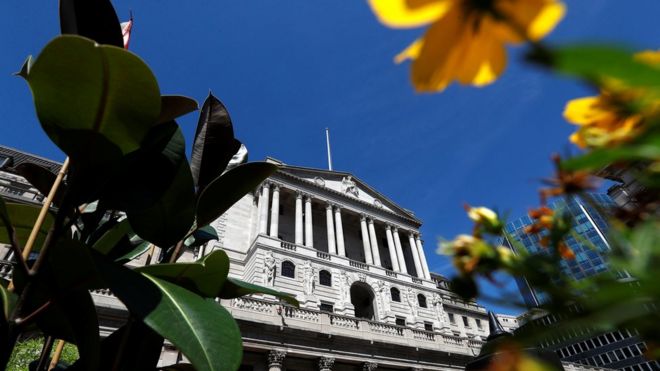
Bank of England
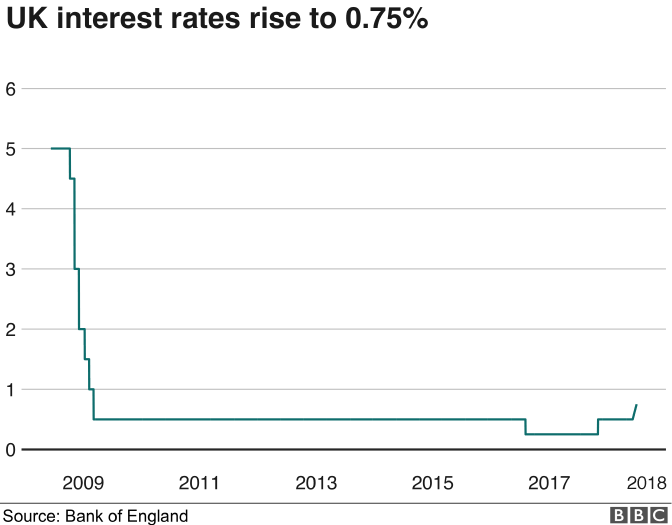
The Bank of England has raised the interest rate for only the second time in a decade.
The rate has risen by a quarter of a percentage point, from 0.5% to 0.75% - the highest level since March 2009.
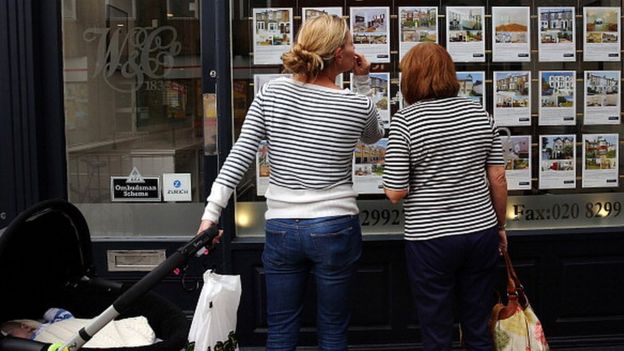
The move will increase the interest costs of more than three-and-a-half million residential mortgages that have variable or tracker rates.
But it will be welcomed by savers, who will be hoping to see a rise in their interest rates over the coming months.
Some business groups questioned the decision to raise the rate now ahead of the UK agreeing a Brexit deal with the European Union.
Suren Thiru, head of economics at the British Chambers of Commerce, said: "While a quarter-point rise may have a limited long-term financial impact on most businesses, it risks undermining confidence at a time of significant political and economic uncertainty."
However, the Bank of England Governor Mark Carney told the BBC that the Monetary Policy Committee (MPC) would lower the rate if the situation merited such a move.
"There are a variety of scenarios that can happen with Brexit… but in many of those scenarios interest rates should be at least at these levels and so this decision is consistent with that," he said.
"In those scenarios where the interest rate should be lower, well then the MPC which meets eight times a year would, I'm confident, take the right decision to adjust interest rates at that time."

Why are they doing this now?

The Bank's MPC had been expected to raise interest rates in May, but held fire because the economy went through a weak patch at the start of the year - partly because of the harsh weather conditions, dubbed the Beast from the East.
The Bank is now confident that the dip was temporary and that economic growth will recover from the 0.2% rate seen in the first quarter, to 0.4% in the second quarter and maintain that pace later in the year.
People looking at estate agent's windowImage copyrightGETTY IMAGES
Image captionHomeowners with a variable rate or tracker mortgage will face an increase in payments
The Bank is sticking to previous guidance that there will be further interest rate rises, but Mr Carney said these will be "limited and gradual".
"Rates can be expected to rise gradually. Policy needs to walk, not run, to stand still," he said.
However, the Institute of Directors said the Bank had "jumped the gun" by raising the rate now.
It said: "The rise threatens to dampen consumer and business confidence at an already fragile time.
"Growth has remained subdued, and the recent partial rebound is the least that could be expected after the lack of progress in the year's first quarter."
Presentational grey line

Five interest rate facts

  • More than 3.5 million residential mortgages are on a variable or tracker rate
  • The average standard variable rate mortgage is 4.72%
  • On a £150,000 variable mortgage, a rise to 0.75% is likely to increase the annual cost by £224
  • A Bank rate rise does not guarantee the equivalent increase in interest paid to savers. Half did not move after the last rate rise
  • No easy access savings account at a major High Street bank pays interest of more than 0.5%
Presentational grey line
The Bank said a pick-up in the economy is being supported by household spending, which the Bank said had been "erratic" earlier in the year.
It is also believes the recent series of store closures on the High Street does not reflect a lack of appetite for shopping.
In its Quarterly Inflation Report, the Bank said: "Although in the past year the number of retail closures have increased and retail footfall has fallen, contacts of the Bank's agents suggest that mainly reflects shifts in consumer demand to online stores and from goods to services."
Commenting on Brexit, Mr Carney said the Monetary Policy Committee "recognises that the economic outlook could be influenced significantly by the response of households, businesses and financial markets to developments related to the process of EU withdrawal".
He said: "Negotiations are now entering a critical period, with the UK and EU both seeking an agreement by the end of the year.
"Although the range of potential outcomes is wide, what matters for monetary policy is how people react to developments."
He said British households so far have been "resilient - but not indifferent - to Brexit news".

What is the outlook?

The Bank sees continuing "modest" economic growth of 1.4% this year and an increase to 1.8% next year.
The unemployment rate is expected to fall further from 4.2% and wage growth is expected to pick up.
Inflation is forecast to fall back to 2% - the Bank of England's target - by 2020.
The Bank sees some clouds on the economic horizon.
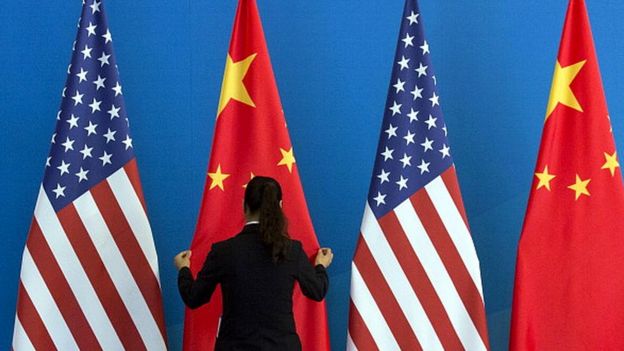
US and China flagsImage copyrightGETTY IMAGES
Image captionThe Bank of England said a trade row between the US and China was weighing on the global economic outlook
It said the outlook for the global economy was a bit gloomier, partly owing to the trade war between the US and China which has seen tariffs imposed on a range of goods.
It also highlighted a slowdown in the UK housing market this year, which has been "concentrated in London", where mortgage completions are down 12% on 2016.
But the Bank thinks that weakness might just be specific to the capital and may not say much about the prospects for the UK housing market as a whole.

What happens next?

The Bank is sticking to its guidance that interest rates will continue to head higher, but only at gradual pace and to a limited extent.
The financial markets have taken this on board and are forecasting one, and perhaps two, rises of 0.25% before 2020.
Interest rate
It also seems unlikely the UK will return to interest rates of 5% and above. In its inflation report ,the Bank published what it thinks is the natural interest rate for the UK economy.
It puts that at between 2% and 3%.
That relatively low rate is partly due to an ageing population.
Older people tend to save more and in the future, that will provide a greater pool of savings for lending to households and industry and help prevent the economy from overheating.