Wednesday, September 21, 2016

Bloomberg News - Fed Focus Turns to Dots as Hike Odds Fade: Decision-Day Guide

Disappointing economic news has led investors to trim expectations for an interest-rate increase when the Federal Reserve concludes its two-day meeting on Wednesday, though with some officials talking up the need to tighten policy, a hike isn’t out of the question.
The Federal Open Market Committee will issue a statement at 2 p.m. in Washington. Chair Janet Yellen will follow with a press conference at 2:30 p.m. Even if there’s no hike, the statement’s description of the economy, a fresh set of quarterly economic projections and the chair’s press conference could shed light on what the Fed may do next. Here’s what to watch for:

Stay or Go?

Support for a rate increase gathered this summer as employers added, on average, 232,000 jobs over the past three months, highlighting a split on the FOMC. The camp that favors gradual rate increases includes three officials who vote on policy this year, led by Boston Fed President Eric Rosengren, who is wary of deliberately letting the economy overheat.
Rosengren or Cleveland’s Loretta Mester could potentially join Kansas City Fed chief Esther George in dissenting if the Fed stays on hold. George has already dissented three times this year in favor of higher rates.
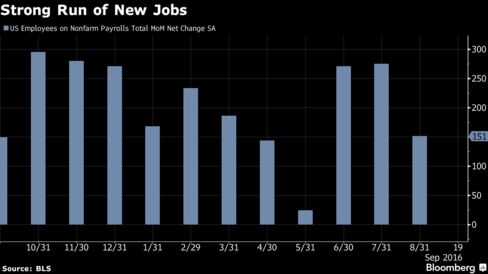
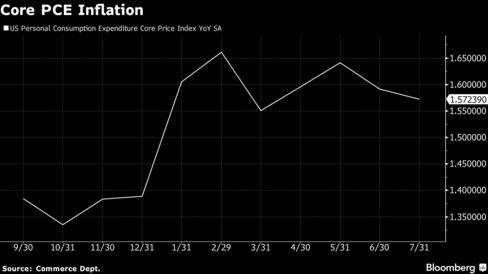
In the opposing camp, Governors Lael Brainard and Daniel Tarullo argued in recent days that the Fed could afford to be patient as it waited for stronger indications that inflation is picking up. The core version of the Fed’s preferred gauge of inflation, which strips out volatile food and energy components, was 1.6 percent in the 12 months through July. It has been below the central bank’s 2 percent target for four years.
Yellen’s last public remarks were Aug. 26 at the Kansas City Fed’s annual symposium in Jackson Hole, Wyoming, where she said that the case for raising rates hadstrengthened. That was before August readings for manufacturing, services and retail spending all came in below expectations.
“The incremental news about the economy has been mildly disappointing across a variety of indicators,” said James Sweeney, chief economist at Credit Suisse Securities USA LLC in New York. “If the decision were close, you’d expect this to sway it to no-go.”
In a Bloomberg survey conducted Sept. 12-14, 48 economists assigned an average probability of 15 percent to a rate hike Wednesday, with 5 percent odds assigned to November and 54 percent to December.

A Hawkish Hold?

In the same survey, 65 percent of respondents believed the Fed will “use a stronger form of forward guidance to signal that it intends to hike rates soon” if it leaves rates on hold, a strategy sometimes referred to as a “hawkish hold.”
“This FOMC meeting will be quite contentious,” said Jonathan Wright, an economics professor at Johns Hopkins University in Baltimore and a former Fed economist. “They will try to achieve as much consensus as possible. That means that if they stand pat, as I think most likely, there will be signaling of a likely rate hike later in the year.”
That could include, he said, bringing back an assessment last seen in December that risks in the economy are, or nearly are, balanced, Wright said.
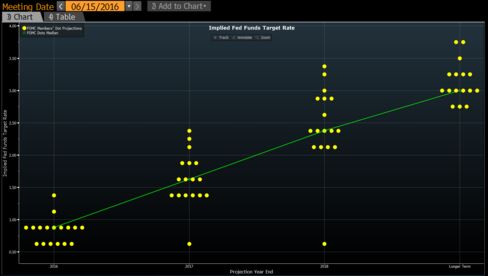
Others think such an explicit signal won’t be necessary. The accompanying quarterly economic projections will already reveal the FOMC’s expectations through the so-called dot-plot, a graphic representation of the FOMC’s forecasts for the appropriate path for interest rates over the next three-plus year. For the end of 2016, it’s highly likely the median projection, as well as a majority of individual projections, will land on 0.625 percent, implying one hike before year’s end.
There’s also a three-month gap before the next FOMC meeting accompanied by a press conference, which can help the Fed manage the impact of an increase.
“I don’t think the Fed will necessarily bring back the balance of risks or insert any other explicit signal in the statement,” said Roberto Perli, a partner at Cornerstone Macro LLC in Washington and former Fed economist. “Risks have still not dissipated entirely, so a firm commitment to move later may be risky.”

Longer Run

Fed watchers will also have an eye out for movement in the dots further out, as well as projections for gross domestic product over the next few years. In June, the median rate forecast implied three hikes in 2017, three more in 2018 and a “longer-run" rate of 3 percent.
FOMC Dot-Plot
FOMC Dot-Plot
The longer-run projection has already declined from 4.25 percent when the dots were introduced in January 2012, reflecting the committee’s “capitulation” to the idea that the neutral rate of interest -- the level that neither stimulates nor holds back the economy -- has fallen, according to Michael Hanson, senior global economist at Bank of America in New York.
Potential explanations for that decline range from population aging, excess flows of global capital into safe assets and declining productivity.
“If the longer-run dots and longer-run GDP forecasts come down, that would be a big acknowledgment on the productivity story,” Hanson said, referring to the new set of forecasts that will be released on Wednesday.
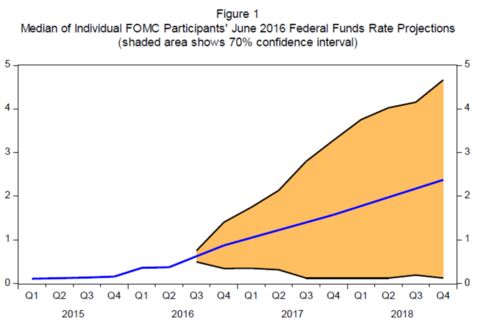
The quarterly forecast might also include something new. In the material released with her Aug. 26 speech, Yellen also published a chart mapping the median of rate forecasts submitted by FOMC participants in June set into a broad shaded area representing a 70 percent confidence band. In other words, to have a 70 percent statistical probability of capturing the actual path of rates through the end of 2018, the shaded area has to include everything from just above zero to about 4.75 percent. The range is based on projections from private and government forecasters over the past 20 years.
The point is to underline how much uncertainty is embedded in Fed forecasts.
Federal Reserve
“The Fed is saying, ‘We could drive a truck through the range of possibilities, but we’re telling you what our best thinking is’,” said Luke Tilley, chief economist at asset manager Wilmington Trust Corp

Tuesday, September 20, 2016

BBC News - 'Dramatic' fall in UK shop openings, a new report shows

Oxford Street 2016Image copyright
There was a "dramatic" fall in the number of shop openings in the first half of the year, according to a new report from the Local Data Company.
It found 20,804 shops opened in the UK between January and the end of June, down 15% on the second half of 2015.
The slowdown was surprising as the first few months of the year typically see a surge in new shops opening up.
The LDC said worries over the state of the global economy and concerns over Brexit were probably behind the fall.
Describing the slowdown as a "dramatic fall", Michael Weedon from the LDC said Brexit was not entirely blame.
"In January and February people were not thinking, 'better not open a shop'," he said.
Instead, concerns over the global economy were likely to have weighed on the minds of entrepreneurs.
The LDC report showed that the number of shop closures also fell in the first half of the year, but by only 5% to 22,801.
All told, closures exceeded openings by 1,997 - reversing the situation in the second half of 2015 when openings were ahead of closures by 335.
Shopper LondonImage copyright

What's next?

The vacancy rate fell for most of the first half of the year, as shops were demolished or used for other purposes faster than new buildings were put up.
However the vacancy rate for shops and leisure premises edged higher in June, rising to 11.2%.
"Whether this will be just a twitch in the statistics or the beginning of a long term reversal will become clear over the coming months," said Matthew Hopkinson from the LDC.
"For example, the 23% net growth in restaurants since 2010 is unlikely to continue.
Business, government and the media are all sniffing the air and scanning the horizon for any piece of news that might tell us what happens next," he added.
Following the financial crisis of 2007, the vacancy rate hit a high of 12.4% in 2011, and has only declined modestly since then.

Monday, September 19, 2016

Bloomberg News - Global Banks to Keep Some Access to EU Post Brexit, Moody’s Says

1474276199_261520234 (1) copy
Photographer: Jason Alden/Bloomberg
Global banks based in the City of London will likely retain limited access to the European Union’s single market after Brexit even if they lose full passporting rights, according to Moody’s Investors Service.
That’s because most EU financial-services laws recognize that some non-EU countries’ rules and oversight of specific business lines are as tough as its own, the credit-ratings company said in a report Monday. While the U.K. leaving the single market would increase costs for the banks, it would likely be “manageable,” Moody’s said.
“In particular, we consider that the third-country equivalence provisions contained within the incoming MiFID II EU directive may provide firms with an alternative means of accessing the single market,” said Simon Ainsworth, senior vice president at Moody’s. “The complexity of (quickly) unwinding the status quo and a desire to minimize the initial impact on European domiciled banks will likely lead to the preservation of most cross-border rights to undertake business.”
Chancellor of the Exchequer Philip Hammond is said to be prepared to accept that Britain may have to give up membership of the single market to achieve the immigration restrictions that voters have demanded. Banks are pressing him to strike an interim agreement with the EU that would preserve their ability to provide services on broadly similar terms to now beyond the end of the official two-year negotiation period.
“The uncertainty around the outcome of any new arrangements mean that it is likely that some banks may choose to move some U.K.-based activities to the EU before the U.K.’s withdrawal negotiations are complete,” Ainsworth said.
London’s position as a financial hub in Europe may be threatened if the U.K. leaves the single market, Bundesbank President Jens Weidmann told the Guardian newspaper. A “hard Brexit” could strip banks of their ability to do business across the EU and open the door for Frankfurt, Weidmann said in an interview.

Friday, September 16, 2016

BBC News - Northern Powerhouse: Osborne to stay and fight for project

George Osborne says he will stay in the Commons to "fight for the things I care about" as he launches a think tank to promote his Northern Powerhouse plan.
Mr Osborne, who was sacked as chancellor by Theresa May, said: "I don't want to write my memoirs because I don't know how the story ends."
There had been a "bit of a wobble" by Mrs May over the project, he said.
No 10 says Mrs May is building on his plan to create a northern economy to rival London and the South East..
In his first major interview since being sacked, Mr Osborne told BBC Radio 4's Today programme: "Politics is a tough business." But he said he believed he could "push and fight for" ideas he backed from outside the cabinet.
The MP for Tatton in Cheshire returned to the back benches following Mrs May's cabinet reshuffle, and said chairing the new body - the Northern Powerhouse Partnership - would "now be a major focus of my political energies".

Analysis by Ben Wright, BBC political correspondent
A mere two months ago George Osborne was the second most powerful member of the government. Then he was the first cabinet minister Theresa May sacked when she became prime minister, dispatching him to the backbenches.
Politics is brutal. But if Mrs May hoped the former chancellor would disappear she was wrong. While David Cameron has opted for memoir writing and - it's safe to predict - a future on company and charity boards his old ally is staying in politics.

The board of the not-for-profit organisation will include business figures from across the north of England, as well as political figures. Its aim is to devolve powers and funds to northern city regions, improve transport links and create new regional mayors to act as figureheads.
Asked why he felt he had to say "the Northern Powerhouse is here to stay", Mr Osborne told the BBC: "To be honest, there was a little bit of a wobble about when we had the new administration about whether they were still committed to the concept of the Northern Powerhouse."
He said he supported economic development across the whole of the country and he had "sweated blood" to get a mayor for Birmingham - but he felt there was a particular opportunity in the North of England because the cities were close together.
Manchester, Leeds, Newcastle, Liverpool
Image captionThe Northern Powerhouse initiative aims to encourage economic growth outside London
Pressed on whether he intended, like his former Downing Street neighbour David Cameron, to quit politics, he said: "No, I'm not."
He said he wanted to "hang around and find out" how his story would end, adding: "There's an enormous opportunity now to take part in the decisions that are going to affect Britain... And I want to be there in ultimately, still the place where these decisions are made, the House of Commons, and be part of that decision-making process. Because I want to fight for the things that I care about."
He said he had voted for Mrs May and she was "the best person for the job of the candidates who put themselves forward" and she had made a "strong start".
She was "perfectly entitled to set the tone" of her administration, including "to take a pause and consider" big decisions like whether to go ahead with the £18bn Hinkley Point nuclear power station.

'Nothing changed'

But he added: "I don't think anything has fundamentally changed from the deal that we put together in government just a few months ago... it looks to me pretty much like the same deal."
On Mrs May's controversial plans to expand grammar schools, Mr Osborne said the new prime minister was "perfectly entitled to set out new ideas" and he supported her goals. But he said grammar schools focused "80% of the political discussion" on where 20% of the children go.
"I'm not against new grammar schools opening up where areas want them, but I think the real focus of education reform remains the academy programme, transforming the comprehensive schools that most people in this country send their children to."

'One of the grown-ups'

Asked about former energy secretary Ed Davey's comments that Mr Osborne and Mrs May had "really disliked each other" when in cabinet together, Mr Osborne responded: "That's genuinely not true. I've worked with Theresa for 20 years in opposition and in government. I actually think she's a person of integrity and real intelligence, and frankly in a Cabinet that included people like Ed Davey, she was one of the grown-ups."
Mr Osborne backed the Hinkley deal and championed the Northern Powerhouse project as chancellor, before being sacked from the cabinet by Mrs May when she became prime minister.
Earlier this month, Labour's mayoral candidates for Greater Manchester and the Liverpool city region urged Mrs May to "honour your promises to the north of England", amid reports that she intends to shift the focus to other areas.
However, Downing Street has denied any lack of commitment, saying Mrs May is building on Mr Osborne's project, having put Treasury aide Neil O'Brien in charge of it in her policy unit and appointing a Northern Powerhouse minister, Andrew Percy.
Crossbench peer Lord Kerslake, who chairs the Northern Powerhouse's advisory board, said it "remains unclear" which direction Theresa May would take the Northern Powerhouse and Mr Osborne wanted to "hold the new government's feet to the fire".
At a news conference, Mr Osborne said he had not spoken directly to Mrs May about the project but had spoken to Communities Secretary Sajid Javid who had been "very supportive".
Mr Javid said the government "realises the huge untapped potential of our great northern towns and cities" and he hoped the new partnership would "become an important part of the debate"

Thursday, September 15, 2016

BBC News - No 'Brexit effect' in latest jobs data

Commuters on way to workImage copyright
Economists have said the slight fall in UK unemployment to 1.63 million between May and July shows there is yet to be a "Brexit effect" on the jobs market.
The unemployment rate was 4.9%, down from 5.5% a year ago and little changed from last month's rate, Office for National Statistics (ONS) data shows.
Nearly three quarters of people who can work have jobs, a record high rate.
Employment was "resilient" before and after the EU vote, despite predictions of an economic shock, analysts said.
Kallum Pickering, an economist at Berenberg, said: "Although it is still early days, the UK labour market is yet to show any Brexit effect for the period immediately before and after the June 23 vote."
His analysis of the ONS data showed that unemployment fell to 4.7% in July, the first month since the vote.
Ben Brettell, senior economist at Hargreaves Lansdown, said: "The UK's labour market proved resilient in the immediate aftermath of the vote to leave the EU, ONS data has shown.
"This is the latest piece of evidence which shows the economy has fared better than expected since June's referendum."
John Hawksworth, chief economist at PwC, agreed the jobs data showed "no immediate impact from the Brexit vote".

Beneath the surface

The ONS said the figures, which only cover one month since the result of the EU referendum, show "continuing improvement" in the jobs market.
But Samuel Tombs, chief UK economist at Pantheon Macroeconomics, warned: "When you scratch beneath the surface, today's labour market figures are not as robust as they first appear."
The rise in people in work "remains supported by surging self-employment", Mr Tombs said.
"The strong growth also reflected a shift towards part-time working; total weekly hours rose by just 0.3% between April and July," he added.
Delivery workerImage copyrigh
Growth in average weekly earnings including bonuses also slowed slightly to an increase of 2.3% on last year. That is still ahead of inflation, which was 0.6% in the year to August.
In signs of a possible slowdown in employment, the claimant count, including Jobseeker's Allowance, went up from the previous month by 2,400 to 771,000.
It comes after a survey this week found employers in six out of nine sectors are less optimistic about adding jobs in the wake of the Brexit vote.
The claimant count is treated with some caution, though, by economists as the move to Universal Credit has made it much harder to calculate.

Analysis: BBC economics editor Kamal Ahmed

One interesting nugget in the employment figures concerns the number of people employed in the public sector.
It is down to 5.33 million, the lowest level since the Office for National Statistics started collecting the figures in 1999 and a drop of 13,000 since March.
The former chancellor, George Osborne, often spoke about the need to "rebalance" the economy.
To an extent, he meant away from financial services and towards manufacturing.
But, more privately, he was actually very comfortable with an economy that was "rebalancing" away from the public sector towards the private sector, where wealth, he would argue, is actually created.
As cuts and wage freezes bite, the public sector has become less attractive as a place to build a career.
Yes, employment is at record levels, but it is the private sector that is on the up.

The unemployment estimates come from the Labour Force Survey in which the ONS talks to 40,000 households every three months.
Although it is a very large survey, there is still a margin of error. The ONS says it is 95% confident that the figure of a 39,000 fall in unemployment is correct to within 78,000.
As the estimated change is smaller than the margin of error, it means the change in unemployment is not statistically significant.

Wednesday, September 14, 2016

Reuters News - Bank bosses call for more time to adapt to life after Brexit

By Huw Jones and Lawrence White | LONDON
Top City of London executives said banks will need more than two years to adapt to Britain's departure from the European Union if the market is to avoid disruption, while the EU's top official called for a prompt start to divorce talks.
Once Britain begins formal negotiations for exiting the EU, known as Article 50, it will have two years until it ceases to be a member of the bloc.
On Wednesday, three of the most senior executives in the City told lawmakers this was not long enough for banks to adapt and they would need more time before a trade deal is put in place.
"It's a multi-year process if it's going to be completed safely and not going to risk financial stability," Alex Wilmot-Sitwell, president of Bank of America Merrill Lynch in Europe (BAC.N) told a House of Lords committee. "I suspect it's two to three years."
HSBC (HSBA.L) Group Chairman Douglas Flint and Allianz Global Investors Vice Chair Elizabeth Corley also warned of the dangers posed by hasty change.
Seeking leeway from Brussels could be difficult, not least because there is disagreement in the British government about what concessions to make in negotiations.
The talks cannot start until Prime Minister Theresa May formally sets the two-year countdown to British departure.
In Strasbourg, Jean-Claude Juncker, who heads the EU's executive European Commission, urged that to be done quickly and repeated the EU negotiating position that Britain could not retain its full EU market access if it blocks free immigration from the EU.
"There can be no a la carte access to the single market," the Commission president told the European Parliament in his annual State of the Union address.
"Only those can have unlimited access to the internal market who accept that there will be free access for persons and goods."
Banks in Britain depend on an EU "passport" to serve clients across the 28-country bloc from one base and lenders worry that these passporting rights will end after Britain leaves the EU.
The European Commission has named a senior German trade negotiator to join France's former EU finance commissioner, Michel Barnier, at the head of the team negotiating Britain's departure from the European Union. [L8N1BQ21N]
In parliament on Wednesday, May said that the government is working for "the right deal" on trade relations with the EU, without giving further details.
NO 'LEGO SET'
Banks are making contingency plans to move some of their operations to continental Europe if Britain does not negotiate access to the bloc's single market after Brexit.
Wilmot-Sitwell said the financial sector is not a "Lego set", where you can pull up and move pieces without affecting clients and financial stability. "You don't move nuclear waste in a race," he added.
HSBC's Flint, who is on a panel advising the government on post-Brexit trading terms, said it would take several years for a bank in London to complete the "enormous task" of setting up a new subsidiary in the EU.
Tinkering with London's financial "eco-system" could undermine new rules regulators have put in place since the 2007-09 financial crisis, Flint said. It could also impact customers across Europe, he said.
London accounts for 69 percent, or $928 billion, of the off-exchange euro-denominated interest rate derivatives market and President Francois Hollande of France has said clearing in euro-denominated contracts should be moved to the euro zone.
That would bump up costs by forcing banks and users to have multiple piles of cash to back trades, Flint said.

(Editing by Elaine Hardcastle and Susan Thomas)

Tuesday, September 13, 2016

BBC News - No rush to raise interest rates, says Fed official

Lael BrainardImage copyright
There is no rush to raise interest rates, a Federal Reserve board member has said a week before the US central bank announces its latest decision.
Economic weakness "counsels prudence", said Lael Brainard, a member of the Fed's Open Market Committee, which decides interest rates.
Her comments come after several Fed officials recently suggested a rate rise this month should be considered.
Ms Brainard has consistently voted against an increase.
Speaking in Chicago, Ms Brainard said the risk that higher rates would damage a fragile US economy exceeded the risk that higher rates would increase inflation.
Her caution follows comments by Boston Fed chief Eric Rosengren on Friday that there was a case for higher rates.
Earlier on Monday, Dennis Lockhart, Atlanta Federal Reserve president, said he still believed that economic conditions justified considering a rate rise this month.
The Fed raised interest rates in December for the first time since 2006, but has held back from increasing them further amid concerns over persistently low inflation.
However, last month Federal Reserve chair Janet Yellen said the case for a hike "had strengthened".
The speculation over the Fed's next move comes amid a claim from Donald Trump that the US central bank was keeping interest rates low to boost the popularity of President Barack Obama.
Republican presidential candidate Donald TrumpImage copyright
The US Republican presidential candidate said Ms Yellen was "obviously political" and had created a "false" stock market by keeping rates low.
Economists and commentators were quick to dismiss his comments, with academic and commentator Paul Krugman tweeting: "In ordinary times this combo of ignorance and paranoia would be shocking. In this election, who'll even notice."
Rates are unlikely to rise until there is a new president, according to Mr Trump. When that happens, the stock market is likely to go "way down", he told CNBC.
"[Ms Yellen] is obviously political and she's doing what Obama wants her to do," Mr Trump said.
Responding to his comments, Minneapolis Federal Reserve president Neel Kashkari told CNBC that at Federal Reserve meetings "politics simply does not come up".
"We look at the economic data," he said.
Federal Reserve Chair Janet YellenImage copyright
Image captionDonald Trump accused Fed chief Janet Yellen of being "obviously political"
When asked about political pressure on the Federal Reserve, Mr Lockhart said: "I don't see the world that way."
Earlier this month, Ms Yellen said the case for raising US interest rates had "strengthened".
Speaking at an annual meeting of central bankers, Ms Yellen was cautiously upbeat about the US economy.
She said economic growth and a stronger jobs market meant "the case for an increase in the federal funds rate has strengthened in recent months".

Savers hit

Mr Trump said that while low interest rates had been good for his property business, savers had been hit.
"The ones that did it right, they saved their money. They cut down on their mortgages... now they're getting practically zero interest on the money that they worked so hard for."