Wednesday, October 19, 2016

Reuters News - Dollar recedes from seven-month peak, lifts oil

A man walks past a currency exchange bureau advertisement showing an image of the U.S. dollar in Cairo, Egypt October 13, 2016.REUTERS/Mohamed Abd El Ghany
By John Geddie | LONDON
The U.S. dollar fell from a seven-month peak on Wednesday, combining with signs of an easing supply glut to help lift oil prices back towards a one-year high.
A weaker dollar boosts crude prices, which gained over 1 percent to top $52 a barrel, since it makes fuel cheaper for countries using other currencies [O/R].
The bounce in oil pushed a key market gauge of long-term euro zone inflation expectations to a multi-month high, keeping bond yields elevated above record lows seen in the wake of Britain's vote in June to leave the European Union.
Wall Street was set to open a touch higher SPc1 but neither the rise in commodity prices nor a barrage of data confirming China's economy, the world's second largest, was stabilizing could prevent a dip in euro zone stocks after a series of poor earnings results. [.EU]
"Oil is a good indicator of expectations for growth next year," said Frederik Ducrozet, a senior European economist at Swiss wealth manager Pictet. "It is comforting for markets that oil is above $50 a barrel and looking stable at those levels."
Against a basket of major currencies .DXY, the U.S. dollar fell 0.2 percent to 97.665, off Monday's seven-month high of 98.169, after consumer price data showed underlying inflation had moderated. That prompted markets to trim bets on a Federal Reserve rate hike later this year. [FRX]
Traders said that had helped lift oil, which was also supported by a report of a drop in U.S. inventories and declining production in China. An upbeat OPEC statement on its planned output cut also supported the market.
International Brent crude futures LCOc1 were at $52.35 a barrel at 1040GMT, up 67 cents, or 1.3 percent, and heading back towards a one-year high of $53.73 seen earlier this month.
U.S. West Texas Intermediate (WTI) crude oil futures CLc1 were trading at $50.96 per barrel, also up 1.3 percent, having been below $40 a barrel at the start of August.
DISAPPOINTING EARNINGS
European shares fell early on Wednesday after a slew of weak updates weighed on British companies Travis Perkins (TPK.L) and Reckitt Benckiser (RB.L). Akzo Nobel's (AKZO.AS) results were hit by a weak pound. [.EU]
The pan-European STOXX 600 index edged down 0.1 percent, following a 1.5 percent rise in the previous session.
For Reuters new Live Markets blog on European and UK stock markets see reuters://realtime/verb=Open/url=http://emea1.apps.cp.extranet.thomsonreuters.biz/cms/?pageId=livemarkets
Earlier, Asian shares edged up for the second straight day after data showing Chinese gross domestic product expanded 6.7 percent in the year to September, exactly as forecast.
Other data showed retail sales rising 10.7 percent and urban investment 8.2 percent. Industrial output disappointed by growing only 6.1 percent.
"The upshot from today's data is that economic activity seems to be holding up reasonably well, with few signs that a renewed slowdown is just around the corner," said Julian Evans-Pritchard, China economist at Capital Economics.
"Nonetheless, the recent recovery is ultimately on borrowed time given that it has been driven in large part by faster credit growth and a property market boom, both of which policymakers are now working to rein in."
MSCI's broadest index of Asia-Pacific shares outside Japan .MIAPJ0000PUS added 0.4 percent on top of Tuesday's 1.4 percent jump.
The recent bounce in oil prices has helped lift a key market gauge of long-term euro zone inflation - the five-year, five-year forward rate - above 1.44 percent EUIL5YF5Y=R, its highest level since early June.

That remains well below the European Central Bank's inflation target of just below 2 percent, but it has taken the heat off the bloc's policymakers - who meet on Thursday - to introduce more easing measures.
Worries that they may eventually scale back their stimulus has seen German 30-year bond yields DE30YT=TWEB climb more than 20 basis points in the last fortnight, already on track for their biggest monthly rise in fourteen months.
DOLLAR RETREAT
The retreat in the dollar came after a report on U.S. consumer prices showed underlying inflation - stripping out food and energy - moderated slightly in September to 2.2 percent, leading the market to slightly pare back bets on a December rate hike.
Fed fund futures <0#FF:> imply around a 65 percent probability of a move, down from 70 percent.
Federal Reserve Chair Janet Yellen said last week the U.S. central bank could allow inflation to run above its target.
The euro was slightly higher against the weakening dollar at $1.0985 EUR=.
Sterling, which plunged to a record low on a trade-weighted basis last week =GBP, continued to recover and hit an eight-day high on Wednesday after a UK government lawyer said that parliament would have to ratify any deal to take Britain out of the EU. [GBP/]
(Additional reporting by Wayne Cole in Sydney; editing by Mark Heinrich)

Tuesday, October 18, 2016

BBC News - Why is globalisation under attack?


Protesters hold a giant snake with dollar notes in its mouth to demonstrate against the TTIP and CETA free trade agreements on Sept 17, 2016 in Berlin, Germany. The EU is currently negotiating with the US over TTIP and Canada over CETAImage copyright
Image captionA model of a giant snake is held aloft by protesters at an anti-globalisation rally in Berlin

Free trade and globalisation seem to be under siege from a broad and loud range of opponents.
For decades there has been a strong consensus that globalisation brought more jobs, higher wages and lower prices - not just for richer countries but also for developing and poorer nations.
But many people, including politicians, are now voicing their anger as they see jobs being taken by machines, old industries disappearing and waves of migration disturbing the established order.
You don't have to look far to see the effect of those concerns in recent events.
The Brexit referendum was dominated by concerns over immigration, the rise of Donald Trump has brought back the rhetoric of protectionismin the US and there have been mass protests in Europe over prospective international trade deals.
What is behind this backlash and what can be done to address this crisis of globalisation?

'Free trade is stupid trade'

The US presidential election has felt like the epicentre of the rising tide of disquiet against free trade and globalisation.
Donald Trump has accused China of wanting to "starve" the US population by manipulating their currency and "cheating" on international trade.
We talk about free trade. It's not free trade; it's stupid trade. China dumps everything that they have over here."
Donald Trump, US Republican presidential candidate
Getty Images
He has said he will impose massive tariffs on Chinese goods because it was economically "raping" the US.
Hillary Clinton has found herself surrounded by political challengers questioning the benefits of international trade and globalisation.
Bernie Sanders, Clinton's opponent in the race for the Democratic nomination, defined his campaign by arguing that globalisation had hollowed out the US middle class.
Clinton's response has been to tack towards the concerns expressed by Sanders and Trump, reneging on her previous support of TTIP (the Transatlantic Trade and Investment Partnership) - the trade agreement between the US and Europe.

US manufacturing's decline

Arguments over the decline of manufacturing in the United States have powered a lot of the heat of the 2016 US electoral cycle.
The sense of grievance is clear - the manufacturing sector in the US has seen six million jobs disappear between 1999 and 2011, according to the Bureau of Labor Statistics.

Workers at on a Chrysler assembly line at the Warren Truck Assembly Plant Sept 25, 2014 in Warren, MichiganImage copyrigh
The decline in manufacturing jobs has become an issue in the US presidential election campaign

Studies have shown that the decline in the US has been mirrored by gains in China.
Chinese imports explain 44% of the decline in employment in manufacturing in the US between 1990 and 2007, according to a report by the Institute for the Study of Labor in Bonn.
Part of that decline has been down to the outsourcing of jobs to other countries but automation and more efficient processes have also taken their toll.
"All countries end up with losers from technological development - whether it is telephone operators or bank tellers," says Gary Hufbauer, a trade expert from the Peterson Institute for International Economics.
"The problem in the US is that we don't do much to help those people who lose out through social security support or job retraining," says Mr Hufbauer.

Police keep watch as demonstrators demanding an increase in the minimum wage to $15-dollars-per-hour march in the streets on April 14, 2016 in ChicagoImage copyrigh
Image captionMany in the US, Europe and Japan have seen no increase in their household income in the past 10 years

Technological and economic change has hit specific geographical areas that have then found it hard to develop new industries and create jobs.
The anger that flows from this has found a home in the protectionist rhetoric of politicians like Donald Trump.
"There has been no growth in household income during the last decade in Europe, the US and Japan. People are not happy and if you have to blame someone, it is easy to blame foreigners,"' says Mr Hufbauer.

Flat-lining world trade

The rise of political opposition to globalisation has coincided with - and contributed to - a period of declining world trade growth since the financial crisis of 2008.

Global trade graph

Between 1986 and 2008 world trade grew at an average of 6.5%, according to the World Trade Organization.
Between 2012 and 2015 that rate has slowed to an average of 3.2% and is predicted to expand by just 1.7% in 2016.
That slowdown would make it the longest period of relative trade stagnation since the Second World War.
Since the financial crisis the slowing of the Chinese economy and political and economic stagnation in the eurozone have contributed to this flat-lining of world trade.
At the same time there has been a steady rise in the application of protectionist measures around the world.

G20 protectionist policies chart

In an attempt to protect companies and industries at home, politicians have turned to tariffs and restrictions on imports from other countries.
"Governments worldwide have almost doubled their resort to trade distortions in the last two years," says Prof Simon Evenett, a trade expert at St Gallen University.
"The recent surge in 'beggar-thy-neighbour' activity predates Trump and Brexit, suggesting that populist pressures are likely to exacerbate protectionism," he says.

Trade restrictions bar chart

Economists warn that while protectionism may seem appealing to politicians assailed by angry workers, they in fact only end up raising prices for consumers.
There was an outcry in 2012 when cheap Chinese tyres flooded into the US market, putting the viability of the domestic producers in question.
President Obama responded with punitive tariffs to get China "to play by the rules".
The protectionist measures were well received in the US, but a study by the Peterson Institute established that the tariffs meant US consumers paid $1.1bn more for their tyres in 2011.
Each job that was saved effectively cost $900,000 with very little of that reaching the pockets of the workers.

Free trade fightback?

With the economic and social benefits of free trade coming increasingly under attack, proponents of globalisation have tried to launch a counterattack.
"For six decades after the Second World War, unprecedented growth of trade in goods and services and spectacular expansion of foreign direct investment were powerful drivers of the best half-century in human history," says Gary Hufbauer.

Taking on inequality

1.1 billion
people have escaped extreme poverty since 1990
  • 100 million people were lifted out of extreme poverty between 2012 and 2013. That's the equivalent of:
  • 250,000 people a day
  • 200 people a minute
Thinkstock
The World Bank, World Trade Organization and International Monetary Fund have made the issue a central part of their meetings in Washington DC this week.
To emphasise the point, the World Bank has brought out a study of developing countries that shows that average incomes for people living in the bottom 40% increased between 2008 and 2013, despite the impact of the financial crisis.
There also seems to be a realisation amongst politicians that income inequality and economic stagnation, whatever the cause, is an issue that must be addressed.
"I think there is a realisation in rich countries and among rich elites that there are problems with globalisation," says Branko Milanovic, an economist whose work on income inequality has driven much of the debate.
"They realise that for their own political self-preservation they have to tackle them."
The problems that flow from this discontent may have been diagnosed but the solutions are not obvious, nor easy to implement.

Trucks transport containers at a port in Qingdao, ChinaImage copyrigh
Image captionCritics argue that the benefits of globalisation have been shared by only a few in many societies

"Most of the benefits of globalisation have been enjoyed by a relatively small group within each country," says Andrew Lang from the London School of Economics.
"The question is not whether there are benefits to globalisation - there clearly are. But the question is about who is enjoying those benefits," says Prof Lang.
Part of the anger might dissipate if economic growth was to stop its stubborn flat-lining trajectory, lifting incomes around the world.
"To help solve these problems you need to get the world economy revved up. Governments need to commit to fiscal stimulus to get their economies going again," says Gary Hufbauer.
Branko Milanovic points to the success of previous politicians in turning round seemingly intractably weak economies.
"It's not impossible for politicians to address these issues," he says.
"Thatcher and Reagan managed to effect change in relatively short periods of time - a presidential term of four years should be enough to start making a difference."

Criticism from right and left

The opponents of globalisation and world trade feel their movement is making inroads.
The TTIP negotiations seem to have ground to a halt, the US election has thrown the future of the Trans-Pacific Partnership (TPP) deal into question and the number of new free trade agreements has fallen.

Global free trade bar chart

There is a broad chorus of disquiet emphasising opposition to the old consensus of free trade.
With voices from the political right and left raising questions about the benefits of globalisation, there is a broad base of discontent
Globalisation may be under assault from all sides but its proponents insist its revival is the only way of alleviating the discontent that now fuels its unpopularity.

Find out more


Unfair Trade logo

The BBC is reporting from around the world on the impact of globalisation on people's lives and on the growing movement against free trade, with special coverage on TV, radio and online.

Monday, October 17, 2016

Bloomberg News - Swiss Immigration Fig Leaf Won’t Sate Hard-Brexit Believers

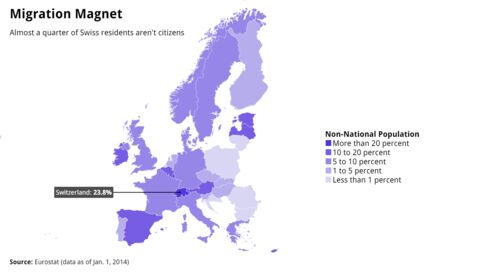
Switzerland is offering a stark lesson for the British politicians tasked with negotiating Brexit: the nation they admired for guarding its sovereignty within Europe has all but thrown in the towel.
More than two years after the Swiss electorate voted to limit immigration by European Union nationals, lawmakers last month sidestepped implementing curbs that threatened an economically vital set of treaties with Brussels. Instead, they backed a “light” proposal that merely stipulates job vacancies are advertised first in Swiss unemployment centers.
“It’s a complete fig leaf, as it won’t make any difference to the flow of EU citizens into the Swiss economy,” said Jacob Funk Kirkegaard, senior fellow at the Washington-based Peterson Institute for International Economics. “It does what it’s supposed to do, which is not to have any changes.”
While Kirkegaard expects the EU to respond favorably to Swiss realpolitik, even the diluted plan for implementing the 2014 plebiscite isn’t a done deal as Brussels and Bern haggle over the fine print. When European Commission President Jean-Claude Juncker meets Swiss President Johann Schneider-Ammann in Brussels on Oct. 28, the EU will be keen to avoid any concessions that could set a precedent for upcoming Brexit negotiations with the U.K.
If that solution falls apart, Switzerland also has a potential Plan B to ensure the economy doesn’t suffer a projected 32 billion-franc ($32.4 billion) a year shock from the cancellation of treaties covering everything from aviation to agriculture. The government will respond by the end of this month to recommend if voters should back or reject the so-called Rasa initiative that would annul the previous referendum on immigration.
The preference among key U.K. negotiators -- Brexit Secretary David Davis, Foreign Secretary Boris Johnson and trade chief Liam Fox -- for a so-called hard Brexit that prioritizes immigration controls over access to the 28-nation bloc’s single market will make it difficult for the U.K. to match Swiss pragmatism, according to Rene Schwok, director of the Global Studies Institute at the University of Geneva.
“They’re not well known for their diplomacy, but perhaps they can adapt,” said Schwok. “The lesson is that Switzerland gave up. It’s been the history of Switzerland for centuries; you make concessions to stronger neighbors.”
U.K. Prime Minister Theresa May, who is fond of holidaying in the Swiss Alps, has said Switzerland won’t be the U.K.’s post-Brexit model.
“May clearly defines Brexit as having more controls on immigration and the Swiss proposal is the opposite,” said Kirkegaard. “If she doesn’t deliver a hard Brexit, then she will be assailed as a sellout.”

Referendum Dilemma

When Johnson called for the creation of “Britzerland” as an outer tier of the EU four years ago, he was admiring the deal negotiated in the 1990s under which Switzerland gained market access while retaining a degree of sovereignty. Crucially, it also allowed EU citizens to take up jobs and reside in the country without a special permit.
That looked like it would change when the anti-immigration Swiss People’s Party, or SVP, sponsored a measure to impose quotas on EU nationals. It passed by fewer than 20,000 votes in February 2014.
With formal EU-Swiss talks failing to produce a settlement, lawmakers sought to end the impasse by voting on Sept. 21 to implement the referendum without imposing immigration quotas or national preference.
While the SVP lambasted the proposal, the partial implementation of plebiscites has a long history in Switzerland, according to Georg Lutz, a professor of political science at the University of Lausanne. One example was the Alpine Initiative to curb heavy truck traffic in the Alps.

Unilateral Solution

“The lawmakers found a unilateral solution because negotiating a deal with the EU would have been impossible,” said Lutz. “For the U.K. renegotiating an exit, it’s much harder to find a win-win situation because there isn’t much to gain, but a lot to lose.”
To be sure, the proposal faces EU scrutiny that could thwart it. Mina Andreeva, a spokeswoman for the bloc’s executive arm in Brussels, said any solution must be implemented “in a way that respects obligations under the free-movement agreement.” Tages-Anzeiger reported last week the EU had concerns about a passage in the proposal that would allow Switzerland to take additional steps to control immigration if the stream of newcomers increases.
Still, Juncker talked of a “Swiss-specific” solution when he visited Zurich last month and the Tages-Anzeiger report said EU ambassadors in Brussels don’t object “in principle” to the implementation plan.
Andreas Auer, a former law professor at the universities of Zurich and Geneva, isn’t taking any chances. He has helped collect the requisite 100,000 signatures for another vote to annul the immigration referendum.
“We have direct democracy and people have the right to review their own decisions at any time,” said Auer, noting that Swiss universities have already been locked out of EU research programs because of the immigration vote.
The U.K. could also have a second referendum if the government “makes a hash of Brexit” and the economy deteriorates, said the Peterson Institute’s Kirkegaard. The Swiss experience shows the EU is guided more by politics than economic considerations, he said.
“There are often no overlaps between what national politics wants and allows and what the EU wants and allows,” according to Anand Menon, a professor of European Politics and Foreign Affairs at King’s College London. “There won’t be a deal to have your cake and eat it.”

Friday, October 14, 2016

BBC News - Bank governor Mark Carney says inflation will rise

Mark CarneyImage copyright
Mark Carney has said that inflation will rise on products such as food because of the fall in the value of the pound.
The governor of the Bank of England made clear that sterling's fall "helps the economy adjust".
However, he said it was "going to get difficult [for those on the lowest incomes] as we move from no inflation to some inflation".
He said that food would be the first to experience price rises.
More broadly, Mr Carney said goods and services would see higher inflation over the next "few years".
"It will show up," he said.
Mr Carney, who was speaking at a public roundtable with charities and other third sector organisations in Nottingham, said it was not the Bank's job to target the value of sterling but that "we are not indifferent to it, it matters to the conduct of monetary policy".
He said the Bank had to "weigh increased inflation against supporting the economy" with low interest rates.
The pound recovered most of the days losses against the dollar following his comments.

Protecting jobs

Earlier, Mr Carney said that the Bank of England was willing to see an "overshoot" of its 2% inflation target if it meant supporting economic growth and protecting jobs.
Between 400,000 and 500,000 jobs could have been at risk if the Bank had not taken action after the referendum, he said.
"We are willing to tolerate a bit of an overshoot [on inflation] to avoid unnecessary unemployment. We moved interest rates down to support the economy."
The Bank cut interest rates and provided more monetary stimulus in August after the vote to leave the European Union.
Mr Carney said long-term economic prosperity could not be guaranteed by the Bank: "We can mess it up, we can't make it. We provide the foundations, not the end."

Inequality

With the fall in the value of sterling, some economists now predict that inflation will hit 3% by the end of next year as imports of products such as food and fuel become more expensive.
On the issue of inequality, Mr Carney said: "We care a lot about distribution. But we are not a political entity."
He said many people were still "scarred" by the financial crisis.
But he argued it was for the government to decide on policies to tackle issues such as globalisation, technological change and skills education.