Monday, December 19, 2016

BBC News - Joint call for EU citizens to stay in UK

Businesses and trade unions have called on Theresa May to guarantee immediately the right of EU citizens to stay in the UK after Brexit.
Hospital ward
Doubt about the status of European workers in the UK threatens the NHS, according to the TUC
The British Chambers of Commerce (BCC), which represents companies with a combined workforce of five million people, and the TUC made the call in an open letter to the prime minister.
Failure to do so would damage the UK economy, the two bodies said.
Downing Street said Mrs May wanted to protect the status of EU nationals.
The bluntly-worded letter was jointly signed by TUC general secretary Frances O'Grady and BCC director-general Adam Marshall.
"We call upon you to demonstrate leadership by providing EU citizens in the UK with the reassurance we would expect to be shown to UK citizens across the Continent - not by making one conditional upon the other," they wrote.
"Now is the time to end insecurity for EU workers and for British businesses alike."
There were 2.1 million people from EU member nations working in the UK as of March this year, according to the ONS. That was 224,000 more than the total for the first three months of 2015.

'Right thing'

Mr Marshall said the government could give an early Christmas present to both businesses and workers by making an "unequivocal commitment" to EU citizens working in the UK.
"Business communities across the UK are deeply frustrated that ministers have declined to guarantee the residence rights of their EU employees and colleagues. Some firms are already losing key members of staff due to this avoidable uncertainty," he said.
"Such a move before the start of a complex Brexit negotiation would be bold, but it is the right thing to do."
Ms O'Grady said: "Continued doubt about the status of workers from the rest of the EU is bad for business, and it puts services like the NHS at risk."
The joint call echoed one made by the TUC and the CBI, which represents businesses employing about seven million workers, the week after voters backed taking Britain out of the European Union.
The two bodies said that the government needed to allay the concerns of EU nationals working in the UK, as well as UK citizens in the EU, as a "matter of urgency".
Last week peers said the UK had a "moral" duty to guarantee the status of EU nationals living in Britain before Brexit negotiations begin.
The Lords EU Justice sub-committee called for an immediate "unilateral undertaking" that EU nationals could continue to live, work and study in the UK after Brexit.
A Downing Street spokesman said: "The prime minister has been clear that she wants to protect the status of EU nationals already living here, and the only circumstances in which that wouldn't be possible is if British citizens' rights in European member states were not protected in return."

Thursday, December 15, 2016

Bloomberg News - S. Africa Ignores Central Bank, Imperils Welfare for 17 Million

South Africa’s Social Development Department’s ability to continue to make monthly welfare payments to about 17 million people is in jeopardy because it ignored advice from the central bank, two people familiar with the situation said.
The department may have to extend its deal with Net 1 UEPS Technologies Inc., with which it has been embroiled in legal battles, to continue with the 129 billion rand ($9.5 billion) in annual payments when the contract ends in April, it said on Tuesday. Alternative arrangements have not been made.
Officials from the South African Reserve Bank are concerned about the risks associated with the expiry of the deal, and that no contingency plan was in place, according to the two civil servants who asked not to be identified because the discussions have not been made public. There have been meetings and e-mail exchanges between the department and the central bank, which is the custodian of the payment systems, after the nation’s Constitutional Court declared Net 1’s contract invalid in November 2013, the people said. 
“When the department fails to remedy the situation after the court found the original contract was flawed, we are left wondering if they are not being deliberately negligent in order to influence who the contract goes to, or they want to continue with the same company,” said Ralph Mathekga, a political analyst at the Mapungubwe Institute for Strategic Reflection, a Johannesburg-based research group.
The department’s relationship with Net 1 has soured this year, with the company challenging a regulatory change that would have halted most deductions from state grants and the department filing criminal charges against Net 1 for allowing them to continue. Rights activists have in turn sued the government to demand it protect welfare recipients from companies that are allegedly selling them goods and services they can’t afford and don’t need.
The central bank has said Net 1 may have a conflict of interest because it has subsidiaries that sell services to people on welfare.
The central bank believed the department was too slow to invite companies, including major banks, to bid for the contract. In July it said that it favored a system where welfare beneficiaries were allowed to open bank accounts with a company of their choice that adhere to the welfare agency’s requirements, which could include subsidized transactions and a restriction on debit orders.
“We have submitted papers in court, basically saying we supervise the payment system, we are prepared to help to try and find a solution,” Kuben Naidoo, a deputy governor at the South African Reserve Bank who is also the head of banking supervision, said on Tuesday.
Net 1 didn’t immediately respond to calls and e-mails to its Johannesburg office on Wednesday. Calls and text messages to South African Social Security Agency officials weren’t answered.
The South African Social Security Agency “will not be the paymaster or operating as the bank that takes the cash or makes the payments” after April, Social Development Department Director-General Zane Dangor said by phone on Tuesday. “We have come up with some really good models, but those models will only be able to kick in from October or November next year,” he said, without giving more details.

Wednesday, December 14, 2016

BBC News - Eurozone suspends Greek debt relief plan

Eurozone lenders have suspended their recently agreed debt-relief plan for Greece.
A Greek pensioner leans on a shepherd's crook during a demonstration against planned pension cuts in Athens, Greece, 3 November 2016
A Greek pensioner at a protest against pension cuts in Athens last month
The lenders are unhappy that the Greek government plans to spend €617m (£517m) on giving poor state pensioners a pre-Christmas bonus.
The European Stability Mechanism, the body that helps eurozone governments in trouble, said it had not been asked to agree the bonus.
It said it would now scrutinise the proposed payment to the pensioners.
"Following recent proposals by the Greek government to spend additional fiscal resources for pensions and VAT, our governing bodies have put their decisions temporarily on hold," a spokesman for the ESM said.
"Institutions are currently assessing the impact of Greek government decisions vis-a-vis the ESM programme commitments and targets.
"[We] will then analyse the institutions' assessment and subsequently decide how to proceed," he said.
The debt-relief deal between Greece and the ESM was agreed on 5 Decemberand would reduce the interest burden on the country's debts.
The Greek government announced its bonus for poor pensioners - those earning below 800 euros a month - just three days later, but without consulting the eurozone representatives.
It also exempted residents of Aegean islands from VAT because of the influx of migrants.
A spokesman for Jeroen Dijsselbloem, the head of the Eurogroup - the eurozone finance ministers who have been negotiating with the Greek government over its massive debts - said the Greek government's action appeared "to not be in line with our agreements".
There was "no unanimity now for implementing short-term debt measures", the spokesman added.

Analysis: Andrew Walker, BBC economics correspondent

This is a familiar refrain in the long-running story of the Greek bailout.
The lenders are once again concerned about the Greek government straying from the agreed programme.
Over and over again, missed objectives and slipping timetables have led to loan payments being delayed.
This time it is debt relief agreed by eurozone ministers rather than a loan payment that is being held up.
The particular issue is whether the measures on pensions and VAT will lead to Greece missing its targets for the government finances.
But there is another dispute in the background.
The International Monetary Fund thinks those targets aren't really desirable and are certainly unrealistic without further economic reforms.

Tuesday, December 13, 2016

Bloomberg News - Oil Climbs to 17-Month High on Saudi Pledge, Non-OPEC Output Cut

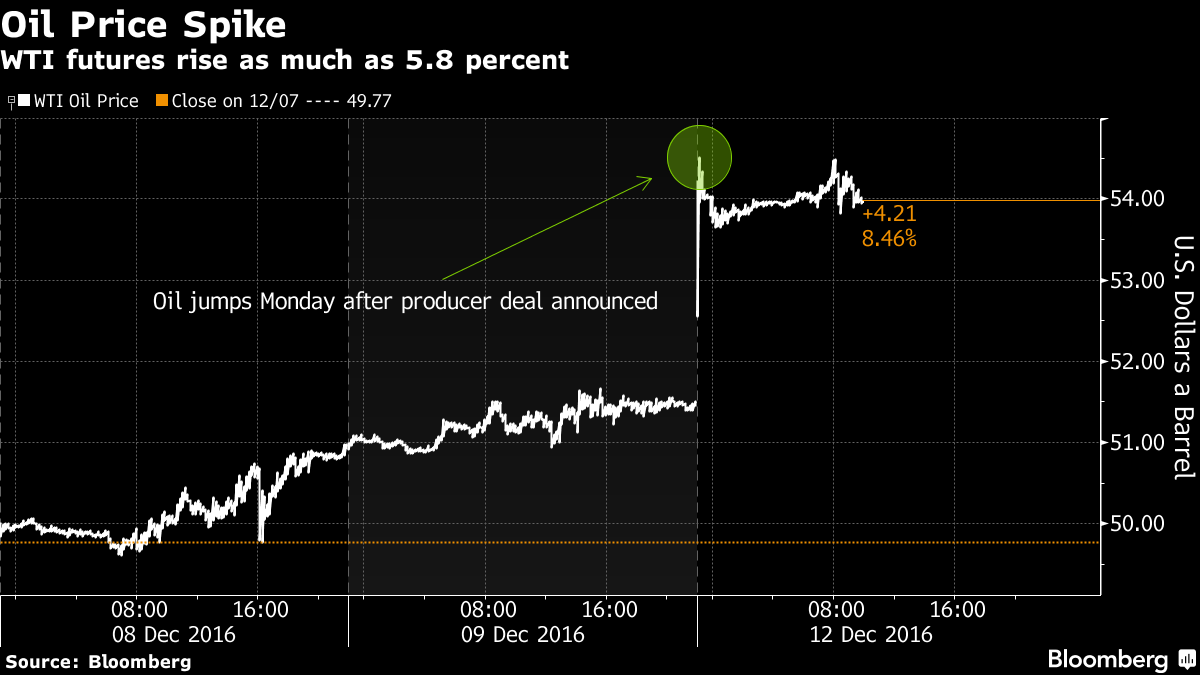
Oil advanced to the highest since July 2015 after Saudi Arabia signaled it’s ready to cut output more than earlier agreed and non-OPEC countries including Russia pledged to pump less next year.

Futures climbed 2.6 percent in New York and 2.5 percent in London. Saudi Energy Minister Khalid Al-Falih said Saturday the biggest crude exporter will “cut substantially to be below” the target agreed on last month with members of OPEC. 
His comments followed a deal by 11 non-OPEC countries to join forces with the group and trim output by 558,000 barrels a day next year, the first pact between the rivals in 15 years.


U.S. oil futures have gained almost 20 percent since the Organization of Petroleum Exporting Countries agreed on Nov. 30 to cut output for the first time in eight years. Saudi Arabia, which initiated OPEC’s decision in 2014 to pump without limits, is leading efforts to regain control of the market. The OPEC and non-OPEC plan encompasses countries that produce about 60 percent of the world’s crude.
"The non-OPEC cut was expected but nobody foresaw the Saudi statement," Bob Yawger, director of the futures division at Mizuho Securities USA Inc. in New York, said by telephone. "The market’s giving bonus points because the Saudis are willing to do whatever has to be done to balance the market. We wouldn’t be up anywhere near as much on the agreement alone."
West Texas Intermediate for January delivery rose $1.33 to settle at $52.83 a barrel on the New York Mercantile Exchange. It’s the highest close since July 14, 2015. Total volume traded was about 81 percent higher than the 100-day average at 3 p.m.

Market Balance

Brent for February settlement climbed $1.36 to $55.69 a barrel on the London-based ICE Futures Europe exchange. The contract closed at the highest since July 22, 2015. The global benchmark crude ended the session at a $1.94 premium to February WTI.
"The main impact of the non-OPEC collaboration is to pull the global market into balance, if not in deficit, in the second quarter of 2017, rather than in the third quarter," said Sarah Emerson, managing director of ESAI Energy in Wakefield, Massachusetts. "On an annual average basis, this pushed the global balance into a 200,000 to 300,000 barrel-a-day deficit for the year."
Oil and gas companies advanced in the U.S. and Europe. Exxon Mobil Corp. and Chevron Corp., the biggest U.S. energy producers, climbed 1.9 percent and 0.7 percent, respectively, at 3 p.m.
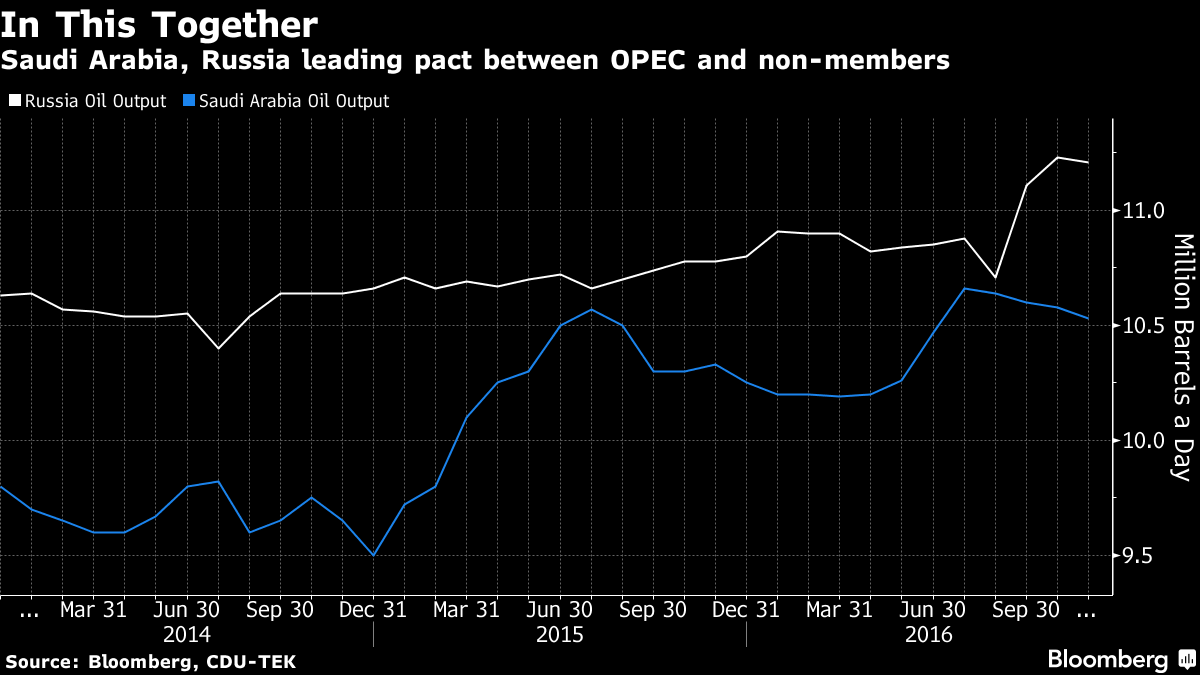
“I can tell you with absolute certainty that effective Jan. 1 we’re going to cut and cut substantially, to be below the level that we have committed to on Nov. 30,” Al-Falih said Saturday in Vienna. The Saudi minister added that the country was ready to take production below 10 million barrels a day, a level it has sustained since March 2015.

Major Players

Al-Falih and his Russian counterpart Alexander Novak also revealed Saturday that they have been working for nearly a year on the agreement, meeting multiple times in secret. OPEC two weeks ago agreed to reduce its own production by 1.2 million barrels a day, and Saudi Arabia has long insisted that any cuts by the group be accompanied by action from other suppliers.
"The Saudi statement show’s they’re really serious," Michael Lynch, president of Strategic Energy & Economic Research in Winchester, Massachusetts, said by telephone. "There’s little chance that they’ll bail if things get difficult. It’s clear they want to make this work."
Oil prices at $60 a barrel would be “ideal” for OPEC as higher levels risk sparking a recovery in competing supplies from the U.S., Nigerian Minister of State for Petroleum Emmanuel Kachikwu said in a Bloomberg Television interview.
  • by Mark Shenk

Monday, December 12, 2016

BBC News - Chancellor urges Brexit interim deal

Chancellor Philip Hammond has backed a transitional deal for Brexit saying it would be "helpful" to allow longer than two years for the UK's EU exit.
Philip Hammond
Mr Hammond told the Treasury select committee that there was an "emerging view" that having longer would tend towards a "smoother transition" .
There would be "less risks of disruption" including "crucially risks to financial stability", he added.
However, both business and government would have to make changes, he said.
His comments are being seen as the strongest signal yet from the government that the Brexit process could take a lot longer than the two years needed for the official Article 50 exit process to be completed.
On Monday the Treasury Select Committee called for written submissions on transitional arrangements as part of its inquiry into the UK's future economic relationship with the EU.
It defines "transitional arrangements" as being "any arrangement that takes effect between the point at which the UK formally leaves the EU... and the point at which the UK's final, settled relationship with the EU becomes effective."

Customs arrangements

"I would not want anybody to think this is just about financial services," Mr Hammond told MPs.
"For example, depending on what future customs arrangements are between the UK and European Union, there could be significant physical infrastructure changes that need to be made at ports of entry and exit, not only in the UK but on continental Europe as well," he added.
He said there could also be a need to train large numbers of people in anticipation of a "much more intensive process at borders.
"So it's not just the business sector, it's also the government sector that has to think about how long it takes to make changes, hire people, train people, introduce IT changes.
"And I think the further we go into this discussion, the more likely it is that we will mutually conclude that we need a longer period to deliver," he added.

Analysis: Kamal Ahmed, BBC business editor

The government position is becoming clearer.
By the end of the Article 50 timetable - which Number 10 believes will be March 2019 - the UK will have legally agreed to leave the EU.
But it will not be like jumping off a cliff edge.
Rather, Britain and the EU will still have a close relationship, with many EU rules remaining in place.
They will slowly be unravelled over subsequent years as Brexit is made a reality.
Committee chairman Andrew Tyrie said it sounded like two years was the "bare minimum, we're probably going to need more."
Mr Tyrie also said he had received briefings from firms about the need for transitional arrangements, including one from a major financial institution which said insufficient time to adjust could result in severe disruption to client services, causing financial instability and significant cost to the wider economy in Europe and globally.
Mr Hammond said he was also hearing about concerns in this area, particularly from the financial services sector.
Later he added that there were "compromises between the political will to get things done and to move on and the bureaucratic and/or business desire to have the largest period possible to make any change".

Friday, December 9, 2016

BBC News - Japan's third-quarter growth rate revised down sharply

Japanese exportsImage copyright
Japan's economy grew much slower than initially estimated in the third quarter of the year, figures have revealed, as business investment fell.
The Cabinet Office said the economy grew 1.3% in the three months to the end of September, compared to the same period a year ago.
However, that was sharply lower than the previous estimate of 2.2%.
The new data indicated that investment by companies in the quarter had been weaker than initially estimated.
Capital expenditure fell 0.4% in the quarter, as steel and real estate companies reduced investment.
However, consumer spending was revised up, while separate data showed improving sentiment in the services sector.

Currency impact

Just over a quarter of the growth came from net exports. Economists are hopeful that exports will pick up following the rise in the value of the dollar since Donald Trump's election as US president.
"With a stronger dollar and potentially higher demand in the US, companies are returning to their investment planning boards, which would fill the missing link in Japan's current recovery," said Martin Schulze from the Fujitsu Research Institute in Tokyo.
Japan's economy has been struggling for several years, raising questions about Prime Minister Shinzo Abe's strategy to revive the Japanese economy.
Mr Abe took office in late 2012, launching a growth plan that included three main elements - pumping more money into the economy, boosting government spending and cutting red tape.
But some analysts believe it is still too early to write off his policies, which have been dubbed Abenomics.
"The revised economic growth numbers are disappointing, but a new US president, a higher US dollar and a lower yen could be all it needs to tip a finely balanced Japanese economy into growth," said David Kuo, chief executive of the Motley Fool Singapore.

Thursday, December 8, 2016

Bloomberg News - Kenya, World Bank Consider $150 Million Off-Grid Power Project

Kenya and the World Bank are in talks about financing a $150 million solar-and-wind project in the country’s remote, off-grid northeastern region.
“We anticipate firm positions on where this project will be situated,” before inviting international bidders to tender, Ben Chumo, the managing director of electricity distributor Kenya Power Ltd., said in an interview Wednesday in the capital, Nairobi.
The government of East Africa’s biggest economy is building more power plants as it targets a tripling of capacity to 6,766 megawatts by 2020, from about 2,327 megawatts. Most of the new capacity will be from renewable sources including geothermal, according to the state-run Energy Regulatory Commission. 
Construction of the solar-and-wind project is expected to start by mid-2017, Chumo said. Electricity consumers in the remote northeastern region are currently served by diesel-fuel generation.
Kenya Power, the nation’s sole electricity distributor, plans to add 1.5 million new customers to its 5.4 million client base next year, taking the number of people connected to the national grid to 70 percent, from 62 percent, Chumo said.
Kenyan consumers pay an average of 18.7 U.S. cents per kilowatt-hour, compared with 9 cents in neighboring Tanzania and 3 cents in Ethiopia, African Development Bank data shows. An unreliable and expensive power supply is cited by business as a deterrent to investment in the $63.4 billion economy.
by Bella Genga