Monday, May 21, 2018

Reuters News - Wall Street advances on trade war truce; Russell 2000 hits record

(Reuters) - U.S. stocks rallied on Monday after the United States and China put their trade differences “on hold” to work on a wider agreement, while sentiment was also boosted by the nearly $28 billion worth of merger deals.

The truce sparked a broad rally, with the Dow Jones Industrial Average .DJI touching a session high of more than two months and the small-cap Russell 2000 hitting a record high for the fourth straight session.
U.S. Treasury Secretary Steven Mnuchin said on Sunday the United States and China had agreed to drop their tariff threats, while China on Monday praised a significant dialing back of tensions.
“I suspect that we’ll continue to trend higher sans some major disappointing news,” said Gordon Charlop, managing director at Rosenblatt Securities in New York.
“This is an indication of what we’ll see near term, because we are through earnings, relatively light on macro data, and with geopolitics, it seems like some of the emotion has been reduced between now and the Korean summit.”
The S&P industrial sector .SPLRCI advanced 0.8 percent. Boeing (BA.N), which sells about a fourth of its commercial aircraft to Chinese customers, jumped 3.4 percent, the biggest percentage gainer on the Dow and lifting the blue-chip index higher.
At 12:41 a.m. EDT the Dow Jones Industrial Average .DJI was up 301.93 points, or 1.22 percent, at 25,017.02, the S&P 500 .SPX was up 20.44 points, or 0.75 percent, at 2,733.41 and the Nasdaq Composite .IXIC was up 41.91 points, or 0.57 percent, at 7,396.25.
General Electric (GE.N) advanced 2.6 percent on an $11.1 billion deal to merge its transportation business with rail equipment maker Wabtec (WAB.N), which jumped about 4.2 percent.
Still, not all U.S. business leaders were happy with the trade war truce, with some cautioning that Washington would find it tough to rebuild momentum to address what they see as troubling Chinese policies.
AK Steel (AKS.N) and U.S. Steel (X.N) both fell more than 4 percent following a delay in implementing tariffs on Chinese imports.
Micron (MU.O) rose 3.9 percent, the most on the S&P, after the chipmaker lifted its current-quarter forecast.
The easing of the trade dispute also boosted the chipmakers, whose major clients include Chinese firms, with the Philadelphia chip index .SOX gaining 0.9 percent. The technology sector .SPLRCT rose 0.8 percent.
Tesla (TSLA.O) jumped 2.9 percent on pricing of Model 3’s fully-loaded version and after brokerage Berenberg raised its already bullish price target.
Regional lender MB Financial (MBFI.O) jumped 13.3 percent after agreeing to be bought for $4.87 billion by Fifth Third Bancorp (FITB.O), which fell 7.8 percent, the biggest percentage decliner on the S&P.
On the downside, Celgene fell 3.6 percent and hit a four-year low, dragging on the Nasdaq Biotech index .NBI 0.8 percent lower.
Advancing issues outnumbered decliners by a 2.67-to-1 ratio on the NYSE. Advancing issues outnumbered decliners by a 1.64-to-1 ratio on the Nasdaq.
The S&P index recorded 32 new 52-week highs and 3 new lows, while the Nasdaq recorded 149 new highs and 26 new lows.
Reporting by Medha Singh in Bengaluru; Editing by Sriraj Kalluvila

Friday, May 18, 2018

BBC News - Iran nuclear deal: EU moves to avoid impact of US sanctions

A gas flare on an oil production platform in the Soroush oil fields is seen alongside an Iranian flag in the Persian Gulf, Iran
European companies have invested heavily in Iran's energy sector

The EU has begun reviving legislation that will allow European companies to continue doing business with Iran, despite US sanctions, officials say.
The so-called "blocking statute" was introduced in 1996 to circumvent US sanctions on Cuba but was never used.
An updated version of the measure should be in force before 6 August, when the first sanctions take effect.
It will prohibit European companies from complying with the penalties and permit compensation for affected firms.
Washington is re-imposing strict sanctions on Iran, which were lifted under a 2015 international deal to control the country's nuclear ambitions.
"We have the duty, the Commission and the European Union, to do what we can to protect our European businesses, especially SMEs," European Commission President Jean-Claude Juncker said in a statement, referring to small and medium-sized companies.
The Commission - the EU executive - said the European Parliament and member states could raise objections to the statute. But the measure could also be activated sooner if there was strong political support.
It also announced:
  • The start of the formal process of allowing the European Investment Bank to lend to EU projects in Iran
  • It would urge EU governments to explore "one-off" transfers to Iran's central bank to help authorities to receive their oil-related revenues
  • It would continue and strengthen the assistance to Iran with Energy Commissioner Miguel Arias CaƱete travelling to Tehran this weekend

What do the sanctions mean for Europe?

European businesses are worried that their ties with the US could be damaged if they continue doing Iranian deals.
Some of Europe's biggest firms had rushed to do business with Iran after the nuclear deal took effect.
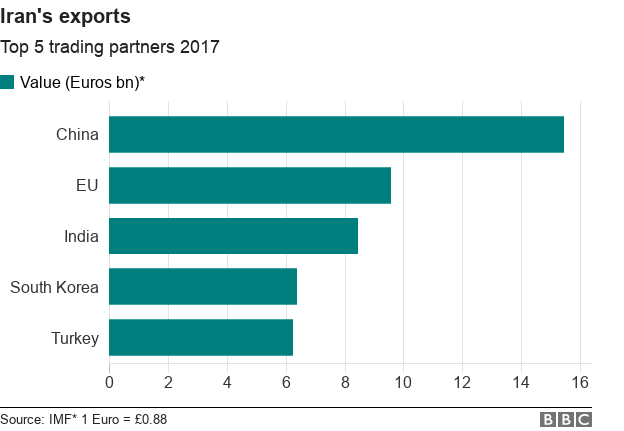
Iran's exports
In 2017, EU exports to Iran (goods and services) totalled €10.8bn (£9.5bn; $12.9bn), and imports from Iran to the bloc were worth €10.1bn. The value of imports was nearly double the 2016 figure.
Now, there are fears that billions of dollars' worth of trade and thousands of jobs could be jeopardised.
Some of the biggest deals that are at risk include:
  • French energy giant Total's deal, worth up to $5bn, signed to help Iran develop the world's largest gas field. Total now plans to unwind those operations by November unless the US grants it a waiver
  • Norwegian firm Saga Energy's $3bn deal to build solar power plants
  • An Airbus deal to sell 100 jets to IranAir

Why is the US imposing sanctions on Iran?

Media captionIran nuclear deal: Trump announces US pull-out
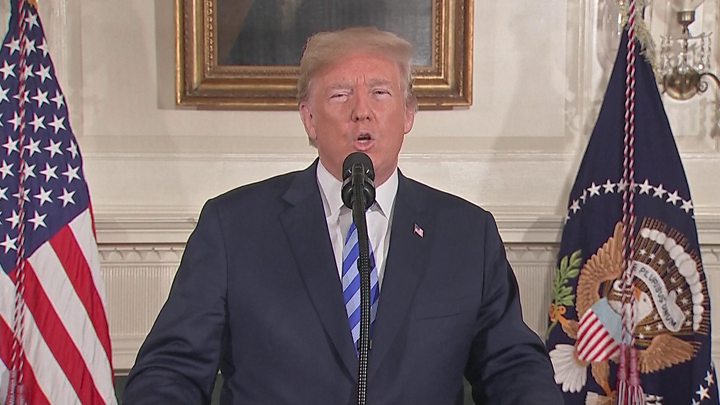
President Donald Trump pulled the US out of the Iran nuclear deal earlier this month and pledged to ramp up pressure on the country.
The agreement was signed by six world powers, alongside Iran, to curbed Iranian nuclear activities in return for the lifting of UN, US and EU sanctions.
But Mr Trump has denounced the "horrible" deal, and now Washington is re-imposing the strict sanctions.
Last week, the US sanctioned six people and three companies it said had ties to Iran's elite military force.
US individuals and entities are barred from doing business with them following the move.
The US position is at odds with that of France, Germany and the UK, which say they are committed to the agreement and to expanding trade with Iran.

Tuesday, May 15, 2018

Bloomberg News - World's Happiest Place Has Women to Thank for Big Wealth Gains

By Frances Schwartzkopff

Pedestrians walk across a waterway in the Aker Brygge district of Oslo. Photographer: Kyrre Lien/Bloomberg
The Nordic countries have grown considerably richer thanks to decades of policies designed to improve gender equality, according to the Organization for Economic Cooperation and Development.
The region, which consistently tops world happiness indexes, has spent the past 50 years bringing more women into the workforce in a shift that has added as much as 20 percent to economic growth per capita, the OECD said in a study published this week. The Paris-based organization says continued progress on gender equality in the labor market could add up to 30 percent to economic growth rates by 2040.
“The Nordic countries are an inspiration,” Angel Gurria, secretary general of the OECD, said in prepared comments. He pointed to structures designed to support families as being key.
“Nordic countries provide a continuum of support to families with children, consisting of generous paid leave for new parents; subsidized and high-quality early childhood education and care; and out-of-school-hours care.”
Female employment rates in the Nordic region range from 68 percent to 83 percent, according to the study. That compares with an OECD average of 59 percent. Higher Nordic employment rates follow official steps in the region to punish discrimination. For example, it’s illegal to fire women after they have children.
Perhaps it’s no coincidence that people living in the Nordic region, where schools and health care are free and parental-leave packages generous, are among the world’s happiest. Finland, Norway, Denmark and Iceland took the top spots in the 2018 World Happiness Report, with Sweden occupying ninth place.

Monday, May 14, 2018

BBC News - Interest rates on hold as Bank cuts growth outlook

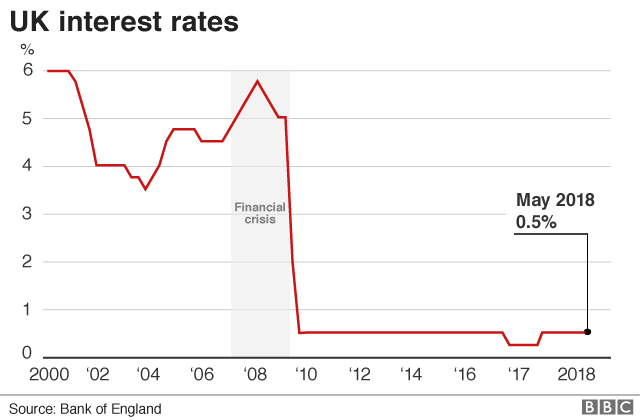
The Bank of England said the UK economy has hit a "temporary soft patch" as it kept interest rates on hold at 0.5%.
The Bank cut its growth forecast for the year to 1.4%, down from the forecast of 1.8% made in February.
The Bank says that cut is almost entirely due to the disruption to the economy caused by bad weather in March.
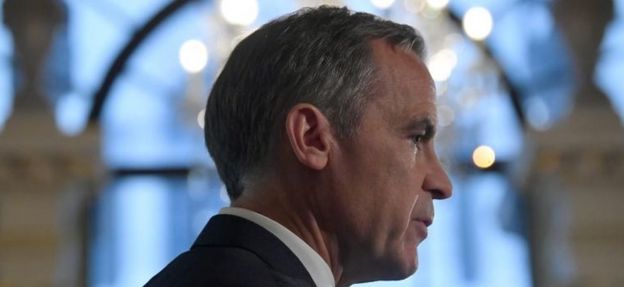
However, Bank governor Mark Carney said in an interview with BBC economics editor Kamal Ahmed that "it's likely" rates will rise this year.
In a press conference after the rates decision was announced, Mr Carney said the "underlying pace of growth remains more resilient than the headline data suggests".
As recently as February economists were expecting the Bank to raise interest rates this month.
That view changed after figures released last month showed that the economy grew by just 0.1% in the first three months of the year.
Interest rates
The slowdown was caused by the Beast from the East - severe weather which shut down construction sites, kept shoppers at home and caused transport chaos.
However, the Bank described that as a "temporary soft patch" with "few implications" for the outlook for the economy.
The financial markets are now indicating there will be an interest rate increase towards the end of the year followed by another in 2019, and a further one in 2020.
Movements in the Bank's official rates can have big effects on UK households. A rise would mean that about four million households with variable or tracker rate mortgages would see an increase in their monthly payments, while an increase would benefit the nation's 45 million savers.
Mr Carney sets interest rates with a team of eight other experts that form the Monetary Policy Committee (MPC).
At the latest meeting, seven members voted to keep interest rates on hold and two, Ian McCafferty and Michael Saunders, voted for an increase.
"It looks like the 2018 rate hike has been delayed not cancelled," Fitch Ratings chief economist Brian Coulton said.
However, former MPC member Andrew Sentance said the Bank had "totally misunderstood" the economic slowdown. He said persistent low interest rates and uncertainty over their future direction were undermining the pound and hurting consumers by causing inflation.
Presentational grey line

Analysis: Kamal Ahmed, BBC economics editor

Mark CarneyImage copyrightREUTERS
Is Mr Carney revealing once again his "unreliable boyfriend" tendencies, promising that interest rate rises are just around the corner, only to pull back?
He might suggest that he and the other eight members of the MPC are less the unreliable partners, more the "sensitive" listeners.
Sensitive to changes in the data which effect a decision based on fine margins and delicate judgements.
It was John Maynard Keynes who said that when the facts changed, so, sir, did he.
Today the Bank has changed tone. Let's wait and see, it is saying.
Let's wait and see how the economy develops until we give any firm guidance on the path of interest rates beyond the Bank's often used formulation of some limited rises "over the forecast period" of the next three years.
Yes, they will rise at some point. But the chances of that happening sooner rather than later has receded.
Presentational grey line
The minutes from the meeting show the MPC wants to wait and see how the economy performs over the coming months.
While they expect it to recover from a weak start to the year, there is a risk that the slowdown could be more persistent.

Rate rise?

The Office for National Statistics appears to be more pessimistic than the Bank of England.
The ONS released data today showing that industrial production expanded just 0.1% in March from February. It said the economy was "sluggish" in the first quarter, but said the bad weather had "little impact overall", suggesting it thinks the economy has underlying problems.
Later on Thursday, in an interview with the BBC's economics editor, Mr Carney said: "It's likely over the course of the next year rates will go up... that's the most likely thing to happen."
But any rate rises would be at a "gentle pace", the governor said. He added that there could be shocks to the UK economy from protectionist trade policies or from Brexit, in which case: "If the economy slows... then we will adjust policy."
The course of interest rates depends on inflation falling in line with the Bank's expectations.
In March, inflation was running at an annual rate of 2.5%, which is above the Bank's target of 2%.
But in its most recent Quarterly Inflation Report, the Bank blames above-target inflation on higher prices of imported goods caused by a weaker pound.
The Bank expects that effect to fade over the coming years, bringing inflation back to 2% by early 2021.
It also forecast that the unemployment rate would fall further, to 4% by 2020, the Bank's lowest forecast since the financial crisis.

Wednesday, May 9, 2018

Bloomberg News - Lords Defeat May, Vote to Remove Brexit Date From Key Bill


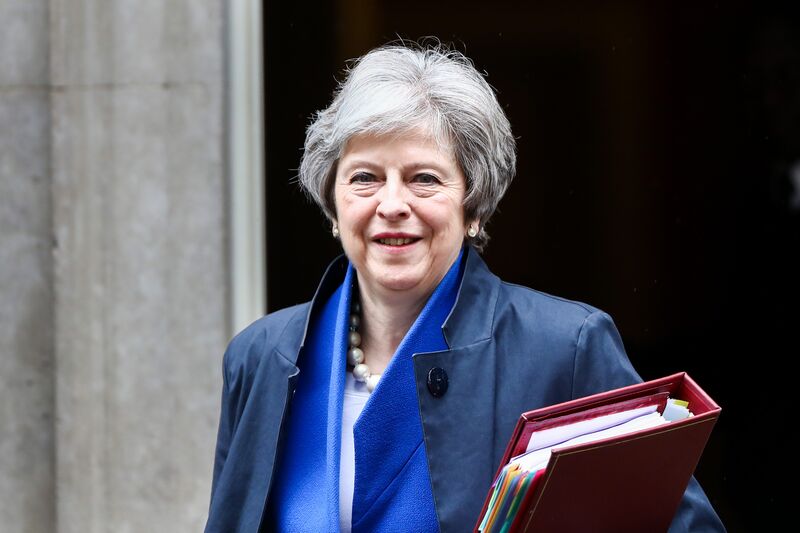
Theresa May Photographer: Simon Dawson/Bloomberg

The House of Lords inflicted another defeat on the U.K. government over its key piece of Brexit legislation, voting to strip out the fixed timing for Britain to leave the European Union.
The government in November inserted 11 p.m. on March 29, 2020 into its own bill to “remove any confusion or concern about what ‘exit day’ means,” Brexit Secretary David Davis said at the time. It was viewed as an attempt to pacify Brexit supporters who feared exit talks dragging on, but critics said it removed the flexibility to extend discussions if needed. Those seeking to thwart Brexit also want to be able to extend membership to give them time to maneuver.
EU member states would have to agree unanimously to any extension.
“What is the point of putting the date on the face of this bill when it may have to be changed in circumstances which we cannot foresee?” Conservative peer Charles Wellesley, the Duke of Wellington, told lawmakers on Tuesday. “This date should not be defined and specified on the face of the bill in case it becomes necessary and in the national interest to agree an extension” to talks.

Earlier, peers voted against the government on an amendment that would allow Britain to participate in EU agencies after leaving the bloc.
The defeats are another Brexit setback for Prime Minister Theresa May, who has suffered a string of losses at the hands of the unelected chamber. In the past three weeks, peers have voted to compel ministers to seek a form of customs union with the EU, curtail ministerial powers and expand the scope of a meaningful parliamentary vote on the final deal. In total, they have voted through 12 amendments against government wishes.
Though all of the changes can be reversed when the legislation returns to the House of Commons, it’s not clear there’s a majority in the lower chamber to do so. At least 10 Conservative lawmakers have put their names to an amendment on a separate piece of legislation in support of staying in a customs union -- enough to defeat the government on the Lords amendment on the same topic.
Tory rebels in the Commons also helped defeat the government to insert the provision for the meaningful vote on the final Brexit deal, before the bill moved to the Lords.
Parliament’s upper chamber voted by 311 to 233 to strip out the Brexit date, and by 298 to 227 for the change on EU agencies. Both amendments were sponsored by peers from across the political spectrum.
The amendment on EU agencies is designed to “give some element of shape to what now seems formless and void,” said Nicholas Baines, The Lord Bishop of Leeds. The government opposed the change even though what it calls for is quite similar to what May has herself proposed.
“The government considers its inclusion in the bill to be both completely unnecessary and totally inappropriate,” Brexit Minister Martin Callanan told the Lords. The legislation as currently worded didn’t prevent any future government or parliament from mirroring EU law, or choosing to participate in EU agencies, he said.
After Tuesday’s sixth and final debate at the “report stage” of the bill in the Lords, it will have a so-called third reading on May 16. Further amendments are still possible at that stage: Labour has said a debate on environmental protections is “one to watch.”
It then returns to the Commons, where lawmakers must decide whether to accept the amendments or send it back to the Lords for further consideration.