Tuesday, April 21, 2020

Reuters News - Trump says he will suspend all immigration into U.S. over coronavirus

WASHINGTON (Reuters) - President Donald Trump said on Monday he will suspend all immigration into the United States temporarily through an executive order in response to the coronavirus outbreak and to protect American jobs.

The move, which the Republican president announced on Twitter, effectively achieves a long-term Trump policy goal to curb immigration, making use of the health and economic crisis that has swept the country as a result of the pandemic to do so.
The decision drew swift condemnation from some Democrats, who accused the president of creating a distraction from what they view as a slow and faulty response to the coronavirus.
Trump said he was taking the action to protect the U.S. workforce. Millions of Americans are suffering unemployment after companies shed employees amid nationwide lockdowns to stop the contagion.
“In light of the attack from the Invisible Enemy, as well as the need to protect the jobs of our GREAT American Citizens, I will be signing an Executive Order to temporarily suspend immigration into the United States,” Trump said in a tweet.
The White House declined to offer further details about the reasoning behind the decision, its timing, or its legal basis.
“As our country battles the pandemic, as workers put their lives on the line, the President attacks immigrants & blames others for his own failures”, former Democratic presidential candidate Amy Klobuchar said in a tweet.
Immigration is largely halted into the United States anyway thanks to border restrictions and flight bans put in place as the virus spread across the globe.
But the issue remains an effective rallying cry for Trump’s supporters.
Trump won the White House in 2016 in part on a promise to curb immigration by building a wall on the U.S. border with Mexico. He and his advisers have spent the first three years of his tenure cracking down on both legal and illegal entries into the country. Crowds regularly chant “Build the Wall!” at Trump’s political rallies, which are now idled because of the virus.
Trump has lamented the economic fallout of the outbreak; his stewardship of the U.S. economy was set to be his key argument for re-election in November.
The U.S. death toll from the virus topped 42,000 on Monday, according to a Reuters tally.
The U.S. economy has come to a near standstill because of the pandemic; more than 22 million people applied for unemployment benefits in the last month.
“You cut off immigration, you crater our nation’s already weakened economy,” former Democratic presidential candidate Julian Castro said in a tweet. “What a dumb move.”
The United States has the world’s largest number of confirmed coronavirus cases, with more than 780,000 infections, up 27,000 on Monday.
But the president has made a point of saying the peak had passed and has been encouraging U.S. states to reopen their economies.
“It makes sense to protect opportunities for our workforce while this pandemic plays out,” said Thomas Homan, Trump’s former acting director of U.S. Immigration and Customs Enforcement. “It’s really not about immigration. It’s about the pandemic and keeping our country safer while protecting opportunities for unemployed Americans.”
The United States in mid-March suspended all routine visa services, both immigrant and non-immigrant, in most countries worldwide due to the coronavirus outbreak in a move that has potentially impacted hundreds of thousands of people.
U.S. missions have continued to provide emergency visa services as resources allowed and a senior State Department official in late March said U.S. was ready work with people who were already identified as being eligible for various types of visas, including one for medical professionals.
The administration recently announced an easing of rules to allow in more agricultural workers on temporary H2A visas to help farmers with their crops.
Additional reporting by Kanishka Singh in Bengaluru, Humeyra Pamuk in Washington, and Mica Rosenberg; Editing by Simon Cameron-Moore

Monday, April 20, 2020

BBC News - China's virus-hit economy shrinks for first time in decades

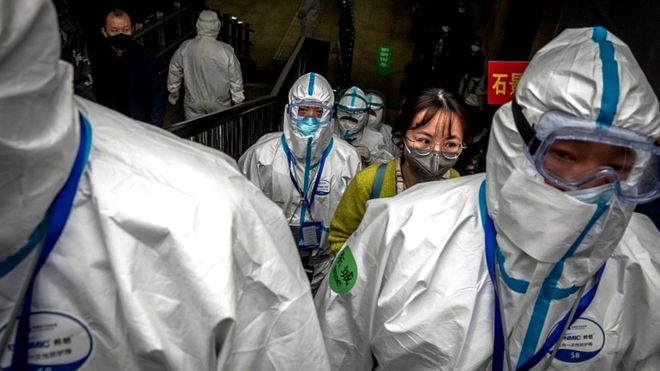
Train passengers arrive from WuhanImage copyrightEPA
China's economy shrank for the first time in decades in the first quarter of the year, as the virus forced factories and businesses to close.
The world's second biggest economy contracted 6.8% according to official data released on Friday.
The financial toll the coronavirus is having on the Chinese economy will be a huge concern to other countries.
China is an economic powerhouse as a major consumer and producer of goods and services.
China GDP
This is the first time China has seen its economy shrink in the first three months of the year since it started recording quarterly figures in 1992.
"The GDP contraction in January-March will translate into permanent income losses, reflected in bankruptcies across small companies and job losses," said Yue Su at the Economist Intelligence Unit.
Last year, China saw healthy economic growth of 6.4% in the first quarter, a period when it was locked in a trade war with the US.
In the last two decades, China has seen average economic growth of around 9% a year, although experts have regularly questioned the accuracy of its economic data.
Its economy had ground to a halt during the first three months of the year as it introduced large-scale shutdowns and quarantines to prevent the virus spread in late January.
As a result, economists had expected bleak figures, but the official data comes in slightly worse than expected.
Among other key figures released in Friday's report:
  • Factory output was down 1.1% for March as China slowly starts manufacturing again.
  • Retail sales plummeted 15.8% last month as many of shoppers stayed at home.
  • Unemployment hit 5.9% in March, slightly better than February's all-time high of 6.2%.
Presentational grey line

Analysis: A 6% expansion wiped out

Robin Brant, BBC News, Shanghai
The huge decline shows the profound impact that the virus outbreak, and the government's draconian reaction to it, had on the world's second largest economy. It wipes out the 6% expansion in China's economy recorded in the last set of figures at the end of last year.
Beijing has signalled a significant economic stimulus is on the way as it tries to stabilise its economy and recover. Earlier this week the official mouthpiece of the ruling Communist Party, the People's Daily, reported it would "expand domestic demand".
But the slowdown in the rest of the global economy presents a significant problem as exports still play a major role in China's economy. If it comes this will not be a quick recovery.
On Thursday the International Monetary Fund forecast China's economy would avoid a recession but grow by just 1.2% this year. Job figures released recently showed the official government unemployment figure had risen sharply, with the number working in companies linked to export trade falling the most.
Presentational grey line
China has unveiled a range of financial support measures to cushion the impact of the slowdown, but not on the same scale as other major economies.
"We don't expect large stimulus, given that that remains unpopular in Beijing. Instead, we think policymakers will accept low growth this year, given the prospects for a better 2021," said Louis Kuijs, an analyst with Oxford Economics.
Since March, China has slowly started letting factories resume production and letting businesses reopen, but this is a gradual process to return to pre-lockdown levels.
Media captionWhy does China’s economy matter to you?
China relies heavily on its factories and manufacturing plants for economic growth, and has been dubbed "the world's factory".
Stock markets in the region showed mixed reaction to the Chinese economic data, with China's benchmark Shanghai Composite index up 0.9%.
Japan's Nikkei 225 jumped 2.5% on Friday, although this was largely due to gains on Wall Street after US President Donald Trump unveiled plans to ease lockdowns.

Friday, April 10, 2020

Reuters News - Fed rolls out $2.3 trillion to backstop 'Main Street,' local governments

WASHINGTON (Reuters) - The U.S. Federal Reserve on Thursday announced a broad, $2.3 trillion effort to bolster local governments and small and mid-sized businesses, the latest in an expanding suite of programs meant to keep the U.S. economy intact as the country battles the coronavirus pandemic.

Announcing details of a promised effort to put its financial weight behind “Main Street,” the Fed said it would work through banks to offer four-year loans to companies of up to 10,000 employees, and begin to directly lend to state governments and more populous counties and cities to help them respond to the crisis.
It may prove to be the Fed’s most groundbreaking step yet in the battle against the economic fallout from a health crisis that has seen a record-shattering 16.8 million people file for unemployment benefits in just three weeks and seen untold numbers of businesses forced to shutter under social distancing rules.
As the pandemic advanced, the Fed set aside inhibitions about inflation, political blowback and other risks that arguably slowed its response to the 2007 to 2009 crisis, and in a matter of weeks has sequentially extended safety nets to different parts of the economy. On Thursday it added help for some key remaining constituencies - small firms, mid-sized industries, local governments, and even corporations which might find their credit standing downgraded because of a fast-evolving economic downturn.
Fed Chair Jerome Powell said the demands of the crisis have led the central bank to broaden its role beyond the usual focus on keeping markets “liquid” and functional, to helping the United States get the economic and financial space it needs to fix a dire health emergency.
Any reopening of the economy should not be rushed said Powell, warning of any “false start,” and the focus of the Fed and elected officials should be on keeping people financially “whole” until the recovery begins.
“People are undertaking sacrifices for the common good,” Powell said in webcast remarks hosted by the Brookings Institution. “We should make them whole. They did not cause this. This is what the great fiscal power of the United States is for, to protect these people from the hardships they are facing.”
Though many of the programs are due to lapse in September, Powell said the Fed’s commitment would only be limited by the need to get the pandemic controlled and try to build a robust recovery - once health authorities have declared it safe to reopen for business, however long that takes.
“We are deploying these lending powers to an unprecedented extent…We will continue to use these powers forcefully, proactively, and aggressively until we are confident that we are solidly on the road to recovery,” Powell said.
The Fed’s latest salvo helped lift U.S. stocks while other global equity benchmarks also gained.

HELPING LOCAL GOVERNMENTS

The program offers to pump up to $500 billion into local governments, which are both on the front lines of the health battle yet also may see tax revenues collapse as unemployment rises and businesses are shut under social distancing rules aimed at curbing the spread of the virus.
The Fed in this case is directly buying municipal bonds of up to two year’s duration – a step called for by some Democrats in the U.S. House of Representatives as a needed prop for local governments. The Fed’s assistance will be available to the states, the District of Columbia, counties with more than 2 million residents, and cities of more than 1 million.
The new “Main Street” facility will use banks to funnel up to $600 billion in loans of at least $1 million to firms that have up to 10,000 employees or less than $2.5 billion in revenue, an effort to expand the safety net for businesses begun under the CARES act recently passed by Congress.
“The Fed made history today” by throwing its vault open to small and medium-sized businesses that are at the core of the U.S. economy, said Joe Brusuelas, an economist who focuses on mid-sized companies with consulting firm RSM.
“This a robust first step towards providing a lending facility that will stem what was a likely solvency crisis inside the critical small and medium-size commercial community.” He said he expected demand for loans under the new Fed facility to be high, and that it might be expanded to as much as $1 trillion as further rescue steps are taken in Congress.
ADVERTISEMENT
That rescue bill authorizes direct loans by the U.S. Treasury to some larger firms, and $350 billion for businesses with under 500 workers. Payments on the new Main Street loans will be deferred for a year; banks will be required to keep at least a 5% stake in each loan.
Firms receiving the loans “must commit to make reasonable efforts to maintain payroll and retain workers,” and cannot use them to refinance existing debt, and must follow the limits on things like dividend payments and compensation set out for larger firms.
The central bank may not be done. The programs announced on Thursday rely on $195 billion in capital provided by the U.S. Treasury. That is only a portion of the $454 billion that Treasury was provided under the CARES act for new Fed programs.
The Fed said in its announcement that it would particularly watch the financial performance of local governments to see if more help is needed.
Reporting by Howard Schneider; Additional reporting by Ross Kerber; Editing by Chizu Nomiyama, Paul Simao and Andrea Ricci

Thursday, April 9, 2020

BBC News - Coronavirus: Government agrees emergency funding deal with Bank

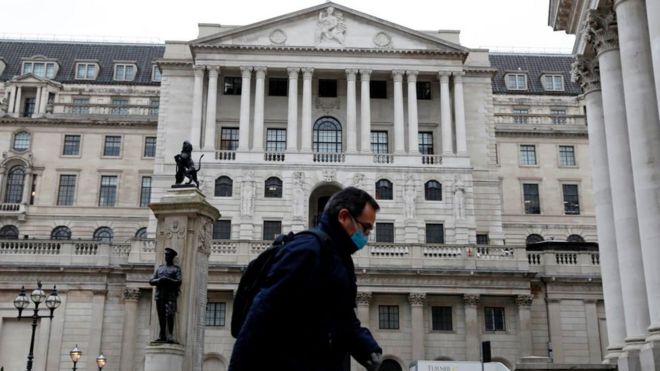
A man wearing protective face mask walks past the Bank of England in the City of LondonImage copyrightGETTY IMAGES
The UK government is set to borrow billions of pounds from its emergency Bank of England overdraft to finance the fight against Covid-19.
The government will draw money from the Bank's "ways and means" facility to help workers and businesses.
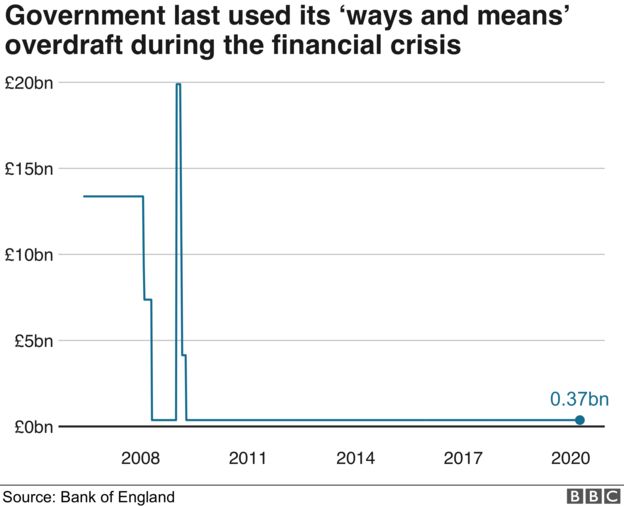
It has not used the facility since the financial crisis.
While it is controversial for a central bank to hand cash directly to the government, the Bank and Treasury insist the overdraft is temporary.

In the red

The ways and means facility will give the government a temporary cash buffer as it seeks to raise unprecedented amounts to deal with the coronavirus outbreak.
The last time it was used was at the height of the financial crisis in December 2008.
In normal times the government uses tax revenues to pay for public services such as hospitals and schools.
If there's a shortfall, it borrows the rest from investors by issuing bonds through the Debt Management Office.
But the government needs to raise a lot of money in a short period of time to pay for its economic stimulus package to support the economy.
It may run into funding problems if there aren't enough buyers for its bonds.
ways and means usage
While the UK has not suffered a failed auction in the main gilt market since 2009, recent jitters in financial markets meant it couldn't find enough buyers in a short-term debt auction last month.
The ways and means facility gives the government the ability to get cash quickly while minimising any financial market disruption.
It is understood that use of the facility was agreed at the end of March, but strong demand for UK debt has meant it has not yet been needed.
The Bank will charge 0.1% interest on any money withdrawn from the facility. This is the same as the Bank of England base rate.
In a joint statement, the Treasury and Bank said any use of the facility would be "temporary and short-term".
They added: "The government will continue to use the markets as its primary source of financing, and its response to Covid-19 will be fully funded by additional borrowing through normal debt management operations."
EU law prohibits central banks from printing money to directly fund public authorities.
Left unchecked, so-called "monetary financing" can cause prices to rise uncontrollably, like in Zimbabwe and Venezuela.
However, in the 1990s, Brussels agreed that the UK could maintain the ways and means facility until it decided to adopt the euro.
While the UK has since left the EU, the provision still stands today.
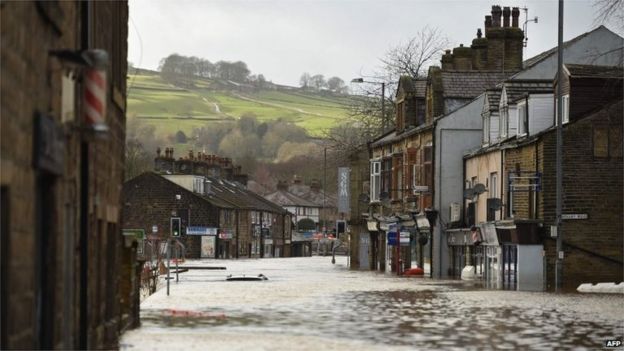
Mytholmroyd's main street floodedImage copyrightAFP
Image captionWet weather and flooding hit the economy in February
The move comes as the latest official statistics show that the UK economy was stagnant in the three months to February, just before the coronavirus pandemic escalated and lockdown measures were introduced.
The UK's gross domestic product (GDP) rose by just 0.1% between December and February, the Office for National Statistics (ONS) said.
The ONS said: "Before the full effects of coronavirus took hold, the economy continued to show little to no growth."
Rob Kent-Smith, head of GDP at the ONS, said that the fall was down to wet weather and flooding seen across the UK hampering house building.
GDP fell by 0.1% in February, which was worse than expected. Economists had predicted that the economy would in fact grow during the month.

What happens next?

Paul Dales, chief UK economist at Capital Economics, said that GDP could "fall at a speed and magnitude no-one has ever seen and no economy has ever experienced before."
Economic activity is thought to have slowed as social distancing measures have kept people away from offices, shops, cafes and restaurants.
Mr Dales added: "What happens next depends on how long the lockdowns last and how quickly households and businesses get back to normal.
"We've assumed a three-month lockdown. And while GDP growth would then surge in the months afterwards, households and businesses aren't going to be the same again for a while."
Presentational grey line
Analysis box by Faisal Islam, economics editor
The Ways and Means account has not been used since the financial crisis, and is normally worth £400m. But outside experts say that this will increase by billions, perhaps tens of billions to help the government manage a sharp increase in immediate spending. During the financial crisis this overdraft reached just under £20bn.
It is also a mechanism to account for more direct lending of electronically created money from the Bank of England to the Treasury.
Over the past month there have been some periods of stress in financial markets for some forms borrowing by many governments. Right now, the Treasury is raising a record monthly amount of government borrowing, with auctions of debt on the majority of days.
This helps take the pressure off those processes at a time when tens of billions in cash is being handed out to businesses and to workers, and at a time when tax revenues are likely to stall alongside an economic contraction.
The government says whatever sum is borrowed will be repaid by the end of the year, and this is not a form of so-called "money printing".
But this is also the mechanism suggested by former top Treasury officials through which the Bank could more formally directly buy government debt from the Treasury, rather than buying it on the open market.
That has not been announced today, but is a possible consequence of the expansion of Quantitative Easing by the Bank of England announced last week.
Today's development is a sign of the unusual moves required to account for significant economic policy challenges around the pandemic, and a sign of things to come.

Wednesday, April 8, 2020

Reuters News - China's Wuhan ends its coronavirus lockdown but elsewhere one begins

WUHAN, China (Reuters) - The Chinese city where the new coronavirus emerged ended its more-than two-month lockdown on Wednesday, even as a small northern city ordered restrictions on residents amid concern about a second wave of infections.

China sealed off Wuhan, a central city of 11 million people, on Jan. 23, a drastic step that came to symbolise its aggressive management of the virus.
More than 50,000 people in Wuhan were infected, and more than 2,500 of them died, about 80% of all deaths in China, according to official figures.
The virus has since spread around the world, infecting more than 1.4 million people, killing 82,000 of them and wreaking havoc on the global economy as governments imposed lockdowns to rein in its spread.
While China has managed to curb its coronavirus epidemic the measures to contain it have exacted a heavy economic and social toll, with many residents in recent days expressing relief as well as uncertainty and worry over the lingering danger of infection.
“I’m going to see my parents,” Wang Wenshu told Reuters as she waited to check in at Wuhan’s Tianhe airport, which reopened on Wednesday.
“Of course I miss them. Stop asking me about it or I’m going to cry.”
Some travellers wore full protective suits, long raincoats or face shields.
Wuhan has slowly been returning towards normal, with people officially allowed to enter the city from March 28, although restrictions remain. Residents have been urged not to leave Wuhan or Hubei province, or even their neighbourhood, unless absolutely necessary.
“We are acutely aware that we must not relax as we have not claimed final victory,” Hubei vice governor Cao Guangjin said at a news conference on Wednesday.
“We need to remain calm, and be just as cautious at the end as at the beginning.”
Shopping malls and the city’s biggest shopping belt, the Chu River and Han street, reopened on March 30. Long queues, thanks to requirements that customers stand a metre apart, have formed at supermarkets while some residents have taken advantage of the warmer weather to resume outdoor badminton games and dancing.
Wuhan has reported just three new confirmed infections in the past 21 days and only two in the past two weeks.

NORTHERN BORDER WORRY

But even as Wuhan came back to life, new imported cases in the far northern province of Heilongjiang surged to a daily high of 25, fuelled by an influx of infected travellers crossing the border from Russia.
On Wednesday, Suifenhe city announced restrictions on the movement of citizens similar to the measures Wuhan has endured.
People must stay in their residential compounds and only one person per family can leave once every three days to buy necessities, and must return on the same day, state-run CCTV reported.
“While the whole country is celebrating the unlocking of Wuhan, few noticed that Heilongjiang is under enormous pressure dealing with infections coming over the border,” one person wrote on the Weibo social media platform.
“Suifenhe is a small city without any high-level hospitals, how can it handle the huge influx of patients?”
Some 55,000 people were expected to leave Wuhan by train on Wednesday. By early morning, more than 10,000 had left by plane, an airport official said. Flights to Beijing and international locations have not resumed.
“I’m very happy, I’m going home today,” migrant worker Liu Xiaomin told Reuters as she stood with her suitcases in Wuhan’s Hankou railway station, bound for Xiangyang city.
People from Wuhan arriving in Beijing must undergo two rounds of testing for the virus.

NEW CASES

China is maintaining strict screening protocols, concerned about any resurgence in infections by virus carriers who exhibit no symptoms and infected travellers arriving from abroad.
China’s new coronavirus cases doubled on Tuesday as the number of infected travellers from overseas surged, while new asymptomatic infections more than quadrupled.
New confirmed cases rose to 62 on Tuesday from 32 a day earlier, the National Health Commission said, the most since March 25. New imported infections accounted for 59 of the cases.
The number of new asymptomatic cases rose to 137 from 30 a day earlier, the health authority said on Wednesday, with incoming travellers accounting for 102 of the latest batch.
Authorities do not count asymptomatic cases in their tally of confirmed infections until patients show symptoms such as a fever or a cough. As of Tuesday, 1,095 asymptomatic patients were under medical observation, with 358 of them travellers arriving from abroad.
To stem infections from outside its borders, China has slashed the number of international flights and denied entry to virtually all foreigners. It also started testing all international arrivals for the virus this month.
As of Tuesday, the total number of confirmed cases in mainland China stood at 81,802, including 3,333 fatalities, the National Health Commission said.
Reporting by Brenda Goh in Wuhan and Ryan Woo, Lusha Zhang, Liangping Gao, Se Young Lee and Yawen Chen in Beijing; Writing by Engen Tham and Gabriel Crossley; Editing by Michael Perry, Richard Pullin and Giles Elgood