Thursday, February 9, 2017

BBC News - Why is Greece back in the headlines?

Greek Prime Minister, Alex Tsipras
Greek Prime Minister Alexis Tsipras has said IMF demands are blocking the completion of a third bailout


Greece is back in the news after eurozone governments and the International Monetary Fund fell out once again over how to handle the country's bailout.
The IMF says Greece needs more leeway to pay its mountainous debts before further rescue funds can be released.
But the eurozone, which has already given the country significant debt relief, is reluctant to go much further.
With major repayments due later this year, can the two sides come to an agreement before Greece's financial situation becomes untenable?

What is the IMF's position ?

It has long been the IMF's view that Greece needs more debt relief in order to make the government's financial situation sustainable.
The IMF has published its annual assessment of the Greek economy and it said: "Greece cannot grow out of its debt problem. Greece requires substantial debt relief from its European partners to restore debt sustainability."
Christine Lagarde, head of the IMF
The IMF, led by Christine Lagarde, says Greece's debt burden could become "explosive"
Eurozone governments have provided some debt relief already, in the form of lower interest rates and extended repayment periods. IMF staff think they need more, although it can take the form of more of the same.
The IMF says there is no need for what it calls an "upfront haircut", a reduction in the principal that has ultimately to be repaid.
There were reports last month that analysis by IMF economists suggested the debt burden would, without relief, become "explosive". That means, on a path of continuous increases (as a percentage of national economic activity).

What about eurozone governments?

Dutch Finance Minister Jerome Dijsselbloem, who chairs eurozone meetings, described the IMF's view as "unnecessarily pessimistic".
Several have domestic political problems about providing debt relief. It doesn't go down well rescuing governments of other countries from what are seen as the consequences of their own irresponsibility.
Some also worry that debt relief would take the pressure off Greece to complete difficult reforms. Last year, German Finance Minister Wolfgang Schaeuble said: "Anyone who now speaks about debt relief for Greece does not strengthen those who want reforms."
There have been reports of disagreements within the German coalition government. Germany is the key player (though not the only one) within the eurozone that has been unenthusiastic about debt relief.
The business newspaper Handelsblatt reported that Sigmar Gabriel, the German vice-chancellor, had expressed "great concern" and called for the German government to moderate its demands for the Greek government's financial targets.
Mr Gabriel represents the Social Democrats, the junior party in the ruling collation. His comments are seen as a criticism of Mr Schaeuble, who leads Germany's input into the negotiations with Greece and is a member of the leading party in the government, the Christian Democratic Union.

Are there divisions within the IMF?

Unusually, diverging views within the IMF's Board have emerged publicly. When the IMF conducts annual reviews of countries, it also publishes a brief summary of the Board's discussion.
On this occasion, the document says "most directors" thought there would be a need for further debt relief. There were several other points where that phrase "most directors" cropped up. Usually these reports convey an impression (justified or not) of consensus.
There is no indication of which directors did not share the view on debt relief, but it's not unreasonable to hazard a guess that they were among those who represent eurozone governments.
The Board is made up of representatives of the member countries, plus Managing Director Christine Lagarde.

Is the situation coming to crisis point again?

Not immediately. The key date is July. That's when Greece is due to make debt repayments, to creditors in both private and public sectors (notably the European Central Bank).
To make those payments, Greece will need the next payment of its current (third) bailout. It won't get that until the review of the programme - by the IMF, the European Commission and the ECB, known as the Troika - is completed.
That has been delayed, as Greece has been unable to convince them that it has made enough progress with reforms intended to support long-term economic growth and stable government finances.

Does the IMF's view matter?

The IMF is not contributing financially to the third bailout. It provides advice and did put money into the first two financial rescues. The eurozone would like to have the IMF's full backing. It would make the exercise look more credible.

And what about political developments across the eurozone?

The situation is further complicated by forthcoming elections in Eurozone countries. In France, Marine Le Pen's National Front and in the Netherlands, Geert Wilders' Freedom Party are both hostile to the European Union and have both criticised the bailout. Germany has elections later in the year.

Wednesday, February 8, 2017

BBC News - Bank of England sees inflation spreading beyond food and fuel


The Bank of England says price rises already seen in food and fuel will spread to other goods later this year.
In a monthly report of business conditions, the Bank said the cost of manufactured goods would also rise.
Companies which made bets to mitigate against last year's drop in sterling will soon see those bets expire, increasing their costs, it said.
However, more exports and "resilient consumer demand" had encouraged more investment, the report said.
"So far, the main effect on consumer prices had been higher food and fuel prices," said the central bank.
"But a wider range of goods prices were expected to be affected over the coming year, causing inflation to rise further."
Rising air fares and food prices helped to push up UK inflation to its highest rate since July 2014 in December.
The annual rate of Consumer Prices Index (CPI) inflation rose to 1.6%, up from 1.2% in November, according to the Office for National Statistics.
And higher costs for imported materials and fuels pushed up producer prices.

Pay rises kept down

With the price of oil and many other raw materials being set in dollars, the pound's slide from as much as $1.49 last summer to about $1.25 today has raised costs for many businesses.
February's report suggested a "slight rise in total labour cost growth in the year ahead" due to "difficulties in hiring and holding on to staff". It said costs from the forthcoming apprenticeship levy of 0.5% on company payrolls, would push up costs. The levy aims to raise £3bn a year and fund three million apprenticeships.
But pay rises will be kept down by what it termed "economic uncertainty" and a difficulty in passing on cost increases to customers.
The report from the central bank makes use of data gathered from its business contacts between late November 2016 and mid-January 2017.

The Bank has 12 Agents based around the UK who gather economic and financial conditions affecting businesses in their area.

Tuesday, February 7, 2017

Bloomberg News - Everyone Is Suddenly Worried About This U.S. Mortgage-Bond Whale

Almost a decade after it all began, the Federal Reserve is finally talking about unwinding its grand experiment in monetary policy.
And when it happens, the knock-on effects in the bond market could pose a threat to the U.S. housing recovery.
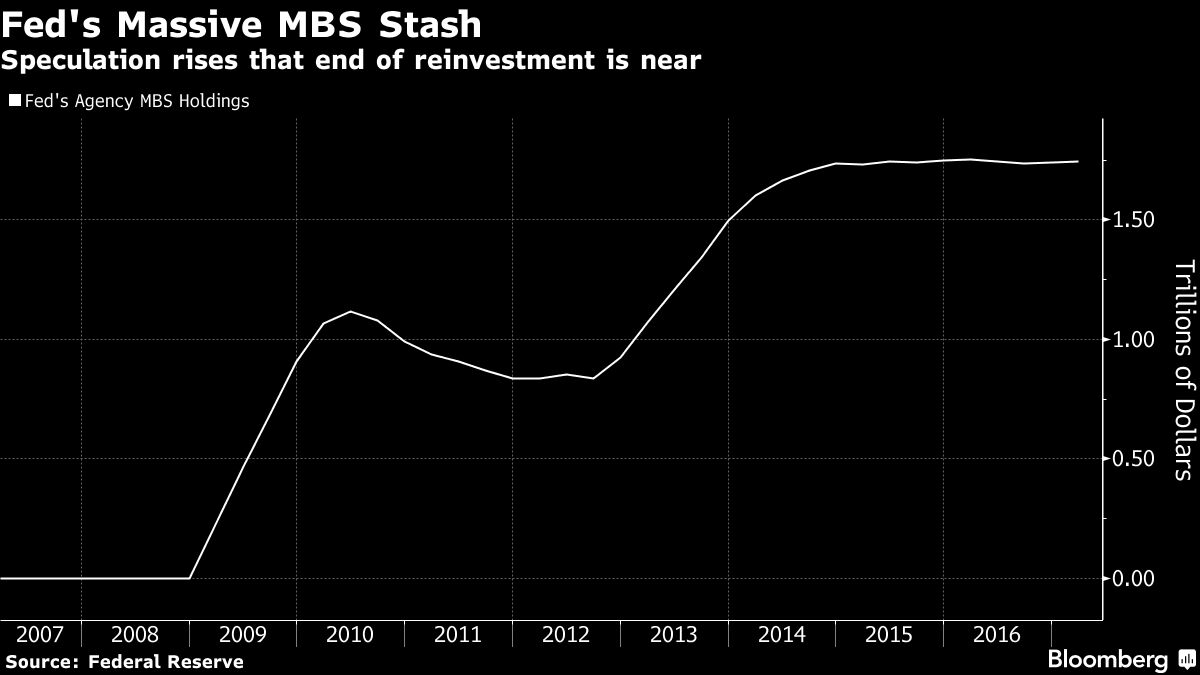
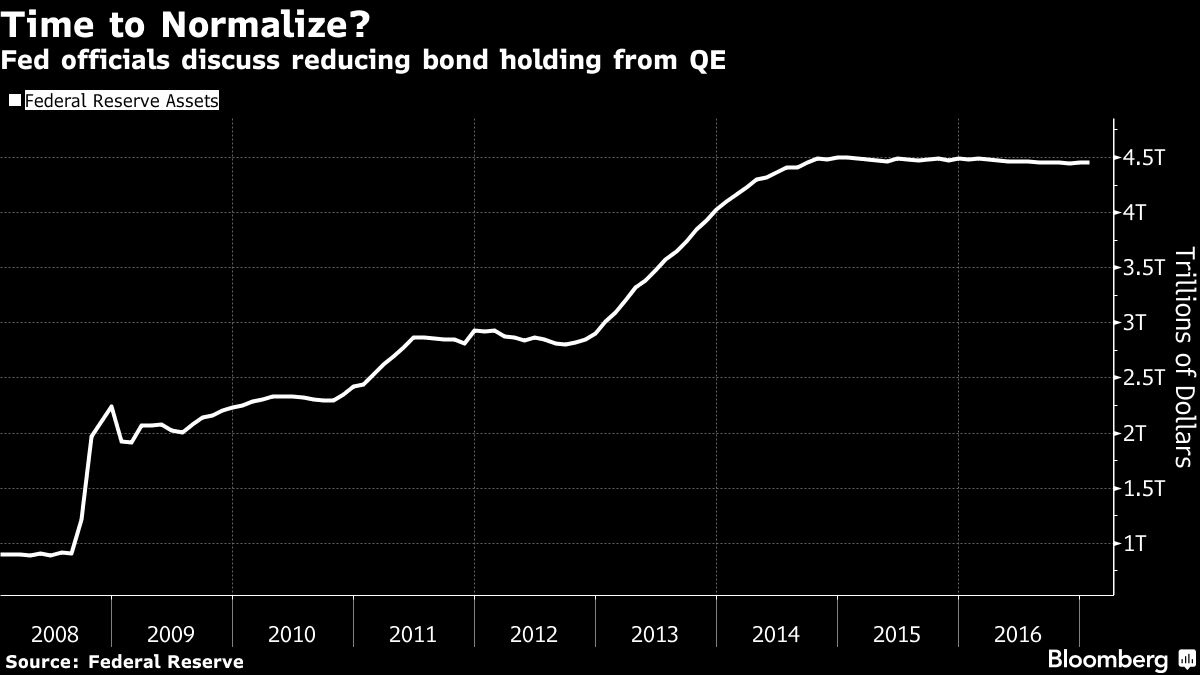
Just how big is hard to quantify. But over the past month, a number of Fed officials have openly discussed the need for the central bank to reduce its bond holdings, which it amassed as part of its unprecedented quantitative easing during and after the financial crisis. The talk has prompted some on Wall Street to suggest the Fed will start its drawdown as soon as this year, which has refocused attention on its $1.75 trillion stash of mortgage-backed securities.
Almost a decade after it all began, the Federal Reserve is finally talking about unwinding its grand experiment in monetary policy.
And when it happens, the knock-on effects in the bond market could pose a threat to the U.S. housing recovery.
Just how big is hard to quantify. But over the past month, a number of Fed officials have openly discussed the need for the central bank to reduce its bond holdings, which it amassed as part of its unprecedented quantitative easing during and after the financial crisis. The talk has prompted some on Wall Street to suggest the Fed will start its drawdown as soon as this year, which has refocused attention on its $1.75 trillion stash of mortgage-backed securities.
While the Fed also owns Treasuries as part of its $4.45 trillion of assets, its MBS holdings have long been a contentious issue, with some lawmakers criticizing the investments as beyond what’s needed to achieve the central bank’s mandate. Yet because the Fed is now the biggest source of demand for U.S. government-backed mortgage debt and owns a third of the market, any move is likely to boost costs for home buyers.
In the past year alone, the Fed bought $387 billion of mortgage bonds just to maintain its holdings. Getting out of the bond-buying business as the economy strengthens could help lift 30-year mortgage rates past 6 percent within three years, according to Moody’s Analytics Inc.
Unwinding QE “will be a massive and long-lasting hit” for the mortgage market, said Michael Cloherty, the head of U.S. interest-rate strategy at RBC Capital Markets. He expects the Fed to start paring its investments in the fourth quarter and ultimately dispose of all its MBS holdings.

Unprecedented Buying

Unlike Treasuries, the Fed rarely owned mortgage-backed securities before the financial crisis. Over the years, its purchases have been key in getting the housing market back on its feet. Along with near-zero interest rates, the demand from the Fed reduced the cost of mortgage debt relative to Treasuries and encouraged banks to extend more loans to consumers.
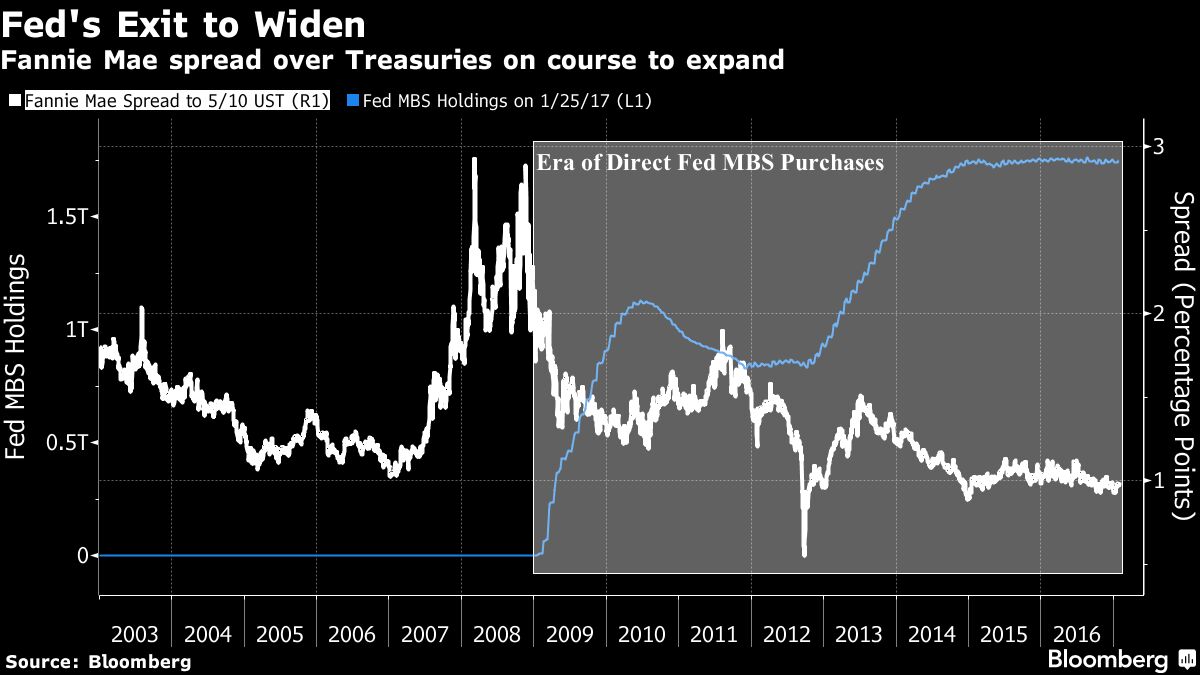
In a roughly two-year span that ended in 2014, the Fed increased its MBS holdings by about $1 trillion, which it has maintained by reinvesting its maturing debt. Since then, 30-year bonds composed of Fannie Mae-backed mortgages have only been about a percentage point higher than the average yield for five- and 10-year Treasuries, data compiled by Bloomberg show. That’s less than the spread during housing boom in 2005 and 2006.
Talk of the Fed pulling back from the market has bond dealers anticipating that spreads will widen. Goldman Sachs Group Inc. sees the gap increasing 0.1 percentage point this year, while strategists from JPMorgan Chase & Co. say that once the Fed actually starts to slow its MBS reinvestments, the spread would widen at least 0.2 to 0.25 percentage points.
“The biggest buyer is leaving the market, so there will be less demand for MBS,” said Marty Young, fixed-income analyst at Goldman Sachs. The firm forecasts the central bank will start reducing its holdings in 2018. That’s in line with a majority of bond dealers in the New York Fed’s December survey.
The Fed, for its part, has said it will keep reinvesting until its tightening cycle is “well underway,” according to language that has appeared in every policy statement since December 2015. The range for its target rate currently stands at 0.5 percent to 0.75 percent.

Mortgage Rates

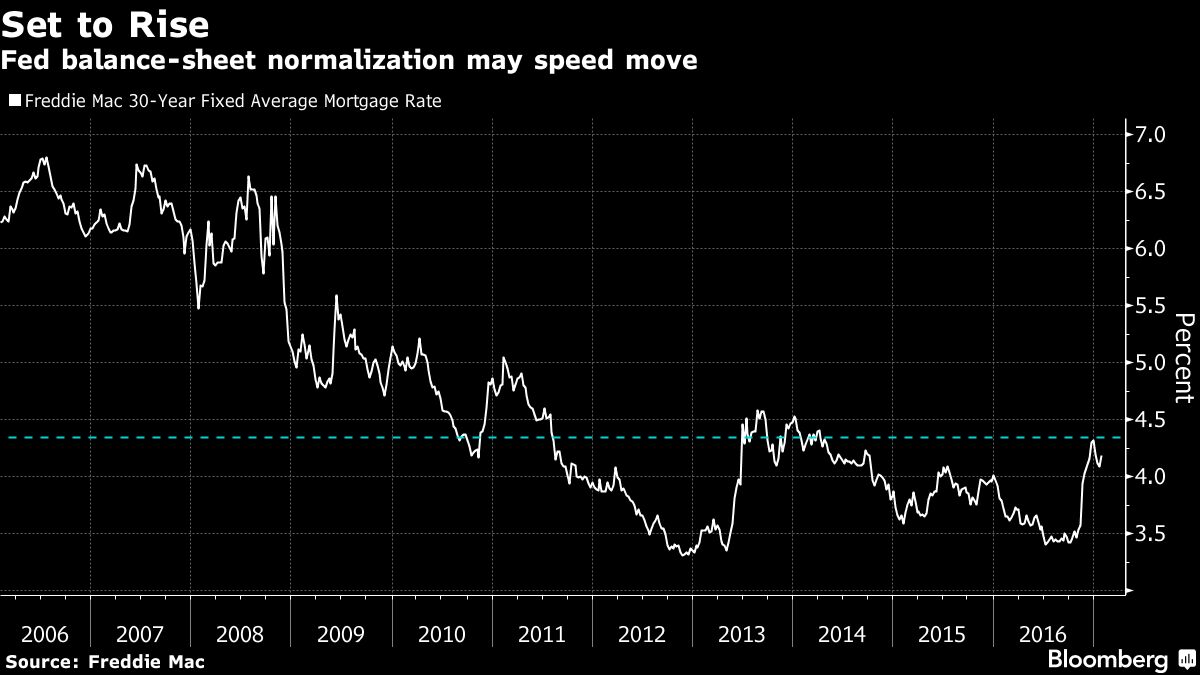
Mortgage rates have started to rise as the Fed moves to increase short-term borrowing costs. Rates for 30-year home loans surged to an almost three-year high of 4.32 percent in December. While rates have edged lower since, they’ve jumped more than three-quarters of a percentage point in just four months.
The surge in mortgage rates is already putting a dent in housing demand. Sales of previously owned homes declined more than forecast in December, even as full-year figures were the strongest in a decade, according to data from the National Association of Realtors.
People are starting to ask the question, “Gee, did I miss my opportunity here to get a low-rate mortgage?” said Tim Steffen, a financial planner at Robert W. Baird & Co. in Milwaukee. “I tell them that rates are still pretty low. But are rates going to go up? It certainly seems like they are.”
Part of it, of course, has to do with the Fed simply raising interest rates as inflation perks up. Officials have long wanted to get benchmark borrowing costs off rock-bottom levels (another legacy of crisis-era policies) and back to levels more consist with a healthy economy. This year, the Fed has penciled in three additional quarter-point rate increases. Traders, meanwhile, have priced in slightly less than two increases in 2017.
The move to taper its investments has the potential to cause further tightening. Morgan Stanley estimates that a $325 billion reduction in the Fed’s MBS holdings from April 2018 through end of 2019 may have the same impact as nearly two additional rate increases.
Finding other sources of demand won’t be easy either. Because of the Fed’s outsize role in the MBS market since the crisis, the vast majority of transactions are done by just a handful of dealers. What’s more, it’s not clear whether investors like foreign central banks and commercial banks can absorb all the extra supply -- at least without wider spreads.
On the plus side, getting MBS back into the hands of private investors could help make the market more robust by increasing trading. Average daily volume has plunged more than 40 percent since the crisis, Securities Industry and Financial Markets Association data show.
“Ending reinvestment will mean there are more bonds for the private sector to buy,” said Daniel Hyman, the co-head of the agency-mortgage portfolio management team at Pacific Investment Management Co.
What’s more, it may give the central bank more flexibility to tighten policy, especially if President Donald Trump’s spending plans stir more economic growth and inflation. St. Louis Fed President James Bullard said last month that he’d prefer to use the central bank’s holdings to do some of the lifting, echoing remarks by his Boston colleague Eric Rosengren.
Nevertheless, the consequences for the U.S. housing market can’t be ignored.
The “Fed has already hiked twice and the market is expecting” more, said Munish Gupta, a manager at Nara Capital, a new hedge fund being started by star mortgage trader Charles Smart. “Tapering is the next logical step.”

Monday, February 6, 2017

Reuters News - Legal battles to test Trump and his immigration ban

By Dustin Volz | WASHINGTON
President Donald Trump's temporary immigration ban faced on Monday the first of several crucial legal hurdles that could determine whether he can push through the most controversial and far reaching policy of his first two weeks in office.
On Monday, the government has a deadline to justify the executive order temporarily barring immigrants from seven mostly Muslim countries and the entry of refugees after a federal judge in Seattle blocked it with a temporary restraining order on Friday.
The uncertainty caused by a judge's stay of the ban has opened a window for travelers from the seven affected countries to enter the United States.
Trump has reacted with attacks on the federal judge and then the wider court system which he blames for stymieing his efforts to restrict immigration, a central promise of the Republican's 2016 presidential campaign.
Democrats, meanwhile, sought to use Trump's attacks on the judiciary to raise questions about the independence of his Supreme Court nominee, Neil Gorsuch.
The 9th U.S. Circuit Court of Appeals in San Francisco over the weekend denied the Trump administration's request for an immediate stay of the federal judge's temporary restraining order that blocked nationwide the implementation of key parts of the travel ban.
But the court said it would reconsider the government's request after receiving more information.
The government has until 5 p.m. PST on Monday to submit additional legal briefs to the appeals court justifying Trump's executive order. Following that the court is expected to act quickly, and a decision either way may ultimately result in the case reaching the U.S. Supreme Court.
Top technology giants, including Apple, Google and Microsoft banded together with nearly 100 companies on Sunday to file a legal brief opposing Trump's immigration ban, arguing that it "inflicts significant harm on American business."
Noting that "immigrants or their children founded more than 200 of the companies on the Fortune 500 list," the brief said Trump's order "represents a significant departure from the principles of fairness and predictability that have governed the immigration system of the United States for more than fifty years."
The controversial executive order also "inflicts significant harm on American business, innovation, and growth as a result," the brief added.
Trump, who during his campaign called for a temporary ban on Muslims entering the United States, has repeatedly vowed to reinstate the Jan. 27 travel ban on citizens from Iran, Iraq, Libya, Somalia, Sudan, Syria and Yemen and a 120-day bar on all refugees in the name of protecting the United States from Islamist militants.
His critics have said the measures are discriminatory, unhelpful and legally dubious.
On Sunday, Trump broadened his Twitter attacks on U.S. District Judge James Robart in Seattle, who issued the temporary stay on Friday, to include the "court system." Trump a day earlier derided Robart, who was appointed by former Republican President George W. Bush, as a "so-called judge."
"Just cannot believe a judge would put our country in such peril," Trump tweeted on Sunday. "If something happens blame him and court system."
Trump did not elaborate on what threats the country potentially faced.

It is unusual for a sitting president to attack a member of the judiciary. Vice President Mike Pence defended Trump, even as other Republicans urged the businessman-turned-politician to avoid firing such fusillades against the co-equal judicial branch of government, which the U.S. Constitution designates as a check on the power of the presidency and Congress.
Democrats, still smarting from Republicans' refusal last year to allow the Senate to consider former Democratic President Barack Obama's nomination of appeals court Judge Merrick Garland to the Supreme Court, have seized on Trump's attacks to question his nomination last week of Gorsuch.
"With each action testing the Constitution, and each personal attack on a judge, President Trump raises the bar even higher for Judge Gorsuch's nomination to serve on the Supreme Court," Chuck Schumer, the top Democrat in the Senate, said in a statement. "His ability to be an independent check will be front and center throughout the confirmation process."
Republicans hope to swiftly confirm Gorsuch, a 49-year-old conservative appeals court judge tapped by Trump to fill the seat left vacant by the death of Justice Antonin Scalia nearly a year ago.
(Editing by Mary Milliken and Jonathan Oatis)

Friday, February 3, 2017

BBC News - Federal Reserve upbeat on US economy as it holds rates

The US central bank remained positive on the economy, as it kept interest rates on hold in its first meeting since President Donald Trump took office.
The Federal Reserve ruled unanimously to keep its benchmark interest rate in a range of 0.5% to 0.75%.
The jobs market and economic activity had continued to strengthen, it said.
"Measures of consumer and business sentiment have improved of late," the central bank also said in a statement.
The Fed had raised its benchmark interest rate by 0.25% in December, only the second increase in a decade.

Trump effect

President Trump has promised to boost growth through tax cuts, spending and deregulation, raising the prospect of higher inflation.
Fed chairwoman Janet Yellen warned last month that, with the economy near full employment, the central bank risked a "nasty surprise" on inflation if it was too slow with rate hikes.
On Wednesday, the Fed said inflation "will rise to 2% over the medium term", but did not comment on the effect of the Trump administration's plans.
Despite being upbeat, the central bank also signalled the Federal Open Markets Committee (FOMC), the body which sets rates, would still only make "gradual increases".
It did not give any update on when the body might next raise rates.
Trading floor TV shows Donald TrumpImage copyrigh
Investors were hoping for guidance on when the next rise would be and how many were planned for this year.
"This is only the first FOMC meeting of eight in 2017 so there are still plenty of opportunities for the Fed to raise interest rates throughout the year and it is likely that we will see a rate rise in March or June," said Kully Samra, UK managing director of wealth management firm Charles Schwab.
"In our view, two rate hikes this year would be sufficient to stave off inflation concerns and would not negatively impact economic growth."

'Chug along'

Dennis de Jong, managing director at UFX.com, said that uncertainty about Mr Trump's economic policies could further delay the next rate rise.
"With Trump still light on any concrete plans or time lines, [chairwoman Janet] Yellen may be forced to wait even longer before pulling the trigger," he said.
Official figures last week indicated the US economy grew at an annual pace of 1.9% in the fourth quarter of last year, a slowdown from growth in the previous quarter of 3.5%.
However, the central bank's outlook suggested "the economy continues to chug along and sentiment has improved", said Brian Jacobson, chief portfolio strategist at Wells Fargo.
The dollar and US stock markets were little changed on the Fed's announcement, as investors had widely expected rates to be left untouched.
The Dow Jones index rose 0.1% at 19,891 points. The S&P 500 index moved less than 1 point to 2,279 and the Nasdaq edged up 0.5% at 5,643.

Thursday, February 2, 2017

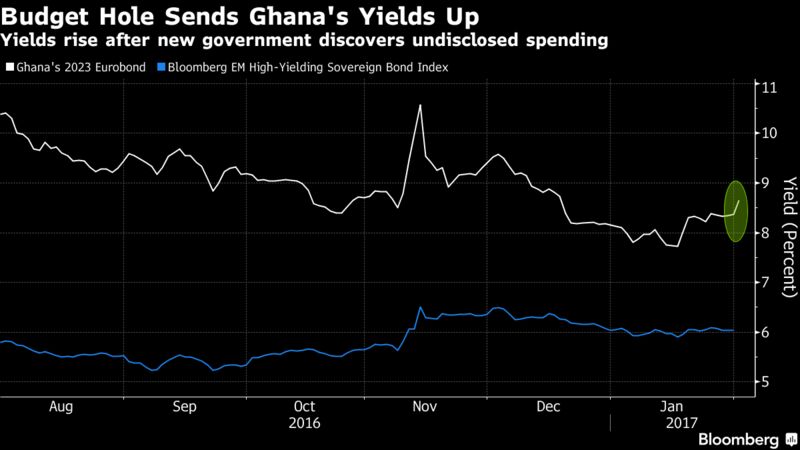
Bloomberg News - Ghana Finds a $1.6 Billion Hole in Budget

Ghana’s budget deficit could be twice as big as previously forecast, Finance Minister Ken Ofori-Atta said a day after the government revealed a 7 billion-cedi ($1.6 billion) hole in the budget. The disclosure sent bonds tumbling.
The shortfall as a percentage of gross domestic product could be close to “double digits” for 2016, Ofori-Atta said Wednesday in an interview in Accra, the capital. “We’re still in the process of gathering information” on the undisclosed expenditures, said Ofori-Atta, who will propose the 2017 budget next month. 
The secret spending dates back three to four years, he said. The budget hole was disclosed by Vice President Mahamudu Bawumia, who along with President Nana Akufo-Addo arrived in office only three weeks ago after winning presidential and parliamentary elections. It was the third transfer of political power since the West African nation’s return to independence in 1992. The nation is the world’s second-biggest cocoa producer and West Africa’s biggest economy after Nigeria.
“We have been very surprised by the fiscal data,” Bawumia said Tuesday night in a speech in Accra broadcast by Citi FM. “How are you supposed to manage an economy with faulty data?”
The central bank on Jan. 23 urged the state to narrow the budget deficit after provisional data for January through November showed a shortfall of 7 percent of GDP, exceeding a government forecast of 5.3 percent. The West African nation will probably miss its target for 2016 because of weak income collection and higher-than-planned capital spending, the International Monetary Fund said last month.
Read more on Ghana’s IPO and its biggest money manager
The economy probably expanded 4.1 percent in 2016, according to forecasts from the government. It was growing at more than 13 percent in 2011.
It was another blow to Ghana, only a few years ago held up as an example of how African countries could modernize, impose the rule of law and operate successfully in global markets. In 2007, it sold its first Eurobond. Today, yields on its benchmark dollar bond due in August 2023 increased 17 basis points to 8.58 percent, the highest since Dec. 19, at 3:23 p.m. in Accra. The cedi weakened for a third day against the dollar, slipping as much as 0.4 percent and trading 0.2 percent lower at 4.37.
The country has also muffed the share sale of a state company, which by the time it closed in December was only 85 percent subscribed and had taken three tries. Ghana is in the second year of an almost $1 billion debt bailout deal with the IMF after a slump in commodity prices weighed on income from oil and gold as government debt spiraled. The IMF also suspended aid to Mozambique last year after the southern African country disclosed hidden debt of $1.4 billion.

Debt Fears

The budget deficit for 2017 will be two to three percentage points lower than last year’s figure, Ofori-Atta said.
Investors will be concerned about a wide budget deficit and there’s still the risk of further debt accumulation, said Courage Martey, an economist at Accra-based Databank Group Ltd.,
“There will be a difficulty in payment which can lead to restructuring” of the nation’s debt, he said by phone. “It only shows that our fiscal and debt situation is quite complicated and too complicated to deal with in the short term very quickly, so the Eurobonds will continue to reflect that difficulty in the short term.”
The 7 billion cedis Bawumia referred to relates to a government contract that was part of a project for an integrated financial management system and doesn’t constitute arrears, Former Finance Minister Seth Terkper said by e-mail.
“The vice president is known for rushing with information to the public and the media, particularly with structural measures and reforms without taking time to understand the rational for the reform or the initiatives,” Terkper said.
Calls to the phone of Mustapha Hamid, a spokesman for Akufo-Addo, didn’t go through.

Wednesday, February 1, 2017

BBC News - UK economy to slow down this year and next, says think tank

Customers look at discounted shoesImage copyright
The UK economy may slow down in the next couple of years, even while the world economy picks up, a report says.
The National Institute of Economic and Social Research (NIESR) revised up its forecasts for UK growth to 1.7% this year and 1.9% in 2018.
However, both would still be a slowdown from the growth rate of 2% recorded for 2016, when the UK was the world's fastest growing developed economy.
NIESR predicted inflation would rise too, hitting household spending.
"Robust consumer spending growth was behind the economic momentum of 2016," said Simon Kirby, head of macroeconomic modelling and forecasting at NIESR.
He said households would see their purchasing power "eroded" this year and in 2018 due to sharply rising prices.

Pound devaluation

The NIESR, widely seen as the UK's oldest independent research body, thinks inflation will jump from an average of 1.2% recorded over the course of 2016, to 3.3% this year then back down to 2.9% in 2018.
Price rises will be stoked, the body argues, by the sharp devaluation of the pound after the UK's Brexit vote last June.
The institute thinks the Bank of England will ignore this "temporary" pick-up in inflation and keep interest rates unchanged at their current historic low point, of just 0.25%, until the middle of 2019.
The Bank of England will announce its latest decision on interest rates on Thursday.
Image copyright
China is forecast to have the world's fastest regional growth rate of 6.4% this year.
All this will be against the background of a more robust world economy, the NIESR forecasts.
It believes the world economy will grow at a faster pace in the next couple of years, with the annual growth rate rising from 3% in 2016 to 3.1% this year, and then to 3.5% in 2018.
But it warns that its predictions could be thrown off-kilter by any sudden changes in economic policy in the US, following President Donald Trump's election.
"Our forecast assumes established policies," the NIESR says.
"Potential policy changes in the US and any response in the rest of the world therefore pose significant risks to our projections."